
Persistent economic uncertainty is reshaping how Americans spend, forcing retailers to adapt quickly. Consumers are pulling back on discretionary purchases, foot traffic remains under pressure, and margins are tightening across much of the retail sector.
This has led to a sharp acceleration in store closures. Many well-known chains are downsizing aggressively to preserve profitability and adjust to the continued rise of e-commerce.
Yet amid this widespread contraction, one legacy apparel retailer is taking a very different approach, pairing selective closures with targeted expansion and long-term brand reinvention.
Founded in 1959, J.Jill is a women’s apparel retailer with a longstanding presence in the U.S. market. Now, like many of its competitors, the company is navigating a challenging retail environment, but its strategy reflects a recalibration of its brick-and-mortar operations rather than a full retreat.
J.Jill confirms store closures
During fiscal 2025, J.Jill (JILL) quietly closed five stores, ending the year with 256 locations.
The retailer framed these closures as part of an ongoing optimization strategy, not a signal of widespread contraction. The focus is on improving store productivity and reallocating capital towards higher-performing markets.
J.Jill CEO Mary Ellen Coyne emphasized that the company is simultaneously investing in new product categories and modernizing its brand to appeal to a broader customer base.
“That’s why our test and learn methodology is so critical,” said Coyne in an earnings call. “It allows us to validate new concepts with both new and existing customers before scaling, ensuring we’re building sustainable growth rather than simply pursuing short-term gains.”
Coyne also noted that the transformation will take time and may not follow a linear path, reinforcing the company’s disciplined approach to expense management and its strong financial position.
J.Jill’s long-term strategy to revive the brand
J.Jill’s store closures are part of a broader brand transformation built around three key pillars.
- Assortment optimization: J.Jill plans to streamline its product offerings by eliminating redundancies and focusing on categories with higher demand and margin potential. The company is also testing new categories to expand relevance and capture a larger share of its target market.
- Customer experience enhancement: It’s rebalancing marketing investments to drive brand awareness and attract new customers, while deepening engagement with its core demographic.
- Operational improvements: The company will invest in infrastructure and technology, including a new order management system (OMS) to strengthen e-commerce capabilities, as well as AI-driven tools to support long-term growth and efficiency.
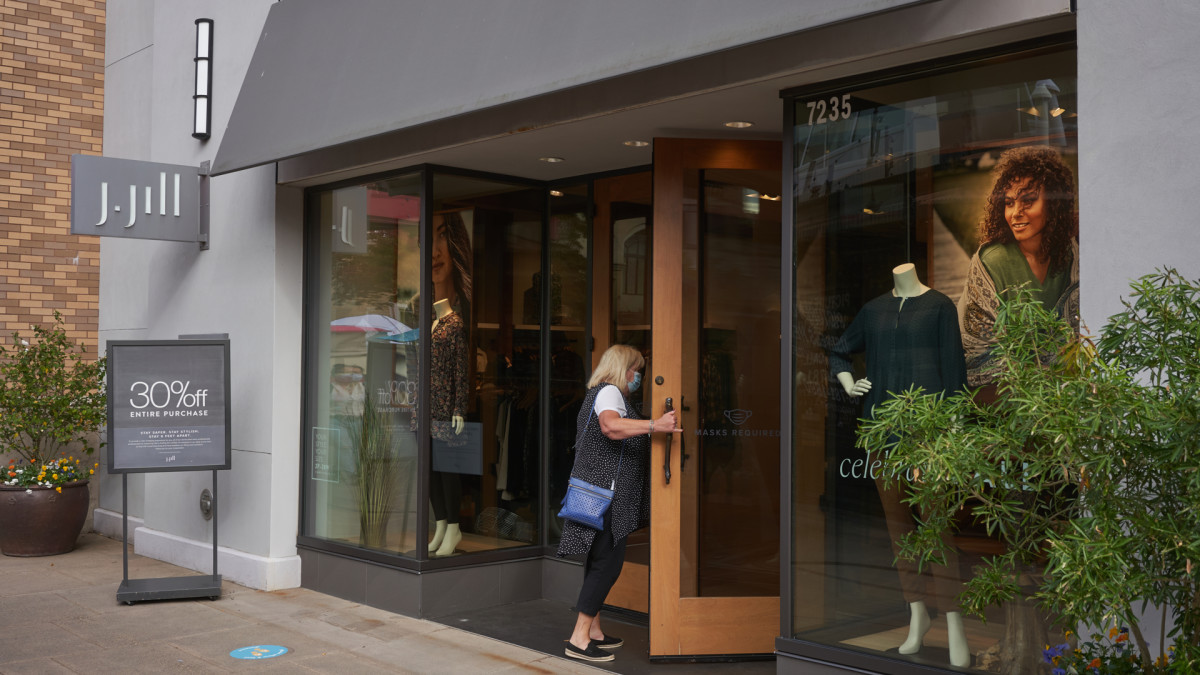 J.Jill closes stores amid a strategy shift.
J.Jill financial results reflect ongoing pressure
J.Jill’s recent financial performance underscores the challenges facing the broader retail sector.
Fourth quarter of fiscal 2025 results
- Net sales decreased 3.1% year over year.
- Comparable sales fell 4.8%.
- Gross profit was $87.3 million, compared to $94.8 million the prior year.
- The company incurred approximately $4.5 million of incremental tariff costs.
- Net loss totaled $3.5 million, compared to net income of $2.2 million the prior year.
Looking ahead, J.Jill expects continued softness.
First quarter of fiscal 2026 outlook
- Net sales projected to decline 5% to 7%
- Comparable sales expected to fall 7% to 9%
Despite headwinds, the company plans to open five new stores and relocate others in 2026.
J.Jill balances closures with expansion
While J.Jill closed five stores in 2025, it also opened nine, highlighting a selective, performance-driven approach to its store fleet.
In mid-2025, the company revealed plans to open 50 new stores by 2029, citing during its Q2 2025 earnings call the role of brick-and-mortar locations in driving brand awareness and customer acquisition.
Notably, most new locations will be in re-entry markets, where brand recognition already exists. This reduces customer acquisition costs and improves the likelihood of early profitability.
At the same time, underperforming stores are being phased out, allowing the company to focus investment in higher-return locations.
More coverage on retail store closures:
- 79-year-old fast-fashion leader closing more stores
- 125-year-old retail chain to close more stores in 2026
- 48-year-old nostalgic mall retailer will close 25 stores in 2026
- 77-year-old jewelry giant will close 100 stores, shut 2 brands
New market entries will be approached more cautiously, with a three- to five-year ramp to full productivity anticipated for stores.
These investments are expected to be completed by the end of 2026.
This strategy reflects a broader shift toward fleet optimization, where retailers prioritize store productivity, market density, and omnichannel integration over sheer scale, an approach that has become increasingly critical as foot traffic declines and digital channels gain share.
The retail industry faces broader challenges
J.Jill’s strategy contrasts with many of its retail competitors, which are aggressively downsizing their store fleet.
According to CoreSight Research, retailers announced 67% more store closures in 2025 compared to the previous year, a sharp acceleration reflecting the industry’s transformation.
E-commerce continues to gain share rapidly. U.S. online spending reached $1.34 trillion in 2024 and is projected to surpass $2.5 trillion in 2030, according to Capital One Shopping‘s Online Shopping Statistics 2026 data.
U.S. online sales accounted for 22.3% of global e-commerce spending in 2024, up nearly 1.5% from the year prior.
Meanwhile, McKinsey & Company’s State of Fashion 2026 Report projects low-single-digit growth for the global fashion industry, citing ongoing macroeconomic instability, tariff pressures, and value-conscious consumer behavior, particularly in the U.S.
Retail rivals accelerate store closures
- Macy’s: Plans to close 150 underperforming stores by the end of 2026, according to Macy’s.
- Francesca’s: Filed for Chapter 11 bankruptcy a second time in January 2026 and liquidated all its remaining 457 stores to prepare for closures, according to the bankruptcy filings.
- Claire’s: Filed for Chapter 11 bankruptcy for the second time in August 2025 and plans to close nearly 300 stores, according to the bankruptcy filings.
- Forever 21: Filed for Chapter 11 bankruptcy again in March 2025 and liquidated all its U.S. stores ahead of closures, according to Forever 21.
A major retail shift
While much of the retail industry is pulling back, J.Jill is pursuing a more balanced strategy, closing underperforming stores while continuing to invest in physical locations that support long-term brand growth.
The company’s approach reflects a broader retail evolution, in which success is no longer defined solely by store count, but by strategic placement, operational efficiency, and seamless integration between physical and digital channels.
Related: Nordstrom brings back fashion brand after 25-year U.S. shutdown