
A major fast-food chain’s efforts to streamline its operations have taken a new turn. This time, into the courtroom.
As the company works through a broader plan to close underperforming locations, a dispute with one of its largest franchise operators is intensifying, raising questions about who ultimately controls whether restaurants stay open or shut down.
At the center of the conflict is Jack in the Box, which is now seeking to halt a wave of closures it says a franchisee has no right to carry out.
Jack in the Box’s legal dispute intensifies over unpaid fees and closures
Jack in the Box (JACK) has filed for a restraining order in Washington state court to block franchisee AJP Enterprises from closing 38 restaurants across the Seattle metro area.
The legal action follows the company’s termination of AJP Enterprises in March over $1.4 million in unpaid marketing fees.
According to court filings, the franchisee was given 30 days to fix the default, but failed to do so. Despite that notice, AJP Enterprises informed the fast-food chain of its intention to begin closing the remaining locations, with shutdowns expected by April 22 unless the default notice is withdrawn, according to Restaurant Business Online.
Jack in the Box argues the franchisee has “no contractual right” to close the restaurants and is seeking immediate court intervention. The company maintains that unauthorized closures could harm the brand equity, disrupt local markets, and create broader operational risks.
According to franchise law experts at Franzy, such agreements typically limit a franchisee’s ability to unilaterally shut down locations, particularly when financial obligations remain unresolved.
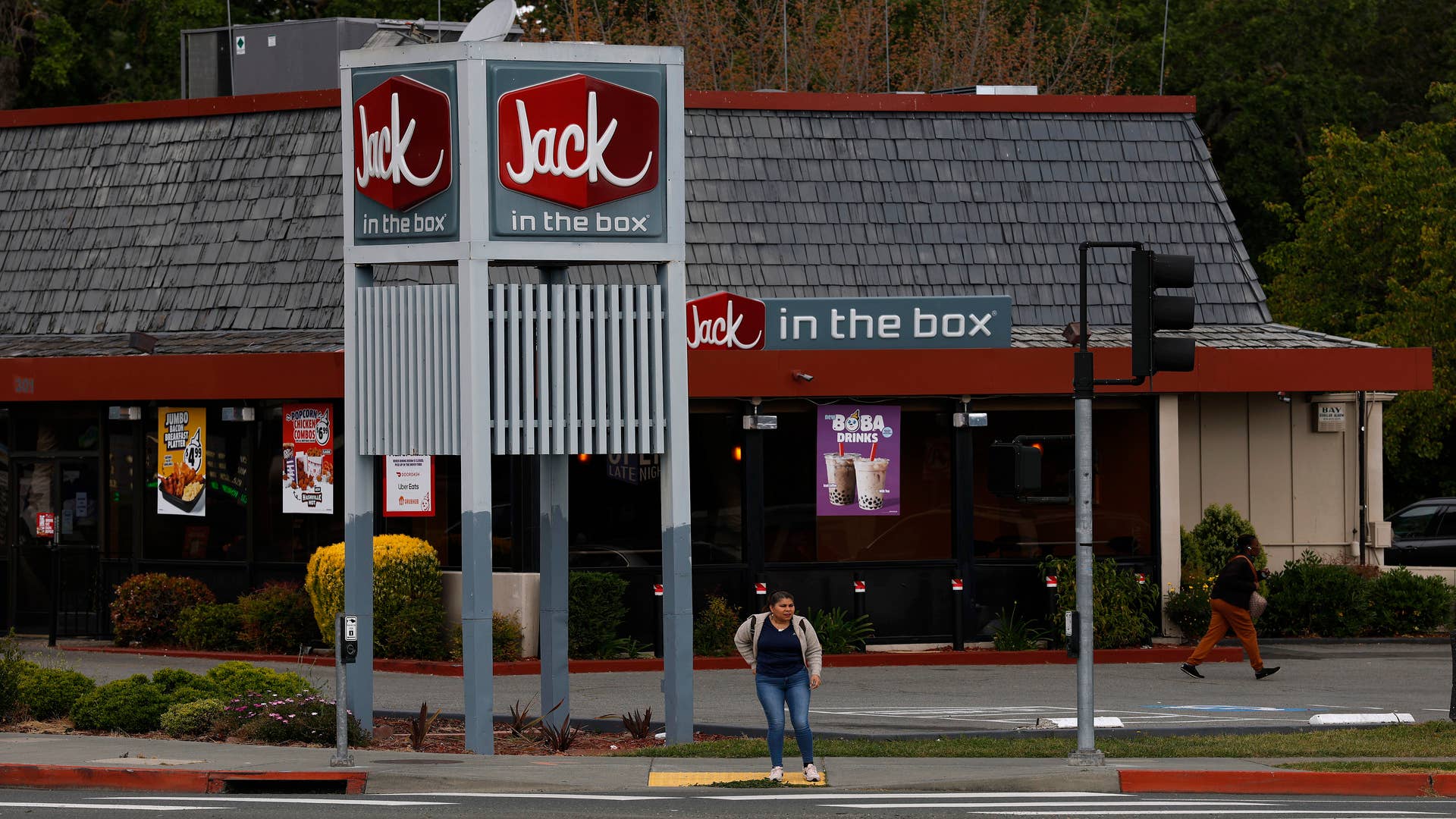 Jack in the Box files an order to block 38 franchised restaurant store closures.
Justin Sullivan/Getty Images
A yearslong conflict between Jack in the Box and AJP Enterprises
The current legal action is the latest development in a yearslong conflict between the company and franchise operator Steve Wazny, who owns AJP Enterprises and NHG Enterprises.
In 2024, the entities filed a lawsuit seeking to block the termination of 39 Seattle-area restaurants. Wazny alleged that Jack in the Box attempted to use the closure of eight underperforming locations as justification for terminating the remaining stores and forcing a sale.
While the fast-food chain initially argued those closures were carried out without its approval, both sides ultimately reached a temporary agreement under which Jack in the Box would not terminate the remaining locations, and the franchisee would continue operating them in compliance with franchise obligations.
However, that agreement began to unravel when AJP Enterprises stopped paying required marketing fees on the remaining units, triggering the current default and legal escalation.
Wazny’s relationship with Jack in the Box dates back to 2012, when he acquired a majority of the locations for $27 million, according to Franchise Times. At its peak in 2024, that portfolio grew to 47 restaurants, including newly developed units.
Court filings indicate that financial challenges began emerging as early as 2017, largely due to underperforming stores. Wazny has argued the company failed to provide adequate operational support, while Jack in the Box disputed that claim.
The broader risks and realities of franchising
The conflict reflects broader structural pressures within the franchise business model.
Franchising allows independent operators to leverage established brands, benefiting from standardized systems, marketing support, and customer recognition. For franchisors, it enables rapid expansion while reducing capital investment and operating risk.
However, the model also introduces complexity. As networks scale, maintaining consistent execution across independently operated locations becomes increasingly difficult, particularly in the restaurant industry, where margins are tight, and performance can vary widely by market.
According to data from the U.S. Bureau of Labor Statistics, about 17% of new restaurants close within their first year. Long-term restaurant survival rates are even more challenging, with about half closing within five years and only 34.6% lasting beyond a decade, according to Oysterlink.
More coverage on restaurant closures:
- Iconic Italian fast-food chain has shut down all its restaurants
- Fast-food burger pioneer chain closes its final location
- These reality TV restaurants are suddenly up for sale after slump
Consultants at FMS Franchise note that consistency is one of the most difficult aspects of scaling a franchise system.
“The essence of franchising lies in offering a consistent brand experience across all locations, a challenge that becomes more complex as the number of franchise units grows,” the firm states. “This consistency is vital for sustaining brand integrity and requires a well-orchestrated franchise development plan.”
Jack in the Box’s closure strategy and financial pressures
The legal dispute comes as Jack in the Box executes its broader turnaround plan, known as “Jack on Track,” introduced in April 2025.
The strategy includes closing approximately 150 to 200 underperforming restaurants, simplifying operations, and improving cash flows to strengthen the company’s balance sheet.
Jack in the Box CEO Lance Tucker said the plan focuses on three priorities: reducing debt, investing in growth initiatives such as technology and restaurant reimaging, and optimizing the company’s restaurant base for long-term profitability.
Recent financial results highlight the urgency behind these efforts.
In the first quarter fiscal 2026:
- Same-store sales declined 6.7% year over year.
- Franchise same-store sales fell 7%.
- Company-owned same-store sales dropped 4.7%.
Franchise-level margin decreased to $84.1 million (38.6%), down from $97.1 million (40.9%) a year earlier, driven primarily by lower sales and a reduced store count.
Total revenue fell 5.8% to $349.5 million, reflecting weaker performance and fewer operating locations. During the quarter alone, the company closed 14 restaurants, 12 of which were franchised units.
More closures expected, despite legal pushback
Even as it seeks to block AJP Enterprises from closing its remaining 38 restaurants, Jack in the Box has confirmed that additional closures are planned as part of its restructuring strategy.
For the fiscal year ending Sept. 27, 2026, the company expects to close between 50 and 100 restaurants, most of them being franchise-operated.
The fast-food chain also anticipates continued pressure on same-store sales, forecasting results to range from a 1% decline to a 1% increase compared to fiscal 2025.
What this means for the franchise industry
The dispute between Jack in the Box and AJP Enterprises highlights the delicate balance in franchising between corporate control and operator independence.
When financial performance declines and contractual obligations go unmet, that balance can quickly break down, leading to legal battles over who ultimately controls whether locations remain open.
As more restaurant brands look to streamline operations and improve profitability, disputes like this could become more frequent and may ultimately reshape how franchisors enforce control across their systems.
Related: Dunkin’ could exit an entire market in 2026 after 14 years
