
U.S. stocks moved lower Friday, while Treasury yields and the dollar held steady, as markets continue to express caution over the prospects of a global trade war while parsing details from a key inflation reading tied to tariff price pressures.
Updated at 1:27 PM EDT
Extending slump
CoreWeave shares opened below their listing price on their Nasdaq debut Friday, wrapping up a disappointing IPO for the Nvidia-backed data center group.
CoreWeave opened at $39 per share, a $1 lower than its IPO price, which was marked sharply lower earlier this week amid concerns tied to the broader AI investment thesis, the group’s small number of customers and reports of founder share selling in the weeks leading up to the listing.
CoreWeave shares were last marked 2.32% lower from their IPO price at $39.06 per share in early afternoon trading.
COREWEAVE $CRWV OPENS AT $39, 2.5% BELOW $40 IPO PRICE pic.twitter.com/zCxnZfoUmQ
— Wall St Engine (@wallstengine) March 28, 2025
Updated at 11:07 AM EDT
Extending slump
Stocks are extending their early declines, with tech stocks pacing the slump, following a surprise uptick in the Fed’s preferred inflation gauge and ongoing concerns tied to President Trump’s tariff policies.
The Nasdaq was last marked 388 points, or 2.17% lower on the day, with the S&P 500 down 92 points, or 1.63% and the Dow slumping 600 points.
In the bond market, benchmark 2-year notes yields to 3.937% while 10-year notes slipped to 4.276%, perhaps reflecting larger concerns tied to growth than inflation risks, despite the hotter-than-expected PCE report.
“The Fed is in a tricky spot,” said Bill Adams, chief economist a Comerica Bank in Dallas. “One the one hand, the economy is downshifting which argues for lower rates.”
“On the other hand, inflation looks set to pick up. Pulled in two directions, the Fed is likely to cut interest rates by a quarter of a percent around midyear—Comerica’s forecast sees the next change in rates as a quarter percentage point cut in July,” he added.
Nasdaq 100 $QQQ now up just 1% from its 3/13 low and down 3% over the last six months. pic.twitter.com/vcSXc3XsFT
— Bespoke (@bespokeinvest) March 28, 2025
Updated at 9:34 AM EDT
Soft open
The S&P 500 was marked 25 points lower, or 0.44%, in the opening minutes of trading, with the Nasdaq down 126 points, or 0.72%.
The Dow fell 130 points while the mid-cap Russell 2000 slipped 6 points, or 0.29% following the faster-than-expected PCE inflation report.
“Historically speaking, the S&P 500 tends to perform pretty well in mild inflationary environments where annual core PCE is between 2% and 4%,” said Bret Kenwell, U.S. investment analyst at eToro. “But investors don’t seem to care about historical statistics right now. Instead, their main concern centers around the Fed’s maneuverability.”
“That’s the biggest worry: That inflation will remain elevated amid a notable slowdown in the economy,” he added. “And while that risk may not be the base case right now, any traction it gains could further weigh on investor sentiment.”
S&P 500 Opening Bell Heatmap (Mar. 28, 2025)$SPY -0.27% 🟥 $QQQ -0.43% 🟥$DJI -0.19% 🟥 $IWM -0.05% 🟥 pic.twitter.com/buMtESkAcI
— Wall St Engine (@wallstengine) March 28, 2025
Updated at 8:41 AM EDT
Sticky PCE
The Federal Reserve’s preferred inflation gauge ticked higher last month suggesting the early impact of tariff price increases are starting to work their way into the world’s biggest economy.
The Bureau of Economic Analysis’s PCE Price Index report for the month of February showed core prices rising at an annual rate of 2.8%, faster than the January reading and Wall Street’s consensus forecast of 2.7%.
Core price pressures, which strip away volatile food and energy components, were up 0.4% on the month, faster than January’s 0.3% increase and Wall Street’s consensus estimate of 0.3%.
Stocks were little changed following the data release, with futures indicating a 17 point opening bell decline for the S&P 500 and a 95 point pullback for the Dow Jones Industrial Average. The tech-focused Nasdaq is called 85 points lower.
Benchmark 2-year note yields were 1 basis points lower at 3.986% following the data release, while 10-year notes slipped 2 basis point to 4.323%.
The U.S. dollar index, which tracks the greenback against a basket of six global currencies, was marked 0.19% higher at 1084.431.
US Core PCE Price Index Annual Change ticked up to 2.8% pic.twitter.com/bbjBBfrBlB
— Mike Zaccardi, CFA, CMT 🍖 (@MikeZaccardi) March 28, 2025
Stock Market today
Stocks ended lower across the board last night, with the S&P 500 falling 0.33% on the session following President Trump’s latest tariff salvo, which includes a 25% levy on auto sector imports in addition to other duties that are set to either resume or be introduced early next week.
Collectively, Trump’s trade agenda has established highest overall U.S. tariff rate since the second world war, prompting reactions from leaders in Europe, Asia and north America that are likely to accelerate that current tensions with Washington over the coming months.
At the same time, both sentiment and practical data suggest the economy has slowed notably over the first three months of the year, with the Atlanta Fed’s GDPNow tracker indicating a contraction of around 1.8%, following the Commerce Department’s final reading of 2.4% for the three months ending in December.
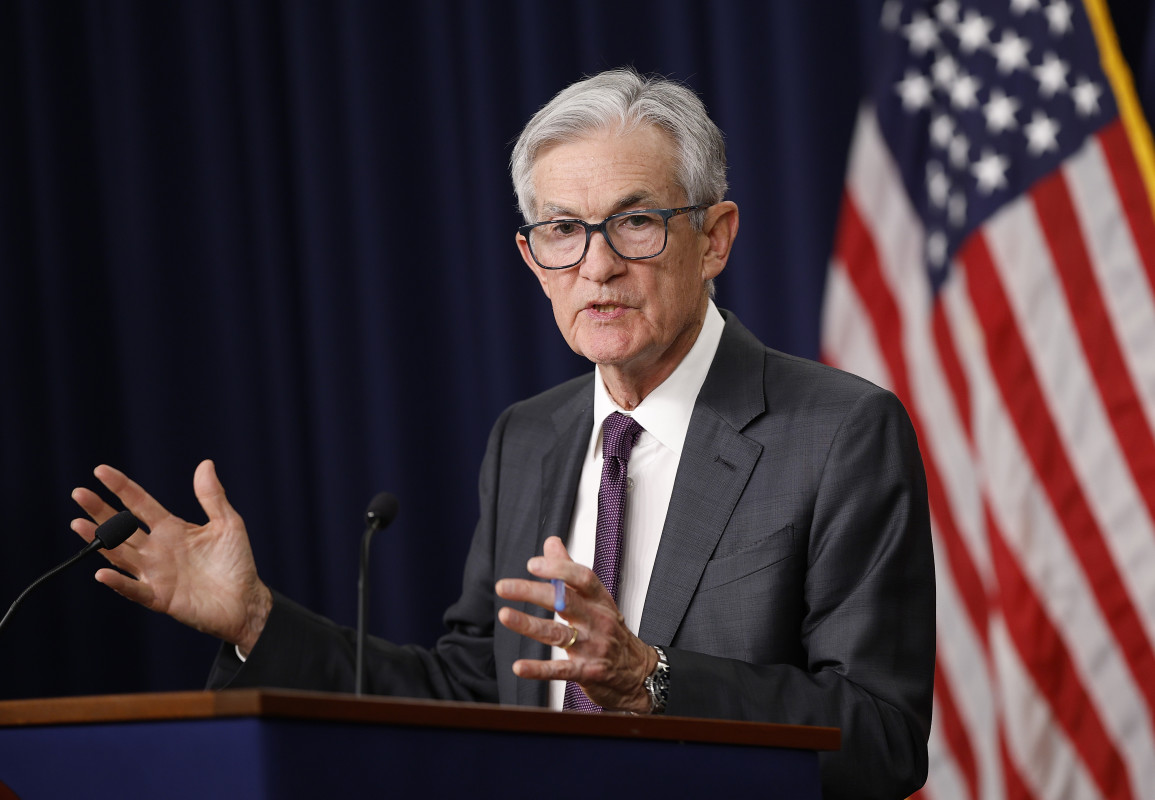 Fed Chair Jerome Powell and his colleagues will pay close attention to any tariff-related inflation pressures in today’s PCE inflation report.
Kevin Dietsch/Getty Images
Investors will get another look at the tariff impact on the economy later this morning, with the Bureau of Economic Statistics’ PCE inflation report, expected at 8:30 am Eastern time.
The Federal Reserve’s preferred gauge is likely to show a moderate acceleration in core price pressures, according to Street forecasts, with little-change in headline readings for the month of February.
Benchmark 2-year Treasury note yields were marked a couple of basis points lower in overnight trading at 3.994% heading into the Friday session, with 10-year notes pegged at 4.341%.
Related: AI reality bytes Nvidia-backed CoreWeave IPO
The U.S. dollar index, which tracks the greenback against a basket of six global currencies, was marked 0.08% higher at 104.421.
Gold prices, meanwhile, extended their recent run of record highs, rising 0.97% to a fresh all-time peak of $3,086.21 as investors continue to seek safe-haven assets amid the trade and growth uncertainty.
The bullion has gained around 17% so far this year and is on pace for its strongest quarterly gain since 1986.
Heading into the start of the trading day on Wall Street, futures contracts tied to the S&P 500, which is down 3.2% for the quarter, are priced for an opening bell decline of around 18 while the Dow Jones Industrial Average is called 105 points lower.
The Nasdaq, meanwhile, is called 82 points lower with Tesla (TSLA) , Nvidia (NVDA) and Palantir Technologies (PLTR) active in premarket trading.
Investors will also be tracking the debut of cloud services group CoreWeave, the biggest IPO of the year, later today on the Nasdaq. The Nvidia-backed group lowered its 37.5 million share sale price to $40 per share.
Lululemon Athletic (LULU) shares were another notable mover, tumbling 12.4% to #299.20 each after the sports and leisure apparel group cited both tariffs and a consumer spending pullback as affecting its weaker-than-expected sales and profit outlook.
More Economic Analysis:
- Gold’s price hit a speed bump; where does it go from here?
- 7 takeaways from Fed Chairman Jerome Powell’s remarks
- Retail sales add new complication to Fed rate cut forecasts
In overseas markets, Europe’s Stoxx 600 was marked 0.24% lower in mid-day Frankfurt trading, with the FTSE 100 down 0.21% in London.
Overnight in Asia, trade war concerns dragged Japan’s auto-heavy Nikkei 225 index 1.8%, while the regional MSCI ex-Japan benchmark fell 0.58% into the close of trading.
Related: Veteran fund manager unveils eye-popping S&P 500 forecast