
Updated at 4:27 PM EDT
Stocks ended firmly higher Monday, powered by gains for megacap tech stocks, following President Donald Trump’s move to exempt some computers, smartphone and electronics components from the sweeping levies he imposed on China last week.
The Dow Jones Industrial Average surged 312.08 points, or 0.78%, to finish the session at 40,524.79, while the S&P 500 gained 0.79% to 5,405.97 and the tech-heavy Nasdaq rose 0.64% to end at the day 16,831.48.
Updated at 12:27 PM EDT
Fading tech
Tech stocks turned briefly lower in early afternoon trading amid the ongoing confusion tied to the Trump’s administration’s tariff messaging and Treasury bond yields creep higher following the lack of progress on inflation expectations and the broader fixed income market uncertainty.
The S&P 500 was last marked 24 points, or 0.43% higher on the session with the Nasdaq last up just 15 points, or 0.07%.
Apple shares, meanwhile, were holding their earlier gains, and were last up just over 2% as investors re-priced the tech giant following the President’s decision to exempt certain tech components, PCs and smartphones from his restrictive China tariffs.
Related: Analysts revisit Apple stock price target as Trump offers tariff relief
Updated at 11:10 AM EDT
Faster ahead
The New York Federal Reserve’s monthly survey of inflation expectations jumped higher again in March, with respondents seeing year-ahead price pressures rising to 3.6% from the 3.1% estimate reported in February.
Five-year forecasts, meanwhile, edged modestly lower, to 2.9% from a February reading of 3%.
“Unemployment, job loss, and earnings growth expectations deteriorated. Household income growth expectations declined,” the survey noted. “Households were also more pessimistic about their year-ahead financial situations and credit access.”
Stocks were little-changed following the release, with the Dow up 385 points and the S&P 500 last seen 63 points, or 1.17% to the upside.
The NY Fed survey shows one-year ahead inflation expectations rose to 3.6% in March from 3.1% in FebruaryThree-year ahead inflation expectations held steady at 3%Five-year ahead inflation expectations ticked down to 2.9% from 3%. pic.twitter.com/q4NT0xZnEL
— Nick Timiraos (@NickTimiraos) April 14, 2025
Updated at 9:35 AM EDT
Solid open
The S&P 500 was marked 84 points, or 1.56% higher in the opening minutes of trading, with the Nasdaq rising 363 points, or 2.17%
The Dow gained 423 points while the Russell 2000 jumped 31 points, or 1.65%. Benchmark 10-year note yields eased 4 basis points from overnight levels to 4.411%.
“Stocks followed up their worst week since March 2020 with their best since November 2023. If the rebound is going to have legs in the near term, investors will probably need to see continued signs of flexibility from the White House on tariffs,” said Chris Larkin, managing director for trading and investing at E*TRADE from Morgan Stanley.
“Uncertainty is still high, and day-to-day volatility could remain elevated, especially if soft data stokes recession concerns,” he added. “Barring any surprises on the policy front, earnings could become more of a focus for the markets, with an emphasis on forward guidance.”
S&P 500 Opening Bell Heatmap (Apr. 14, 2025)$SPY +1.64% 🟩$QQQ +2.07% 🟩$DJI +1.12% 🟩$IWM +1.27% 🟩 pic.twitter.com/qjvh5fYtsK
— Wall St Engine (@wallstengine) April 14, 2025
Updated at 9:24 AM EDT
Coming home
Nvidia unveiled plans for a massive investment in its U.S.-based manufacturing setup Monday as the ripple-effects of President Donald Trump’s tariff gambit, as well as China’s retaliation towards the tech sector, continue to reverberate.
Nvidia said it plans to manufacture an American-made ‘supercomputer’ from a U.S. platform, and plans to produce as much as $500 billion in AI infrastructure over the next four years as part of a partnership with Foxconn and Taiwan Semiconductor.
Nvidia shares were last marked 3.9% higher in premarket trading immediately following the investment announcement to indicate an opening bell price of $115.27 each.
Related: Nvidia stock leaps after massive U.S. investment surprise
Updated at 8:44 AM EDT
Intel cashes out
Intel (INTC) shares jumped after the chipmaker agreed to sell a 51% stake in its Programmable Solutions Group, branded as Altera, to private equity investors at Silver Lake.
The deal, expected to close later this year, will see Silver Lake paying around $4.47 billion for the controlling stake, valuing Altera at around $8.75 billion — around half the price Intel paid for the tech group in 2015.
“This investment represents a once-in-a-generation opportunity to invest in a scale leader in advanced semiconductors,” said Silver Lake Chairman Kenneth Hao. “We look forward to working closely with Intel as a strategic partner who will continue to provide U.S.-based foundry services and complementary engagement with customers.”
Intel shares were marked 4.2% higher in premarket trading to indicate an opening-bell price of $20.53.
$INTC Intel is nearing an agreement to sell a stake in Altera, its programmable chips unit, to Silver Lake Management, says Bloomberg, citing people familiar with the matter. Intel may announce a deal to sell Altera to the private equity firm as soon as this week, according to… pic.twitter.com/xjB4GbRxp1
— Marty Chargin (@MartyChargin) April 14, 2025
Updated at 7:43 AM EDT
Goldman trading boost
Goldman Sachs (GS) posted better-than-expected first-quarter earnings, including the highest trading revenue tally on record, but the investment bank cautioned that it was entering an operating environment “markedly different” from earlier this year.
Goldman earned $4.74 billion, or $14.12 a share, in Q1, up 22% from a year earlier and topping Wall Street forecasts. Trading revenue rose 27% to $4.2 billion amid the post-election volatility.
Goldman Sachs shares were marked 2.56% higher in premarket trading immediately following the earnings release to indicate an opening bell price of $507.12.
$GS | Goldman Sachs Q1 25 Earnings:- EPS $14.12 (est $12.26)- Rev $15.06B (est $14.76B)- FICC Sales & Trading Rev $4.40B (est $4.47B)- Equities Trading Rev $4.19B (est $3.8B)- Net Interest Income $2.90B (est $2.28B)- Approved Up To $40 Billion Share Buyback Program
— LiveSquawk (@LiveSquawk) April 14, 2025
Updated at 7:20 AM EDT
Pfizer drops obesity pill
Pfizer (PFE) shares moved lower in early trading after the drugmaker scrapped development of its nascent obesity pill after it was linked to potential liver damage.
Pfizer said it would abandon a late-stage study of danuglipron, a once-a-day pill expected to compete with Eli Lilly’s (LLY) Zepbound in the weight-loss market. The move came after a trial patient developed a liver injury that ultimately healed once the danuglipron doses had ceased. The group will instead focus on early-stage obesity treatments.
Pfizer shares were marked 0.55% lower in premarket trading to indicate an opening bell price of $21.69.
$PFE to discontinue development of danuglipron (PF-06882961), an oral GLP-1 receptor agonist, which was being investigated for chronic weight management. $LLY $VKTX $NVO
— Bio Stocks™ (@BioStocks) April 14, 2025
Stock Market Today
Stocks rallied hard on Friday, ending a whipsaw week that ultimately powered the largest five-day gain for the S&P 500 since November 2023. The market move came after the president backed down again on his latest tariff gambit by pausing his so-called reciprocal’ levies for at least three months.
He did, however, slap a 145% tariff on China-made goods, which Beijing countered with its own trade-killing levy. Late Friday Trump did exempt key electronics from the final list.
Adding to the confusion, Trump later said in a social media post that no exemptions were made, despite the executive order he’d signed explicitly saying there were. He finally told reporters on Air Force One that semiconductor-specific tariffs would be announced within a week.
That leaves tech companies facing tariffs of 20% on China-made components, as opposed to Friday’s schedule of 145%, with global levies holding at 10% for the next 90 days. Tariffs on goods from Canada and Mexico, meanwhile, remain at 25%.
“We wanted to uncomplicate it from a lot of other companies because we want to make our chips and semiconductors and other things in our country,” Trump said, adding there would be “some flexibility” for certain companies.
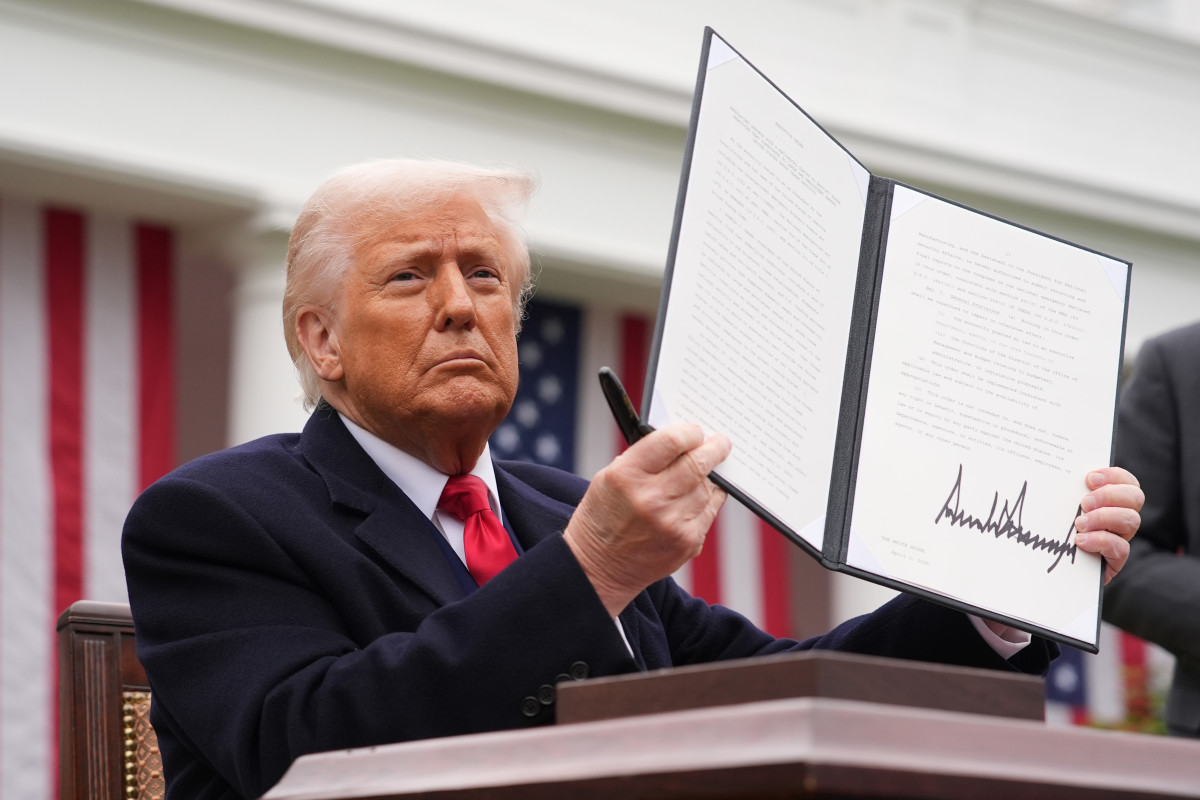 President Donald Trump, having unveiled tariff exemptions on Friday, told reporters on Sunday that there will be no exceptions for the semiconductor sector.
Andrew Harnik/Getty Images
The potential for exemptions powered China-reliant stocks such as Apple (AAPL) , Nvidia (NVDA) and Tesla (TSLA) firmly higher in premarket trading, with tech names pacing the market’s broader Monday advance.
The moves, however, were tempered by more mixed messages from the White House, with Commerce Secretary Howard Luntnick claiming semiconductor-focused tariffs would arrive ‘in a month or two” as opposed to Trump’s signaling of one week.
“Overall, we view the dizzying weekend tariff news as a step forward net positive for Apple as well as other tech names at it gives some flexibility and allows for China negotiations to hopefully take place in the coming months, which could deescalate some tariff/trade war issues with Big Tech caught in the middle,” said Wedbush analyst Dan Ives.
Related: Bond, dollar rout spark concerns of safe-haven status of U.S. assets
The tariff confusion, as well as the prospect of months of uncertainty tied to business investment and economic growth, pushed the dollar firmly lower again in overnight trading, with the benchmark testing three-year lows against a basket of its global peers.
Benchmark Treasury bond yields, meanwhile, nudged modestly higher, with 10-year notes trading at 4.458% and 2-year notes pegged at 3.921% heading into the start of the New York trading session.
Wall Street seems willing to go with the bullish narrative for the moment, with futures contracts tied to the S&P 500 priced for a 58 point opening bell gain. The benchmark is down 4.4% for the month and 8.8% for the year.
The Nasdaq, meanwhile, is called 240 points higher, with Apple rising 5% and Nvidia gaining 2.1%, while the Dow Jones Industrial Average is priced for a 330 point advance.
More Economic Analysis:
- Wall Street overhauls S&P 500 price targets as tariff selloff accelerates
- Inflation would like a word, please
- Stocks could bounce, but big bank earnings hold the cards
In overseas markets, the news of the tariff exemptions lifted Europe’s Stoxx 600 by 2.13% in early Frankfurt trading, with the euro rising to 1.1383 against the U.S. dollar amid its strongest rally in fifteen years.
Overnight in Asia, Japan’s Nikkei 225 rebound from an eight-month low to gain 1.18% in Tokyo, while the regional MSCI ex-Japan benchmark gained 1.59% into the close of trading.