
Costco and Sam’s Club serve the same audience. The two warehouse clubs have very similar business models where they promise customers low prices in exchange for them paying a membership fee.
when you visit both companies, their warehouses are very similar. They don’t call them stores as both Costco and Sam’s Club literally open up their warehouses to customers.
Related: Beloved DIY retailer suddenly announces it’s closing for good
There’s very little in the way of fancy merchandising and items are generally stacked on pallets and pretty bare shelving. Overall, the selection is also very small.
In order to get the best prices possible, each chain tries to limit its selection for every item it carries. If, for example, a warehouse club only carries one SKU of ketchup or Cheerios, rather than multiple sizes it can place a bigger order.
Both chains can leverage those larger orders to get better prices. In some cases, they can also go back to their vendors and ask them to make packaging changes or do other things that further lower the cost.
💵💰Don’t miss the move: Subscribe to TheStreet’s free daily newsletter💰💵
But just because Costco and its Walmart (WMT) owned rival have similar business models does not mean they’re exactly the same. In fact, the two companies have made very different choices when it comes to preventing retail and making sure that customers pay for every item they are leaving the store with.
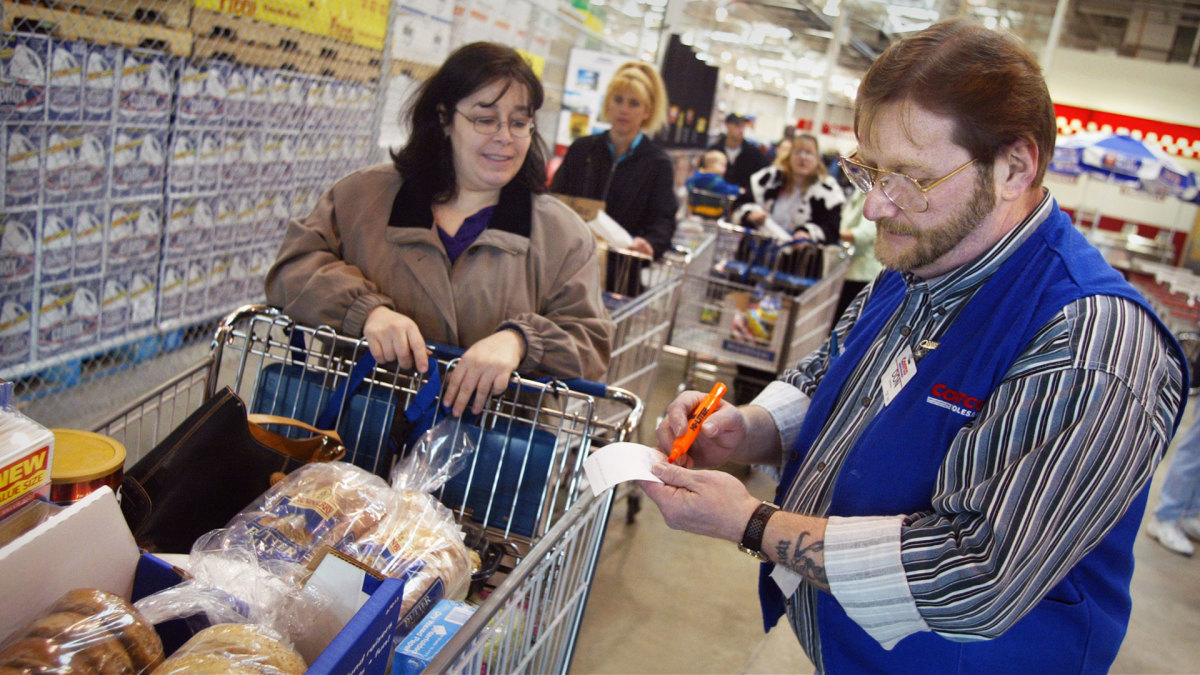 Costco has mostly returned to human checkout.
Image source: Tim Boyle/Getty Images
Costco opts for human checkout
Both Costco (COST) and Sam’s Club have tested self check out. Neither one of them chose to move forward with bringing that technology to all of its locations.
Self check out is widely believed to lead to increased theft, both accidentally and unintentionally. Neither warehouse Club specifically cited that as a reason to drop it, but both Costco and Sam’s Club have largely dropped it.
Related: Walmart store section closing indefinitely after scary incident
In Costco’s case, the company has opted to go back to human cashiers. That also gives the company the option of having a person check to see that the customer checking out is actually the member whose card is being used.
There are technology based ways to do that, and some Costco locations require members to scan a card upon entering, but having a human involved is the easiest way to do it.
Costco has kept self-checkout in select locations, but that may be a case of the chain not getting around to removing it, rather than an actual decision to keep it.
Sam’s Club opts for something different
Sam’s Club us adding Scan & Go technology to all of its stores. That allows customer to scan each item as they add it to their cart, and then leave the store without waiting for checkout.
That’s a pretty big step forward for the chain and perhaps a small competitive edge over Costco.
Neil Saunders, Managing Director of GlobalData’s retail division and a leading voice on retail, shared his thoughts on RetailWire.
“Traditional checkouts have always been inefficient. They use store space, they add to time, and they create labor costs. Ditching them makes some sense, especially if it is done in a simple way such as Scan & Go, rather than via the over-engineering of just walk-out technology,” he shared.
Sam’s Club has not phased out all its traditional checkout lines for one key reason.
“While incredibly efficient, if you go to Sam’s on any given day, you will still see a significant amount of customers who don’t use Scan & Go standing in line to be checked out. To maximize the customer base Sam’s is going to have to meet people where they are and while some love it, others don’t, which is why they are likely to keep at least some regular checkouts for the near future,” wrote Lisa Taylor in response to Saunders comments.
Related: After 8,500 store closings, iconic chain down to less than 50 stores
Most think that the traditional checkout will be part of the mix for a long time to come.
“Everyone I know who has used the Scan & Go tech loves it. Let’s take a lesson from the airlines. They want everyone to use their website or app to book a flight, but there is always a number to call to make a reservation. The same strategy should be considered for this. There will be some bumps along the road to the transition, but this is our future, added author Shep Hyken.