
The Trump administration late Wednesday announced what looked at first like innocuous changes in export rules for semiconductor companies.
Innocuous the changes were not, and shares of Nvidia (NVDA) , Broadcom and Advanced Micro Devices all surged.
💵💰Don’t miss the move: Subscribe to TheStreet’s free daily newsletter 💰💵
Nvidia jumped the most, 3.1% to $117.08. Broadcom (AVGO) added 2.4% to $204.81. AMD was up 1.8% to $100.36. The Van Eck Semiconductors Holders ETF (SMH) was up 2.2%. This group save for Nvidia is higher in morning trading on Thursday.
The original restrictions, known as AI diffusion and developed by the Biden administration, had been scheduled to take effect next week. They had drawn strong opposition from major tech companies and foreign governments, Bloomberg News reported.
Related: Uber CEO has a harsh message for frustrated employees
The rule change actually requires new rules, which may take several months to develop. The idea is to simplify the standards needed to win government permission to sell to customers outside the U.S. while ensuring that chips don’t fall into unfriendly hands.
Trump adminstration eases limits on sales of chips
The key point: The rules, once enacted, would no longer limit how many high-end chips a country, such as Saudi Arabia or the United Arab Emirates, may buy from a chipmaker like AI-chip leader Nvidia or AMD, (AMD) which competes in that sector.
The UAE recently pledged to invest $1.4 trillion in the U.S. And the disclosure of the plan comes as President Donald Trump is about to travel to the Middle East.
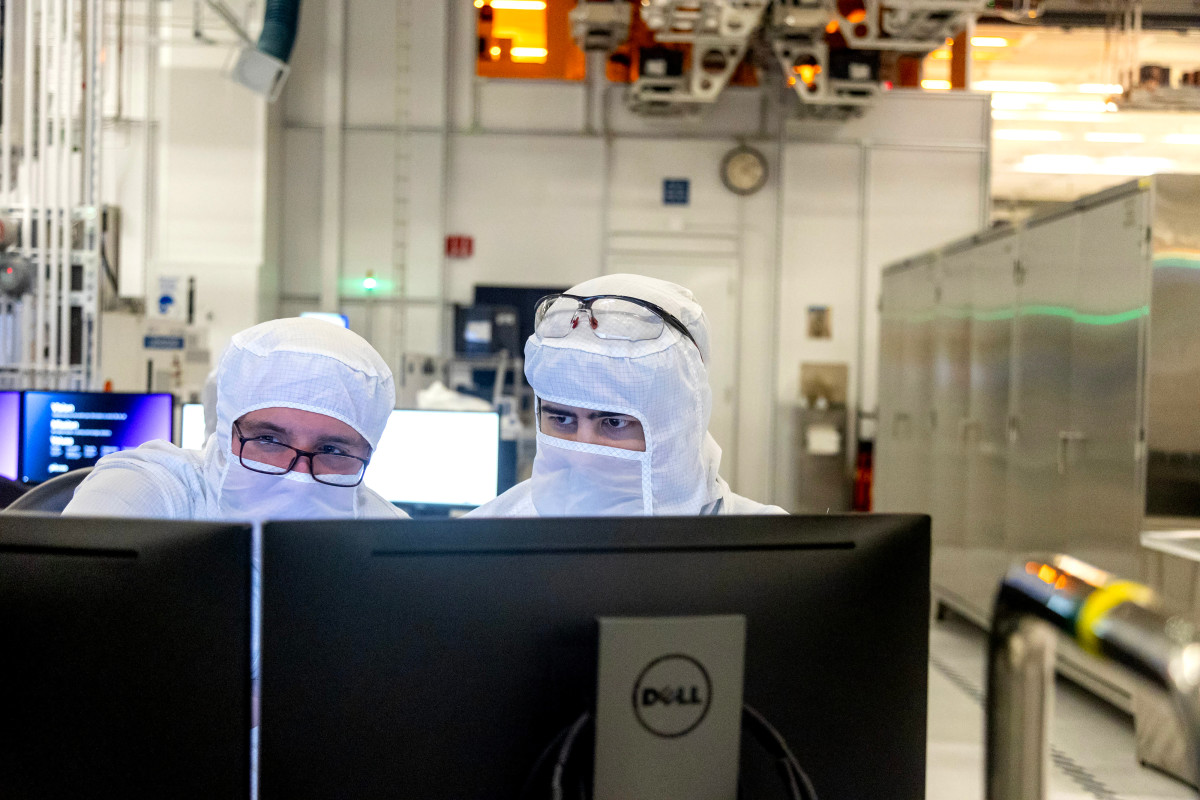 Workers at a clean room at Micron Technology headquarters in Boise, Idaho.
How the plan might work
Theoretically, new rules might enable chip companies to basically sell to whomever they wanted. But for national security reasons some countries would still face limits on what they can buy. Like, say, North Korea, Iran, Cuba and, oh yes, China.
And standards would have to be set to limit what customers can do with the chips once they get them.
An issue with some Nvidia products has been that individuals have bought the very high-end products, and taken them to, say, Singapore. Buyers there would resell them to customers not permitted by U.S. regulations in, say, China.
The actual details aren’t yet clear and other rules govern sales to China. Still, what the Trump administration wants to do is essentially gut the rules put in place by the Biden administration.
More Nvidia:
- Will Nvidia get hit hard by AI capex risk?
- Analysts revise Nvidia price target on chip demand
- Surprising China news sends Nvidia stock tumbling
Nvidia, already the biggest chipmaker and a key player in artificial intelligence, would like greater flexibility to do business outside the U.S., especially in China.
Nvidia designs its chips in the U.S. and has them manufactured by others, most notably Taiwan Semiconductor (TSM) , usually in Asia.
Nvidia CEO Jensen Huang has said China represents a potential market of $50 billion a year. And he’s hungering to win a big share of that business for his company.
Related: Veteran fund manager unveils eye-popping S&P 500 forecast