
If you’ve flown in the U.S. recently, you know the drill: crowded terminals, long security lines, and hidden fees on everything from baggage to seat selection that make “cheap flights” feel anything but.
Once you’re on the plane, the experience is often uncomfortable. Seats are tight, there’s limited legroom, and the overhead bins are already stuffed before the plane is even halfway loaded because no one wants to pay those baggage fees.
Then there’s the nickel-and-diming that is now part of the economy experience, with charges for everything from pretzels and coffee to the headphones needed to watch in-flight entertainment on the often-spotty WiFi.
For most travelers these days, flying is something to endure, not enjoy.
But every so often, an airline does something that bucks the trend — better service, more luggage, free alcohol — and it turns heads.
In Travel + Leisure’s just-released 2025 World’s Best Awards, one lesser-known airline has taken the top spot, leaving the big names in its jet stream.
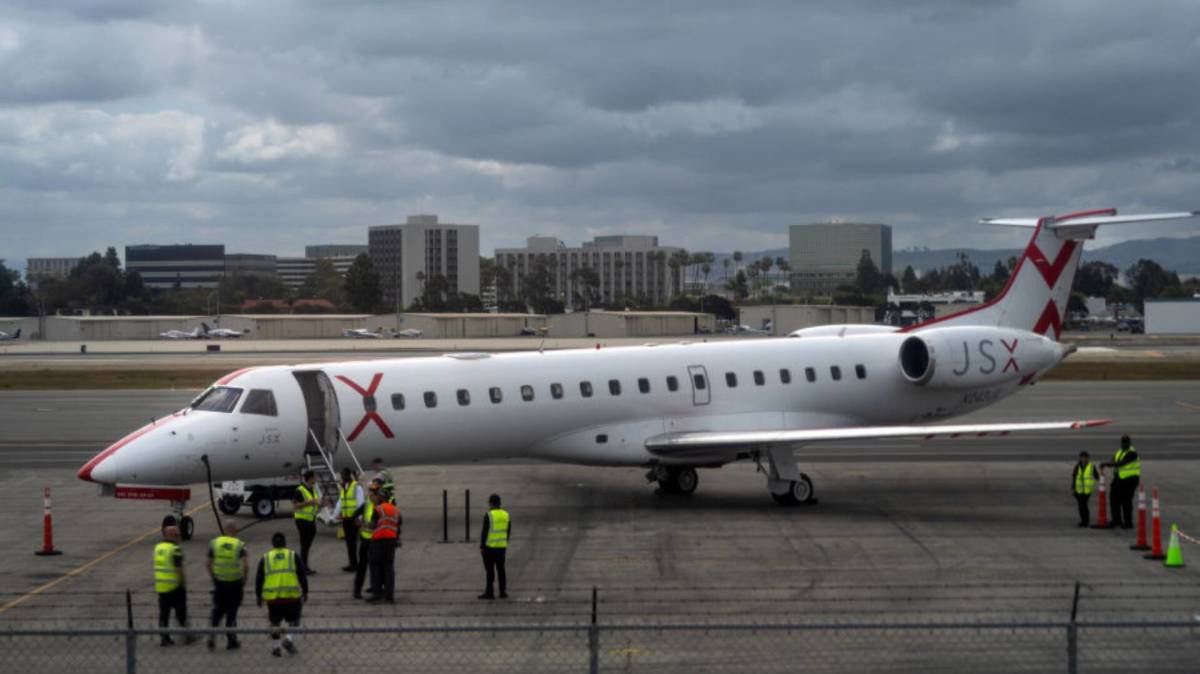 JSX is known as an “on-demand public charter” airline.
Image source: Orange County Register via Getty Images
JSX named best domestic airline in America for 2025
JSX, a small public charter airline, has officially been ranked the No. 1 domestic airline in the U.S. by Travel + Leisure readers. With a near-perfect score of 92.29, JSX beat out JetBlue, Alaska Airlines, Hawaiian Airlines, and Delta.
So what makes JSX different from the rest?
JSX doesn’t operate like a traditional commercial airline. It flies out of private terminals and smaller regional airports, allowing passengers to arrive just 20 minutes before takeoff. There’s no TSA security chaos, no need for TSA PreCheck, no crowded gates, and no long lines.
Boarding is fast, baggage is included, and the seating feels more like business class than economy. (Most airplanes in the JSX fleet accommodate around 30 passengers and are configured to either have one seat on each side of the aisle, or one on one side and two on the other.)
Alex Wilcox, a founding executive of JetBlue and veteran of Virgin Atlantic and Kingfisher, co-founded JSX in 2016. Wilcox came up with the concept for a charter‑based model that would operate like a scheduled airline under FAA Part 135.
Related: The $18 TSA travel hack that will make your airport routine easier
He had plenty of naysayers, and he is proving them all wrong, so it’s no wonder other airlines are protesting, claiming that JSX’s status as an “on-demand public charter” allows it to evade rules that apply to the major airlines.
JSX also offers complimentary high-speed Starlink Wi-Fi, free snacks and drinks, and friendly service that reviewers described as feeling “like flying private without the price tag.” The airline currently operates on fewer than 30 routes, mostly in the western U.S., including Burbank, Las Vegas, Phoenix, and Dallas.
This is JSX’s second consecutive year topping the Travel + Leisure list, solidifying its status as a luxury alternative to mainstream domestic carriers.
How much does JSX cost — and is it worth it?
With all that comfort, you might expect JSX to be priced like a first-class ticket. But JSX one-way fares generally start around $249 — more than ultra-low-cost carriers like Spirit or Frontier, but often comparable to what you’d pay flying economy on Delta, United, and Southwest, especially once you factor in all the add-on fees.
Here’s how it breaks down:
- JSX: ~$249 base fare includes checked bag, carry-on bag, seat selection, snacks, Wi-Fi
- Spirit or Frontier: ~$99 base fare + seat selection + bag fees (including for carry-ons) + priority boarding add-ons, adds up to ~$180–$220
Related: TSA quietly cracks down on popular travel essential
If you’re traveling for work or on a tight event schedule, JSX’s premium might be worth it. You’re essentially paying more for a stress-free, VIP travel experience.
That said, JSX isn’t available everywhere. The airline serves a limited number of cities, mostly in the West and Southwest. JSX doesn’t serve major East Coast or Midwest cities like New York, Chicago, or Atlanta — yet.
JSX reportedly has plans to expand. The airline is adding ATR 42‑600 turboprops, featuring all‑business‑class cabins, to access thousands of smaller regional airports.
It’s leased two ATR 42‑600s and signed a letter of intent for up to 25 more. The aircraft are scheduled to begin service in late 2025, unlocking service to over 1,000 new U.S. airports, as reported in Aviation A2Z.
Related: This common mistake can cost you your TSA PreCheck for 5 years