
Delta Air Lines had some good news recently. The airline released its second-quarter earnings report, and there was a lot for investors to love.
Bookings had stabilized after demand dropped earlier this year, and although demand is at lower levels than originally projected at the start of 2025, Delta did reinstate its 2025 profit outlook. This was despite declining to reaffirm its forecast in April due to confusion about tariffs and their uncertain impact on the travel industry.
💵💰Don’t miss the move: Subscribe to TheStreet’s free daily newsletter 💰💵
Delta also said it had $15.51 billion in adjusted revenue versus $15.48 billion in expected revenue, and it expects adjusted full-year earnings of $5.25 to $6.25 per share.
While that is down from the $7.35 per share or more that was projected in January when the CEO said the coming year would be the company’s best ever, the news still sent not just Delta’s stock price rising, but also the share price of other airlines.
Rising consumer demand for travel is one reason Delta’s CEO is feeling more optimistic, but the company also has another trick up its sleeve.
It appears to be aiming to maximize revenue by charging each consumer the highest price they are likely to pay.
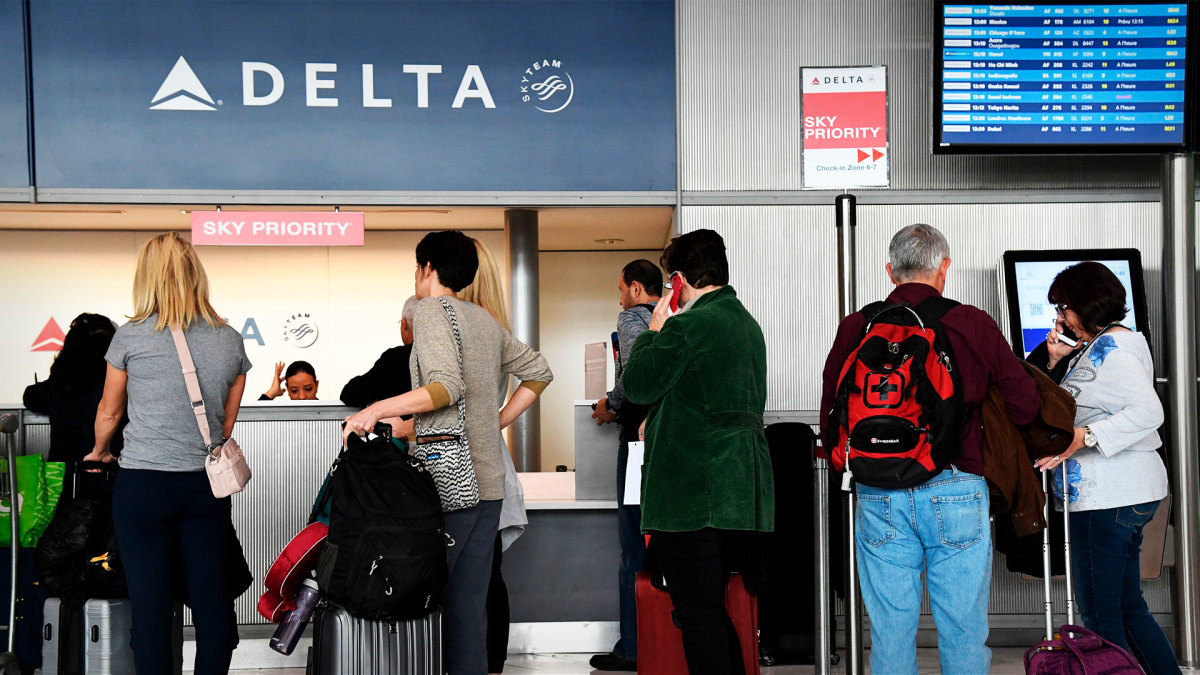 How much did these Delta passengers pay for their tickets?
Image source: Guay/AFP via Getty Images
Delta Air Lines implements new tools to try to maximize ticket prices
In Delta’s Thursday earnings call, President Glen Hauenstein mentioned that the company had been making progress on a new pricing initiative: The use of artificial intelligence to set ticket prices.
Delta had announced last fall that the airline was planning to price around 1% of its inventory with the use of AI technology, using the services of an Israeli company called Fetcherr. The goal of the initiative: Price each ticket for as much as each consumer would pay.
Related: Southwest Airlines cancels hundreds of flights from July to Sept.
“What we have today with AI is a super analyst,” Hauenstein explained at the time. “We have an analyst that’s working 24 hours a day, seven days a week, and trying to simulate in real time – given the same inputs that an analyst sees today, what should the price points be?”
At the airline’s Investor Day, Hauenstein also explained that this push toward AI was “a full re-engineering of how we price and how we will be pricing in the future,” and he said “what we’re really trying to do is to get inside the mind of our consumer and present them something that’s relevant to them at the right time, with the right price.”
Of course, “right price” means the maximum price for Delta, not the cheapest price for the consumer.
Delta Air Lines says more flights will soon be priced with AI technology
On Thursday’s earnings call, Hauenstein revealed that Delta Air Lines is now using AI to price up to 3% of domestic flights, which means the number of trips priced this way has tripled since last fall, when the technology was first implemented.
Related: TSA issues stern warning forbidding popular summer item
The airline isn’t stopping there, either. While Delta still considers the AI tool in its testing phase, its “goal is to have about 20% by the end of the year.”
This will mean that one out of every five flights will be priced based on an AI tool’s estimate of the most consumers will be willing to pay for their fare. And, although this process is still preliminary, Delta has made clear, “We like what we see. We like it a lot, and we’re continuing to roll it out.”
More on travel:
- U.S. government issues serious warning for cruise passengers
- Delta Air Lines makes a baggage change that travelers will like
- United Airlines passenger incident triggers quick response
Passengers, for their part, will need to make sure they shop around and try to show Delta that they are price sensitive and aren’t willing to pay just any price.
It remains to be seen how successful AI is at optimizing the amount customers pay, but the fact that Delta is trying this technique on such a large scale shows that AI may be changing the world of ticket pricing for good.
Related: Veteran fund manager unveils eye-popping S&P 500 forecast