
The first clue was the location.
After years of delays, Tesla finally unveiled its Robotaxi concept in October last year on the Warner Bros. studio lot in Burbank, California.
The demonstration wasn’t going to show Tesla’s concept Cybercab vehicle navigating real-world situations, because the vehicle was confined to the land of make-believe on a Hollywood studio lot.
Related: Tesla has late start in a crucial race for its future
It did, however, feature remote-controlled Optimus robots serving drinks to VIPs, who were then “driven home” (off camera) during a futuristic night out on the town.
The show was enough to impress permabulls like Wedbush’s Dan Ives and Ark Invest CEO Cathie Wood, both of whom believe autonomous driving could add trillions —yes, trillions — of dollars to Tesla’s bottom line.
A little more than eight months later, Tesla unveiled the Tesla Robotaxi autonomous driving experience on the streets of Austin, Texas, with a couple of major caveats.
First, the Cybercab concept is absent, and CEO Elon Musk doesn’t sound optimistic that it’ll be seeing city streets anytime soon.
But more importantly, a Tesla employee is sitting in the front passenger seat to ensure nothing catastrophic happens.
The dozen or so Model Ys traversing Austin are a far cry from the millions of Tesla Robotaxis Musk predicted would be online by 2026. However, the company is undoubtedly making progress, as it recently expanded its geofenced travel area to include more of the city.
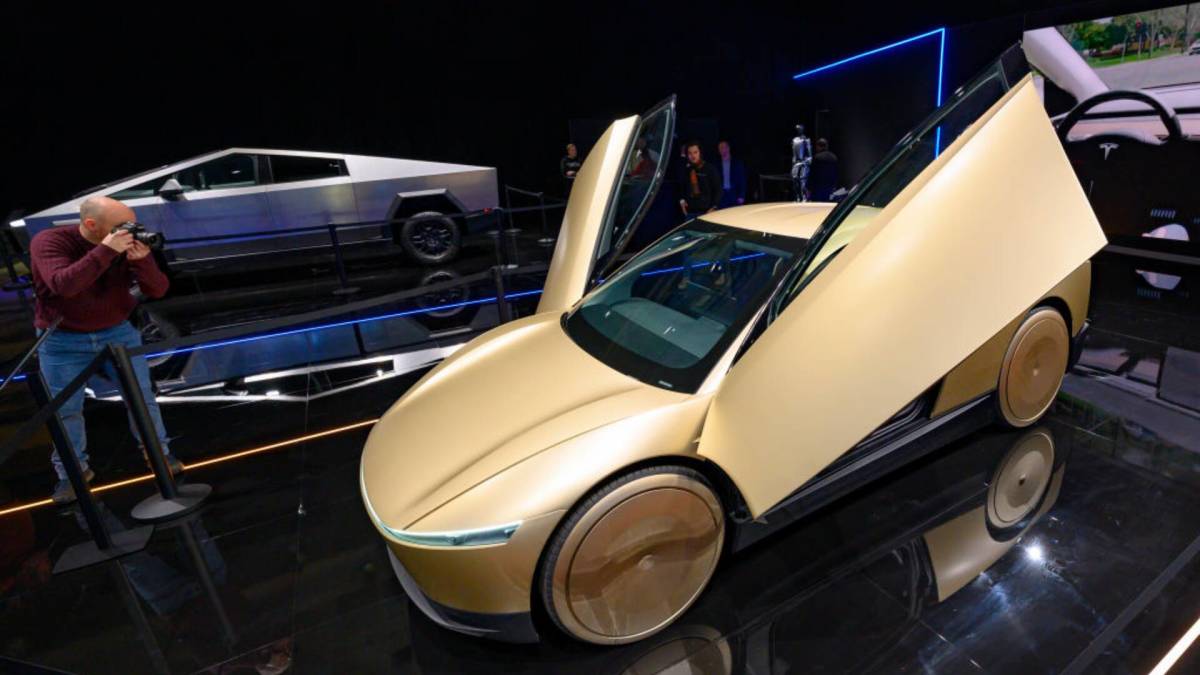 The Cybercab never made it off the Hollywood studio lot.
Image source: van der Wal/Getty Images
Waymo’s newest data shows just how far ahead of Tesla its robotaxis are
While Tesla Robotaxi is just getting off the ground in Austin, Alphabet’s Waymo has been testing its cars on U.S. streets since at least 2018.
Since then, Waymo robotaxis have driven more than 100 million miles autonomously, doubling its mileage from just six months ago, according to a company update.
“Reaching 100 million fully autonomous miles represents years of methodical progress now accelerating into rapid, responsible scaling,” said Waymo Chief Product Officer Saswat Panigrahi, according to Reuters.
Related: Tesla rival makes huge announcement about what’s coming in 2026
“As we expand to serve more riders in more cities, we’ll encounter new challenges that will continue strengthening our service.”
Waymo had reported traveling 71 million miles autonomously in March, after reaching 50 million at the end of the year.
In May, Waymo said its Waymo One app registers over a quarter of a million paid weekly trips across Phoenix, San Francisco, Los Angeles, and Austin. In 2026, it plans to expand to Atlanta, Miami, and Washington, D.C.
Waymo’s current fleet features over 1,500 vehicles spread across its four current host cities, but by next year, it expects to more than double its fleet with more than 2,000 new additions.
The company is relying on a new, 239,000-square-foot factory outside Phoenix in Mesa, Arizona, to integrate thousands of Jaguar I-PACE vehicles with Waymo’s fully autonomous technology. The factory is a joint venture between Waymo and mobile tech company Magna International.
“The Waymo Driver integration plant in Mesa is the epicenter of our future growth plans,” said Vice President of Operations Ryan McNamara. “With our partners at Magna, we’ve opened a manufacturing site that enables the cost efficiency, flexibility, and capacity to scale our fleet to new heights.”
Tesla ramps up its own Robotaxi push
Tesla knows it must step on the gas pedal to reach the trillions in revenue Wood and Ives expect.
Musk recently announced that Robotaxi will be coming to the San Francisco Bay Area in the fall.
While the version of Tesla Full Self-Driving that Robotaxi uses is reportedly different from the one available to current paying Tesla customers, the software is built on the same system.
Earlier this year, Tesla said that its FSD system has driven a cumulative total of 3.6 billion miles, nearly triple the 1.3 billion cumulative miles it reported a year ago.
However, the public may not trust autonomous vehicles yet.
“Consumers are skeptical of the full self-driving (FSD) technology that undergirds the robotaxi proposition, with 60% considering Tesla’s full self-driving ‘unsafe,’ 77% unwilling to utilize full self-driving technology, and a substantial share (48%) believing full self-driving should be illegal,” the May 2025 edition of the Electric Vehicle Intelligence Report (EVIR) said.
Related: Tesla makes surprising admission about its robotaxi