
Car buyers have been busy so far in 2025.
Auto sales climbed sharply through the first half of the year, as consumers were motivated by the incentives and the need to buy vehicles before any tariff-related price increases.
But the data suggests the buyer’s market is coming to an end, making it more expensive for everyone to buy cars.
Related: New car buyers are finally starting to feel the pain from tariffs
The price increases are mainly due to the 25% tariffs the U.S. has imposed on all auto imports, as well as associated costs due to tariffs on essential materials.
Customers raced to dealerships to buy cars before tariffs impacted prices. But that window of opportunity is fast closing.
A recent Bank of America note shows consumer vehicle loan applications declined from their peak in April, “suggesting that ‘buying ahead’ has largely run its course.”
Bank of America expects lower-income and younger buyers to feel the most pain, as its data shows that median car payments have grown faster than new and used car prices since 2019.
This is leading to a dangerous financial situation for a large portion of drivers.
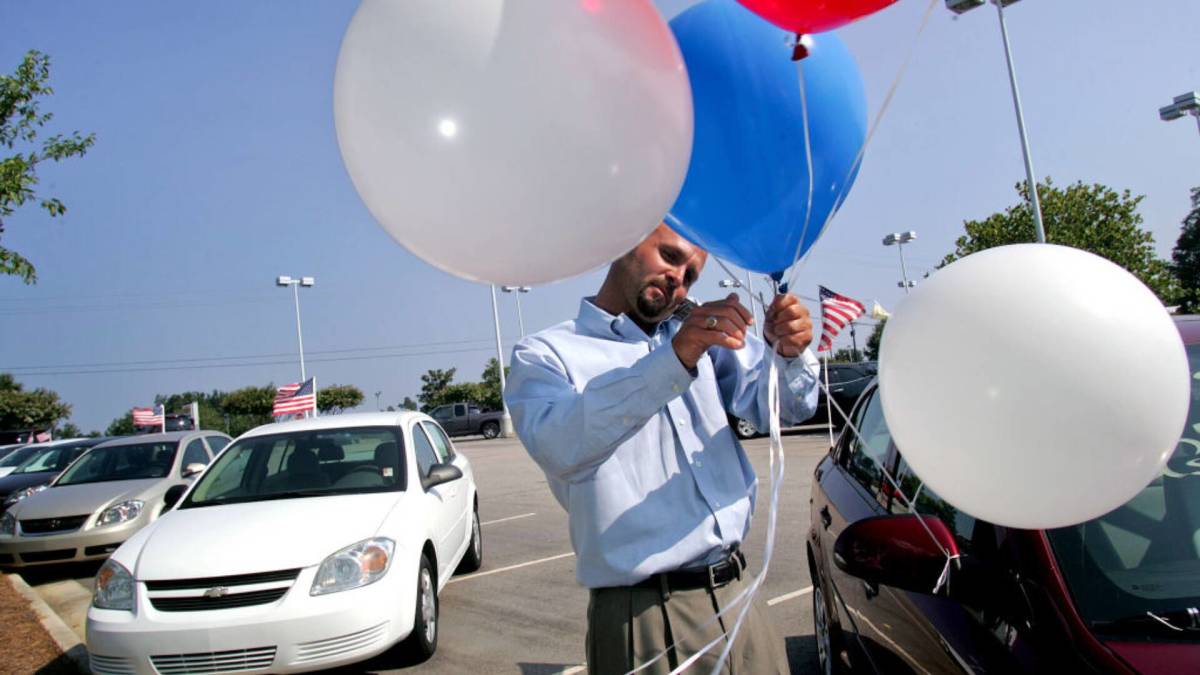 Car buyers are pulling the few levers they can control to manage affordability.
Image source: Bounds/Bloomberg via Getty Images
Record number of Americans commit to unsustainable monthly car payments
As tariffs start impacting the stickers on dealer lots and interest rates remain elevated, car buyers are taking on larger monthly payments to finance the new car of their dreams.
A whopping one in five Americans (20%) have $1,000+ monthly care payments, according to new research from analysts at Edmunds.
But Edmunds says the problem isn’t so much tariffs as it is consumers.
“It would be easy to assume that tariffs are already reshaping the market, but the reality is that the record-breaking trends we saw in the second quarter are reflective of more consumers opting for maxed-out term lengths, despite vehicle prices remaining steady,” said Director of Insights Ivan Drury.
“It’s clear that buyers are pulling the few levers they can control to manage affordability, whether that’s by taking on longer loans, financing more, or putting less money down — even if some of those decisions increase their total costs.”
Related: Ford debuts plan to increase sales that car buyers will love
New car buyers agreed to average loan terms of 69.8 (5 and 3/4 years) in the second quarter, which is much higher than the 69-month terms they agreed to last year and slightly ahead of the 69.5 months they agreed to in the first quarter.
The amount financed has risen to $42,388 from $40,730 a year ago and $41,473 in the previous quarter.
But car buyers are paying slightly less up front, possibly due to persistent incentive spending. New car buyers, on average, put down $6,433 in the second quarter, down from $6,579 last year and $6,511 a year ago.
Monthly payments are up to $756, up from $740 annually and $741 sequentially.
“While extended loan terms may make a monthly payment more palatable, consumers need to keep in mind the risks associated with a loan extended that far into the future, including increased costs for upkeep down the line and the risk of being underwater on the loan if the car is traded in before it’s paid off,” said Edmunds Consumer Insights Analyst Joseph Yoon.
Car buyers got some relief in the One Big Beautiful Bill Act passed in July
The giant omnibus bill Congress passed this summer features a provision that will allow car buyers to write off up to $10,000 a year in interest paid on qualifying auto loans.
The tax breaks would apply to loans taken out between 2025 and 2028.
The tax credit would only go to buyers who purchase cars assembled in the U.S. So even if you’re buying a Toyota, as long as it’s one of the nearly 2 million vehicles the company builds in the States annually, you’re eligible.
But popular imported models, even if they’re imported by one of the U.S. Big 3 automakers, are not covered.
Cars built before December 31, 2024, are not eligible.
The final version of the bill covers cars and motorcycles, ATVs, trailers, and campers.
Related: Car buyers have a lot riding on the ‘Big, Beautiful Bill’