
Something is cracking at the top.
It’s not often you see the world’s biggest luxury empire wobble.
But the conglomerate LVMH just announced its first-half earnings, and underneath the polish, there’s pressure.
Revenue is down. Profits fell harder. A global slowdown is testing even the strongest brands in the game.
Travel spending isn’t what it was. Asia isn’t bouncing back fast enough. And in Japan (where tourist-driven shopping boomed last year), the comeback has cooled.
Related: Luxury giant behind Cartier, Van Cleef raises a red flag
High-end fashion, watches, and cognac are all feeling it. Even Louis Vuitton, Dior, and Fendi, brands that rarely blink, are showing signs of fatigue.
But amid the softness, one brand stood tall.
It didn’t launch a new bag. It didn’t host a cruise show at a palace. It didn’t need to.
It just kept selling lipstick.
And that was enough to help steady a $430 billion company.
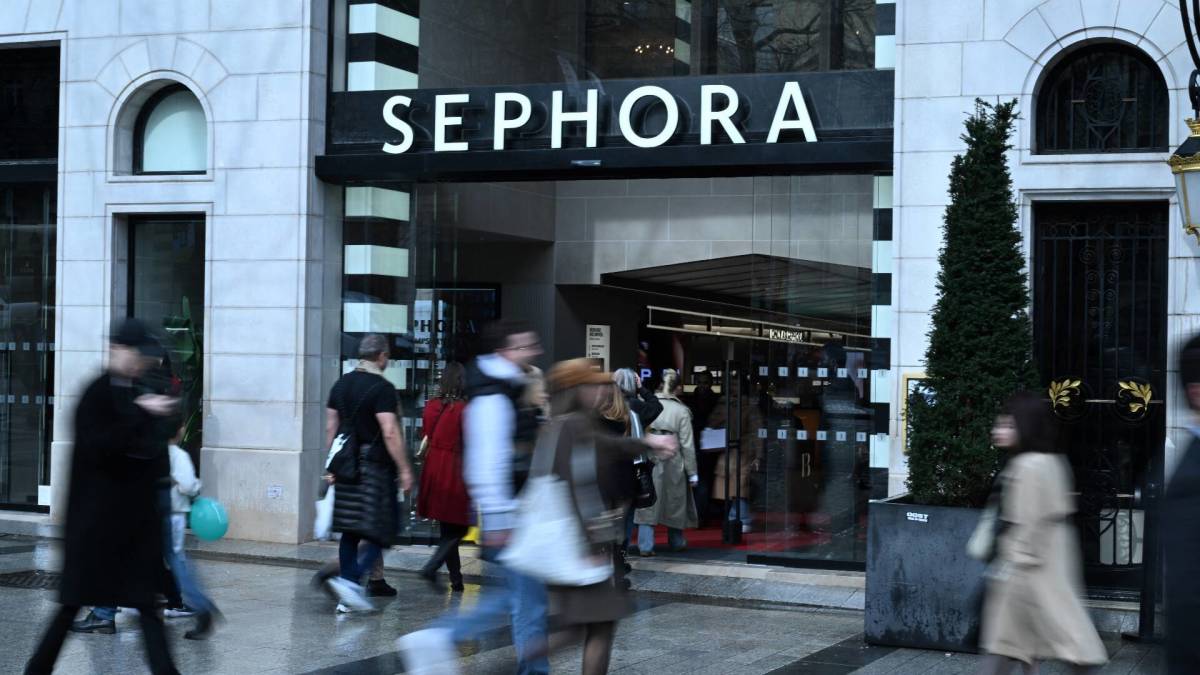 Fashion stumbled. Spirits softened. But beauty didn’t blink.
MIGUEL MEDINA/AFP via Getty Images
The lipstick effect hits different at this scale
Sephora isn’t just surviving. It’s thriving.
While Fashion & Leather Goods, LVMH’s biggest segment, saw revenue fall 8% and profits tumble 18%, the company’s Selective Retailing division—anchored by Sephora—quietly posted a 12% jump in profit.
Let that sink in. Everything else is sliding. Sephora is growing (and glowing).
It’s not just about selling more product. It’s about expanding strategically: opening stores in the U.K., scaling exclusive partnerships (like Makeup by Mario), and growing its 74 million-member loyalty engine.
Related: Burberry’s Q1 earnings show a troubling trend
Europe and Latin America carried the momentum. In the U.S., growth softened but didn’t stall. And in China, Sephora’s differentiation strategy is helping it hold ground.
This isn’t a fluke. Sephora’s model is high-frequency luxury. Customers come in often, spend modestly, and still feel a thrill.
It’s also lower-risk. Less reliant on tourists. Less cyclical. More tech-enabled. And far more adaptable than heritage fashion houses built on couture.
In a quarter where even the crown jewels slipped, Sephora didn’t blink.
Can beauty keep carrying the crown?
The short answer: not forever.
Sephora is LVMH’s stabilizer. But it’s not its center of gravity. It made up 22% of revenue during the first half of the year. Strong? Absolutely. But not enough to cover shortfalls in Fashion, Watches, and Spirits segments.
Still, it’s sending a loud message.
Sephora is where LVMH’s customer base is growing, where margins are improving, and where the company is doubling down. It’s a different kind of luxury, less about aspiration and more about access.
And right now? That’s what’s working.
Consumers are pulling back on $4,000 bags, but they’re still buying the $40 gloss. They’re skipping shopping in Paris but still swinging by Sephora after work.
More in Retail:
- Ulta Beauty makes surprise huge expansion
- Nike eliminating some classic sneaker models
- Why the latest Messi Stanley collab is smarter than it looks
It’s the lipstick effect—at scale.
With beauty, LVMH isn’t just weathering the storm. It’s buying time.
The rest of the business needs to catch up. Or, at the very least, stop the bleeding.
Because when a company this big starts leaning on its smallest-ticket items, you know the winds have shifted.
And if LVMH’s next quarter looks like this one?
We’ll all be talking about Sephora a lot more.
