
The U.S. auto industry has been transformed over the past five decades.
Once the envy of the automotive world due to its sheer volume, the U.S. auto industry is still extremely valuable as the second-largest market behind China. Still, the market has shifted in recent years.
💵💰Don’t miss the move: Subscribe to TheStreet’s free daily newsletter💰💵
While U.S. hallmark General Motors still has the highest U.S. market share at 17% and Ford ranks third with a 13% market share, foreign models from Asia round out the top five, according to Cox Automotive data.
Toyota ranks second with 15% U.S. market share, while Korean brand Hyundai ranks fourth with 11%. Toyota’s fellow Japanese brand, Honda, is fifth in the market, with 9%.
Hyundai is especially impressive, since the Korean automaker had an inauspicious start in the U.S.
Related: New car buyers are finally starting to feel the pain from tariffs
Earlier this month, Hyundai Motor North America CEO Randy Parker said, “We just wrapped up the strongest first half in Hyundai’s history, driven by sales growth across our lineup.”
Hyundai (HYMLF) sold 439,280 vehicles worldwide in the first half of the year, a 10% year-over-year increase that was capped by a 10% second-quarter increase to 235,726 units. June sales increased 3% year-over-year to 69,702 units in North America.
Fellow Korean automaker Kia isn’t doing as well as its compatriot, so this week the company shared it’s switching gears amid the 25% auto tariffs it faces for its U.S. imports.
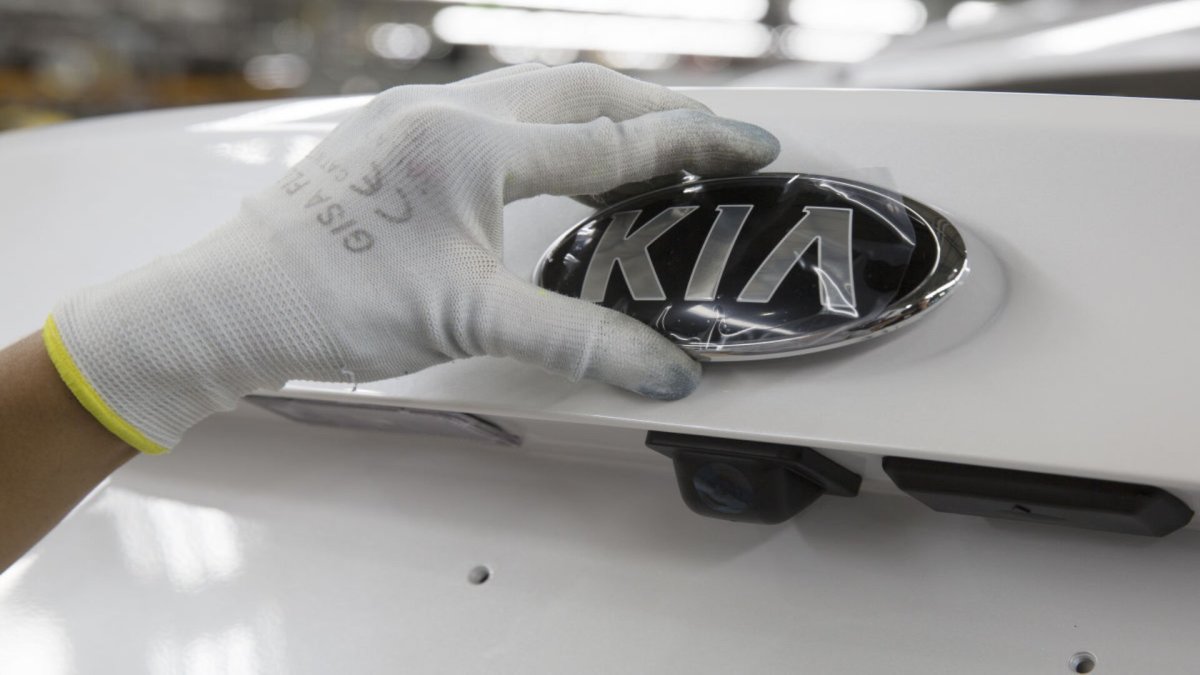 Kia is shifting its manufacturing strategy in the face of tariffs.
Image source: Gonzalez/Bloomberg via Getty Images
Kia to cut incentives for U.S. buyers to combat tariffs
Even American manufacturers are losing billions on tariff-related costs, so one can imagine how much foreign manufacturers struggle.
On July 25, South Korean automaker Kia revealed that it will adjust its U.S. business operations, cutting the incentives that automakers have been using to entice tariff-weary shoppers.
Kia vehicles manufactured at its Georgia facility will be prioritized for the U.S., while supplies are shifted away from Mexico and the Middle East. Meanwhile, cars made in Korea will be redirected to Canada to avoid U.S. tariffs.
Like many automakers, Kia expects tariffs to affect its bottom line more in the second half of the year.
Related: Ford debuts plan to increase sales that car buyers will love
Tariff costs take time to appear on the balance sheet, and as pre-tariff inventory wanes, costs will only rise.
Kia’s quarterly operating profit of 2.8 trillion won ($2 billion) was down 24% year over year, despite sales climbing 6% in the period.
Tariffs alone cost the company $569 million in the quarter.
These costs don’t just affect importers like Kia, however. U.S. carmakers are experiencing the same conundrum: strong sales and lower profits.
Carmakers rely on incentive spending to combat tariffs
Earlier this month, Big 3 U.S. automaker Ford (F) also announced that it was switching strategies.
Ford says its total sales rose in the second quarter at a rate about 7x that of the overall industry.
The company says it was the top-selling brand in the U.S. during the first half of the year, thanks mainly to buyer offers like its “From America, For America” employee pricing offer and the “Zero, Zero, Zero” offer it debuted to replace it.
Ford isn’t expected to report its quarterly earnings until next week, but rival GM already has, and the tariff costs were staggering.
In the past, the company said that President Donald Trump’s 25% auto tariffs would cost it $4 billion this year. Now, the company says tariffs could cost between $4 billion and $5 billion between the second and fourth quarters.
Tariff payments caused adjusted automotive free cash flow to fall to $2.8 billion, a $2.5 billion decline year over year.
Even though GM reported an industry-leading 12% increase in first-half-of-the-year sales, paying 25% tariffs on its imports shaved $350 million off its bottom line.
Related: GM CEO shares sliver of hope as tariffs send it stock down
