
Your mortgage, credit cards, and savings are vibing on high alert right now.
Anticipation is palpable among U.S. consumers, businesses and investors as the Federal Reserve’s Federal Open Market Committee (FOMC) prepares to convene its latest monetary policy meeting July 29-30.
💵💰Don’t miss the move: Subscribe to TheStreet’s free daily newsletter💰💵
The central question: Will the policymaking panel vote to cut the Federal Funds Rate for the first time this year?
Related: White House tours Fed seeking fraud
Some Fed watchers and economists say it’s about time (just ask President Donald Trump), while others are committed to the current “wait and see” approach.
The implications of any rate movement — or lack thereof — are substantial for every American household.
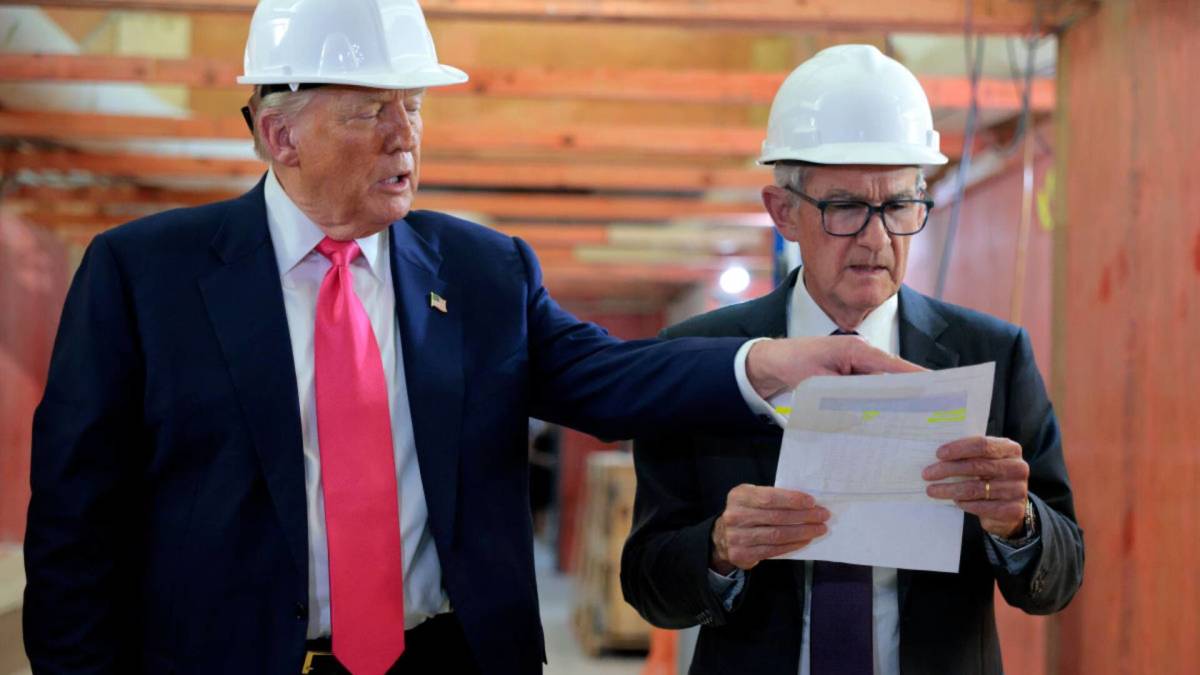 President Donald Trump, who made a rare visit to the Federal Reserve on July 24, has been pushing for a 3% rate cut for weeks. Fed Chair Jerome Powell, right, has resisted Trump’s calls to resign from the independent central bank.
Image source: Chip Somodevilla/Getty Images
The current Fed landscape: Holding steady amid uncertainty
Recent FOMC meetings have seen the Fed maintain the Federal Funds Rate within its target range of 4.25% to 4.50%.
This “wait-and-see” approach, per Federal Reserve Chair Jerome Powell, reflects a cautious stance in a post-pandemic economy marked by persistent inflation and ongoing geopolitical uncertainties, including the impact of tariffs and trade wars.
The Federal Reserve must comply with its dual mandate set by Congress to keep prices steady and unemployment low while maintaining steady economic growth.
This is a delicate balancing act for the independent central bank.
Related: Why the Federal Reserve matters so much
The FOMC makes all decisions regarding the appropriate position or “stance” of monetary policy to help move the economy toward these congressionally mandated goals of maximum employment and price stability.
It uses interest rates as a tool to manage that balance.
The Federal Funds Rate is the price the Fed charges U.S. banks to borrow money overnight. This in turn sets the pace for short-term costs of borrowing money like credit cards and auto and student loans.
The 10-year Treasury Bond yield is the benchmark for longer-term interest rates like the 30-year fixed mortgage, currently hovering around 6.8%. The market expectations for how the Fed will set rates in the future influences long-term rates.
President Trump, who made a rare visit to the independent central bank on July 24, has been pushing for a 3% rate cut for weeks. He and his White House team say the current rates are holding back the American economy from robust growth.
What the latest interest rate projections indicate for the Fed
The latest projections from the Fed’s June meeting indicated a median expectation of two quarter-point rate cuts later in 2025.
However, these are projections and not guarantees.
The FOMC remains highly data-dependent, as Powell has repeatedly maintained.
Current market probabilities, as tracked by tools like the highly regarded CME Group’s FedWatch Tool at 97.4%, suggest a high likelihood that the FOMC will keep interest rates steady next week.
More Economic Analysis:
- GOP plan to remove Fed Chair Powell escalates
- Federal Reserve official gives green light to July rate cut
- Trump deflects reports on firing Fed Chair Powell ‘soon’
- Former Federal Reserve official sends bold message on ‘regime change‘
The reason? The FOMC wants to continue to assess incoming economic data, particularly regarding tariff inflation and the labor market, before making a move.
Some Fed watchers are looking at the September FOMC meeting for the next rate cut, pending the outcome of tariff inflation and the unemployment rate.
Is there a unanimous FOMC vote ahead?
A 12-0 vote to hold interest rates steady would be a powerful signal of a strong conviction among the members of the FOMC.
But there may not be such unanimity.
Federal Reserve Governor Christopher J. Waller said earlier this month the FOMC should cut the Federal Funds Rate.
The latest data, including the June CPI figure at 2.7% and other recent economic numbers, show it’s definitely time for the Fed’s first rate cut in 2025, Waller said.
Waller, a Trump appointee like Powell and a voting member of the FOMC, said his opinion was based on economic data and not influenced by politics.
Fed Governor Michelle Bowman is also on record as saying a July rate cut would be warranted if cooling inflation data supported the move.
Divergent opinions within the FOMC often exist, reflecting different interpretations of economic data and risks.
Some members may prioritize ensuring inflation is firmly on a path to the 2% target, while others might emphasize supporting employment and growth.
Related: Fed official voices blunt 3-word message on Fed rate cuts