
America wants its interest rates cut.
From Main Street to Wall Street, there is a general expectation that lower interest rates on borrowed money will free up finances and allow households and businesses greater financial freedoms.
💵💰Don’t miss the move: Subscribe to TheStreet’s free daily newsletter💰💵
But will that relief come during the dog days of summer?
Inflation, jobs feed into an interest rate cut
Maximum employment and price stability are the twin priorities — officially called the dual mandate — of the Federal Reserve.
These goals require a delicate balance because higher interest rates lower inflation but increase job losses, while lower interest rates lower unemployment but increase inflation.
The independent central bank uses interest rates as a tool to manage its dual mandate.
Related: Former Fed Chair sends stern message on economy, Fed
The Federal Funds Rate is the price the Fed charges U.S. banks to borrow money overnight.
This in turn sets the scene for short-term costs of borrowing money like credit cards and auto and student loans.
The 10-year Treasury Bond yield is the benchmark for longer-term interest rates like the 30-year fixed mortgage, currently hovering around 6.8%.
President Donald Trump and his allies have been escalating demands — sometimes deploying harsh and often vulgar rhetoric — at Federal Chair Jerome Powell to support a rate cut this week.
Powell, a Trump appointee, is the FOMC chair but not the only Fed vote.
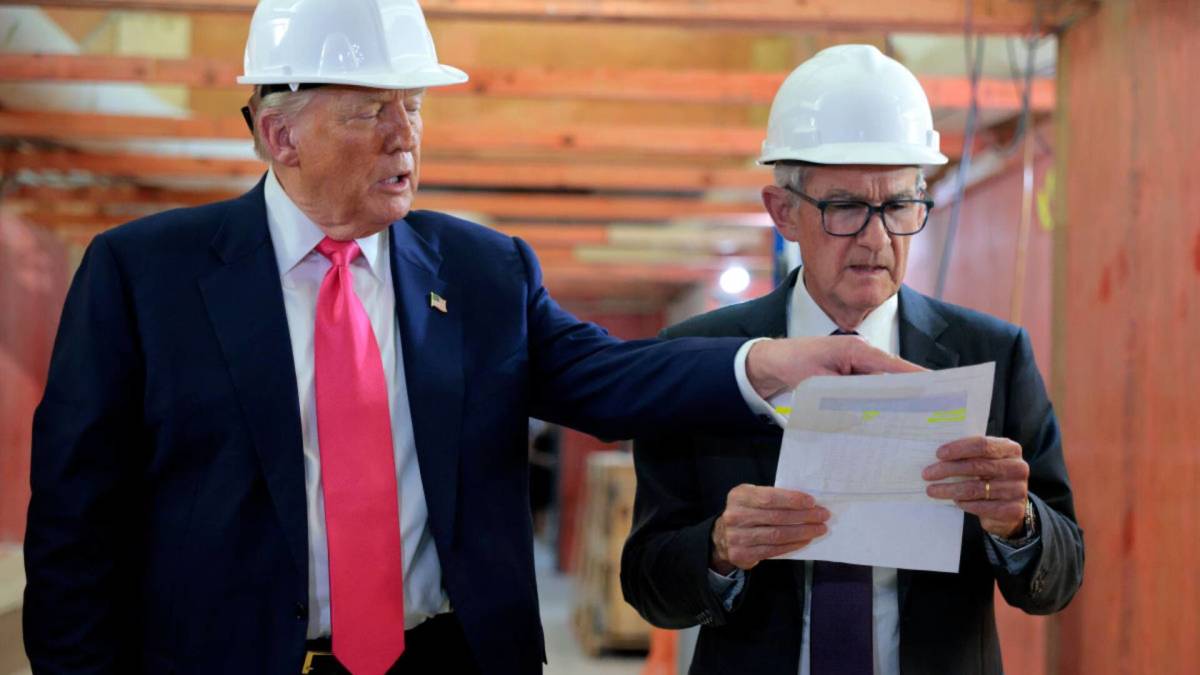 The Trump White House has been pressuring Federal Reserve Chair Jerome Powell to cut interest rates as much as 3%. The Federal Open Market Committee meets July 29-30 to vote on an interest rate reduction.
Image source: Chip Somodevilla/Getty Images
FOMC vote determines interest rate activity
Many economists and market watchers have said there needs to be more evidence that the labor market is cooling and inflation is inching closer to its 2% target before the Fed can consider cutting interest rates.
The reason: Expected inflation this summer from President Donald Trump’s tariffs, currently the highest the nation has seen in nine decades.
More Fed:
- Fed interest rate cut decision resets forecasts for the rest of this year
- Federal Reserve prepares strong message on long-term interest rates
- Fed official revamps interest-rate cut forecast for this year
The Federal Open Market Committee, a 12-member policymaking panel, is expected to keep the Federal Funds Rate steady at 4.25% to 4.50% when it meets July 29 and 30.
The CME Group’s widely respected FedWatch Tool reports a 2.1% chance the rate cut will come this week.
This “wait-and-see” approach reflects a cautious stance in a post-pandemic economy marked by persistent inflation and ongoing geopolitical uncertainties, including the impact of tariffs.
White House pushes for an immediate rate cut
The last time the FOMC voted to cut the Federal Fund Rate was in December 2024.
Fed Governors Christopher Waller and Michelle Bowman, both Trump appointees, separately have said a funds rate cut could come as early as the July meeting, provided tariff inflation proved to be transitory and the jobs numbers don’t weaken.
“It’s not political,’’ Waller said, signaling that his thoughts were influenced by data, not the wishes of the Trump administration.
Related: Fed official voices blunt 3-word message on Fed rate cuts
President Trump has been demanding a 3% rate cut. As part of his campaign, he had threatened to fire Powell — which is illegal unless shown to be “for cause.”
That “cause” campaign took the White House to a rare onsite visit to the Federal Reserve last week in an attempt to highlight that renovations to the Fed’s D.C. campus incurred millions of dollars in overruns under Powell’s management.
The Fed’s response to the $2.5 billion renovations placed the blame for cost overruns on inflation and tariffs.
It was the first visit by a president to the Fed in almost 20 years.
Afterwards, the president walked back his threats to fire Powell but has continued to make near-daily demands that the FOMC begin to cut rates immediately.
Fed watchers forecast next rate cut possibility
FOMC meets next in September 2025, which is seen as the next possible vote to cut the Federal Funds Rate.
At that time, new economic data tracking inflation and jobs will be known.
Alex Tsepaev, chief strategy officer at B2Prime Group, a global financial services provider for institutional and professional clients, said a rate cut this week “is virtually off the table.”
“In my opinion, the inflation situation has simply worsened too much over the last quarter for the Fed to even think about a rate cut this week,” Tsepaev said, adding “that a rate cut might only happen if the economic landscape shows clear signs of improvement, with September being the earliest possible time frame, assuming inflation starts to decline.”
James Bullard, dean of Purdue’s business school and former president of the Federal Reserve Bank of St. Louis, told The New York Times that he expected the Fed to restart interest rate cuts in September and lower borrowing costs by another quarter-point in December.