
An eye-popping $100 billion U.S. investment sounds like good press, but Wedbush’s Dan Ives says there’s a lot more than meets the eye.
Apple (AAPL) CEO Tim Cook stood beside President Donald Trump in announcing a massive $100 billion boost in U.S. spending as part of the “America First” strategy.
Is this just Apple looking to play politics, or was the move more calculated?
💵💰Don’t miss the move: Subscribe to TheStreet’s free daily newsletter💰💵
Ives’ note effectively answers those questions, as he looks to delve deeper into the timing, the politics, and what it signals about Cook’s strategy.
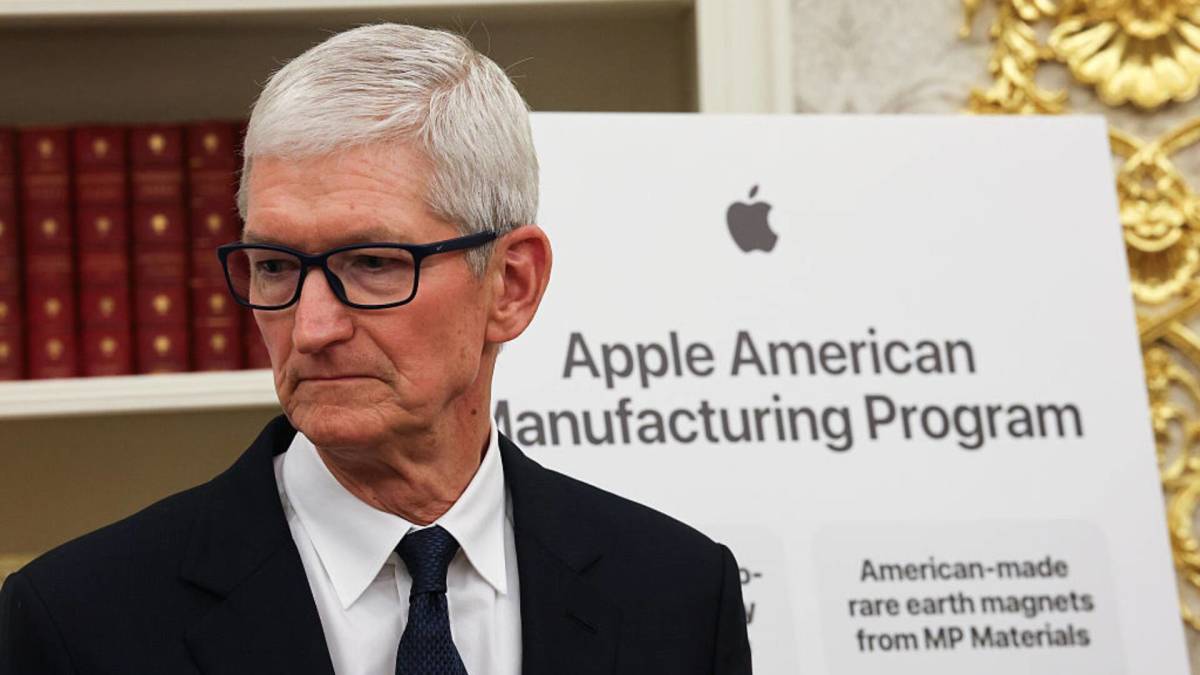 Dan Ives says Apple’s latest U.S. pledge is a smart political move amid tariff threats.
Image source: McNamee/Getty Images
Apple leans into “Made in America” with $100 billion pledge
Apple shook things up with a whopping $100 billion investment in expanding its U.S. manufacturing footprint.
Announced on Aug. 6 during a White House event with President Trump, the huge bet takes Apple’s total U.S. investment to $600 billion over the next four years.
Also, it builds on an earlier $500 billion promise made this year, which involves hiring 20,000 American workers.
Related: Nvidia tops list of veteran analyst’s best stocks for rest of 2025
The move’s timing seems very intentional.
Tariffs are once again on the table, and Apple is making sure it’s not in the crosshairs.
Through partnerships with Corning (for Kentucky-made iPhone glass) and MP Materials (for rare-earth magnets), CEO Cook is doubling down on key components that could prove economically viable to produce domestically.
The positive press doesn’t hurt, either.
Some might deem the move as more about optics, considering how Biden-era chip controls and President Trump’s tariff threats have boxed Apple into a corner.
Still, don’t expect full iPhone assembly to be coming home anytime soon.
Analysts feel that replicating Foxconn-style production in the U.S. would lead to a sharp increase in prices and weigh down margins, while eroding Apple’s tight grip on operational efficiency.
Instead, the focus stays on high-impact investments in states like Arizona, Texas, and North Carolina, areas that effectively deliver political wins and component-level gains.
Dan Ives lavishes praise on Apple’s $100 billion U.S. push
Apple’s latest move to shell out $100 billion into U.S. operations is earning cautious praise from Wall Street’s finest.
Wedbush analyst Dan Ives hails the announcement as a “good step in the right direction,” signaling that Apple is finally aligning itself more closely with the shifting political climate.
The bet brings Apple’s total U.S. investment to $600 billion over the next four years, sending Apple shares higher in the process.
Related: ChatGPT maker quietly shakes the AI landscape and Elon Musk’s xAI
“This isn’t just about manufacturing,” Ives said. “It’s a strategic chess move that helps Apple get on Trump’s good side and avoid becoming the next trade-war headline.”
It seems like a clear nod to the Trump administration’s America First policy as the pressure continues to mount on Big Tech to reinvest at home.
However, not everyone is convinced it’s a game-changer; some analysts believe the pledge is more about optics than overhaul.
A big part of that is the logistical hurdles, which effectively make iPhone development in the U.S. mostly impractical.
More News:
- Veteran analyst spots unexpected star in Apple’s earnings report
- Bank of America drops shocking price target on hot weight-loss stock post-earnings
- JPMorgan drops 3-word verdict on Amazon stock post-earnings
Still, Cook has bought Apple considerable breathing room as he looks to tweak the tech giant’s complex supply chain.
Whether it’s enough to shift the tide or consumer perception remains to be seen.
Apple leverages federal funding to power domestic and sustainable growth
Apple’s $100 billion pledge isn’t just a political hedge — it’s a savvy financial move.
It appears to be a broader play into tapping federal incentives from the CHIPS and Science Act and the Inflation Reduction Act. That effectively positions Apple to qualify for U.S. investments in the billions for subsidies, grants, and tax breaks.
Under CHIPS, a massive $39 billion is earmarked for onshore chip manufacturing, along with a 25% tax credit for qualifying chip equipment.
The Inflation Reduction Act adds another layer to that, which also offers roughly 30% in credits for clean-energy manufacturing, along with bonuses for domestically sourced materials, including green steel and iron.
So Apple’s partnerships with Corning in Kentucky and MP Materials in Texas are no accident.
These supply-chain tweaks, in line with federally funded chip-packaging and testing hubs in Phoenix and New York, could potentially lead to overlapping incentives.
As Washington leans into clean tech, Apple’s early alignment with these priorities could give it a major edge.
Related: Jim Cramer drops jaw-dropping price target on Palantir stock post-earnings