
Wine is the divine juice of September, the French philosopher Voltaire once said, and investors will probably will be swimming in the stuff for the next 30 days.
This is what market analysts call the “September Effect,” where the stock market, particularly the S&P 500 index, tends to perform poorly and investors tend to reach for their corkscrews.
💵💰Don’t miss the move: Subscribe to TheStreet’s free daily newsletter 💰💵
This pattern has led to negative average returns, making it the worst-performing month on average since data have been recorded.
But why all the hate for the month when the leaves of brown come tumbling down?
Well, there’s no single definitive cause, but some theories include portfolio rebalancing by institutional investors after summer vacations and tax-loss harvesting by funds.
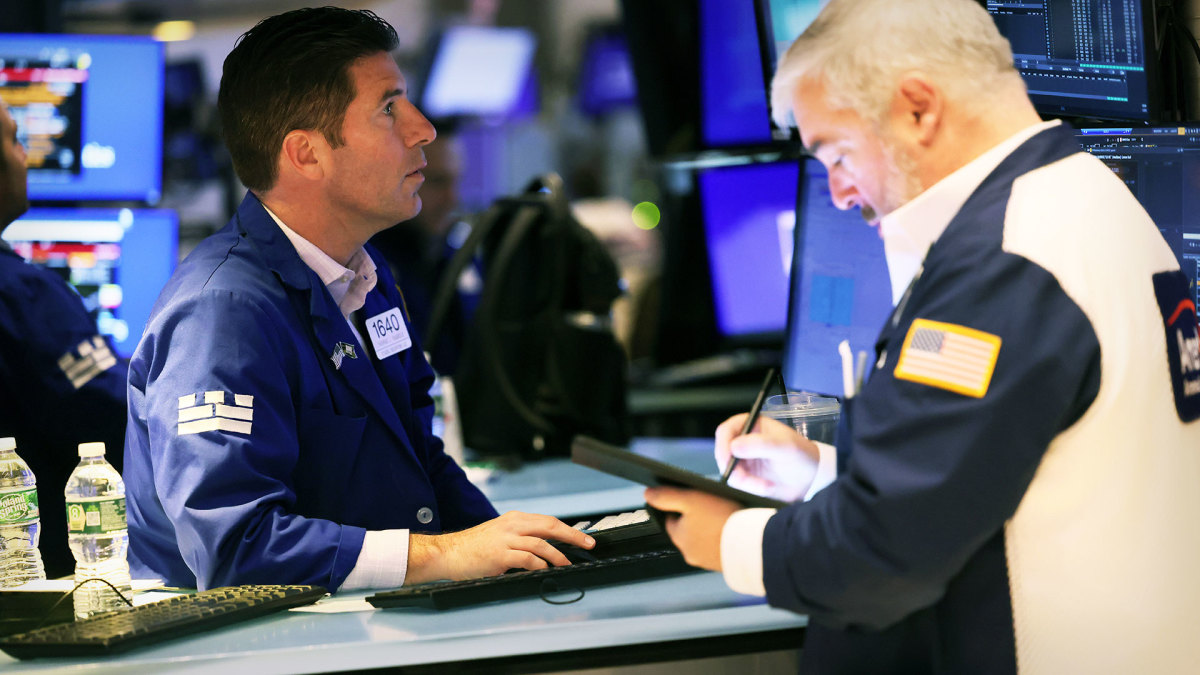 Wall Street traders at work. TheStreet Pro’s James “Rev Shark” DePorre notes that the S&P 500 is at an all-time high as it heads into September, the worst-performing month.
Michael M. Santiago/Getty Images
And then there is the specter of the self-fulfilling prophecy, with Voltaire (yeah, him again) noting that “the human brain is a complex organ with the wonderful power of enabling man to find reasons for continuing to believe whatever it is that he wants to believe.”
Veteran trader: Bonds are lower, gold at highs
“The financial markets often shift gears in September, moving away from the quiet summer months marked by low trading volumes and limited volatility, and entering a period historically associated with seasonal weakness and increased market instability,”said Adam Turnquist, chief technical strategist, with LPL Financial.
“Of course,” he noted, “seasonal trends should always be viewed with caution — they reflect the broader market climate, not the current market conditions.”
More Economic Analysis:
- What the star-studded Jackson Hole Fed meeting means to you
- Producer price inflation shocks Fed interest rate cut bets
- White House taps more potential candidates to head the Fed
TheStreet Pro’s James “Rev Shark” DePorre notes that the S&P 500 is at an all-time high as it heads into the weakest month in the calendar.
“Since 1950, September is the only month of the year in which the S&P has averaged a negative return,” he said.
“The index is down about 55% of the time and has an average loss of 0.5%. Since 2000, the results have been much worse, with an average loss of 1.7%, which is a full percentage point lower than any other month.”
DePorre warned that seasonality is a tendency and not a certainty, There are many exceptions to this particular rule, such as September 2024 when the S&P rose 2%.
Still, he added, negative seasonality is a well-known factor and that can make it self-fulfilling to some extent.
“With the indexes near all-time highs following a very powerful rally off the April lows, technical conditions are extended and there has not been any notable corrective action for a while,” DePorre said.
“An additional problem is that there are a host of potential news catalysts that can be used to justify a selloff.”
TheStreet Pro’s DePorre: Small-cap index ETF outperforms
The biggest positive for the market recently, he noted, has been confidence that the Federal Reserve will cut interest rates at its next meeting, scheduled for Sept. 16-17.
“The market is currently seeing a 91.8% chance of a quarter-point cut on September 17, but to what extent has that already been priced into the market?” DePorre said.
“Bonds are lower and gold is hitting a new high, which indicates that maybe investors haven’t given up on their worries about inflation and interest rates.”
Related: Trust us: This week’s jobs report is a really big deal
The U.S. Labor Department is scheduled to release the August employment report on Friday and will very likely influence the odds of a Fed move.
This is the first report since the surprisingly weak Bureau of Labor Statistics revision of July job numbers and President Donald Trump’s firing of Erika McEntarfer, who headed the agency.
Several other major issues will affect the market this month, DePorre said, including a Supreme Court ruling on tariffs, new Fed members, and negotiations within Congress on the federal budget.
A federal appeals court ruled on Aug. 29 that most of Trump’s global tariffs were illegal, striking a blow to the core of his aggressive trade policy, CNBC reported.
Trump attacked the appeals court as “highly partisan” and asserted that the Supreme Court will rule in his favor.
The president is also attempting to fire Federal Reserve Governor Lisa Cook in a case that will likely end up before the Supreme Court
“One recent bright spot has been the rotational action into areas of the market outside the Magnificent 7,” DePorre said, referring to the group of megacap tech stocks: Apple, Alphabet, Amazon, Meta Platforms, Microsoft, Nvidia and Tesla.
“The Russell 2000 ETF (IWM) has been outperforming and there has been a good supply of attractive charts for stock pickers,” he said. “I’ll be watching to see if we continue to have some hot pockets of speculative action.”
Right now, DePorre said, “we have a poor start to the month.”
Related: The stock market is being led by a new group of winners