
For generations, travelers have left home not just to see faraway cities and load up on new experiences, but also to find tranquility and peace in the quiet of nature.
Ralph Waldo Emerson, William Wordsworth, Emily Dickinson, and Rachel Carson have all explored the natural world’s ability to soothe the soul in ways that landed them in the canon of English literature.
Different forms of writing about traveling into nature even date back to the earliest centuries for which human paper records can be found.
Taking countless different names across different cultures over the centuries, the practice of seeking peace in the natural world has in 2025 gotten new attention through the ancient Japanese practice of Shinrin-yoku.
Translated into English as “forest bathing,” the practice in its simplest interpretation means going for a forest walk meant to bring an inner sense of calm.
Using the hashtag “forest bathing,” travelers with no connection to Japan have also been posting hundreds of new videos of themselves going into nature in recent months.
“Slowing down and connecting to nature with all your senses”: Ancient practice finds new popularity
Google Trends shows that the English translation of Shinrin-yoku saw an upward trajectory in search volume at the end of 2023.
“It’s slowing down, it’s connecting to nature with all your senses,” Mark Ellison, who founded the Pinnacle Forest Therapy guide company, said to CNBC. “The key things are to find a place where you can spend some time uninterrupted, and then notice the things that are around you.”
Related: A remote part of Norway is becoming a key summer travel destination
The practice has also recently been picked up by resorts and wellness guides selling getaways to travelers.
Several U.S. destinations have been marketed and are emerging as spots to forest bathe — California’s Muir Woods, Maine’s Cape Elizabeth, and Colorado’s Woodland Park.
In the latter, nature therapy guide Jane Deming Scanlon started the Above The Clouds Forest Bathing company, taking the curious on by-donation walks through nearby forest trails.
The Association of Nature and Forest Therapy at Pennsylvania State University has recently also launched autumn forest bathing sessions at an on-campus wood, serving students and faculty who need a break from studying.
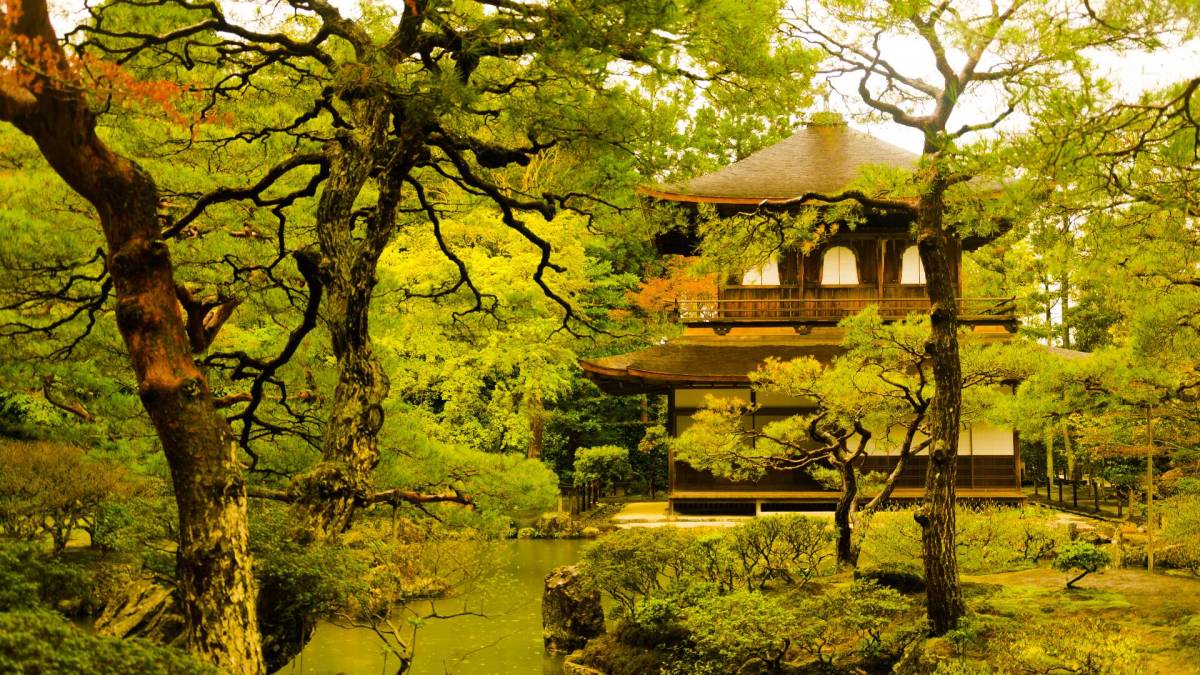 Japanese forests are often dotted with shrines and temples.
Image source: Shutterstock
Some places for Shinrin-yoku or forest bathing in the U.S. (and why you should also book a trip to Japan)
“Derived from the Japanese practice Shinrin-Yoku or ‘forest bathing,’ forest therapy is a guided walk through the woods intended to disconnect the practitioner from the busyness of their life and reconnect them with nature,” the university writes.
But as the traditional practice of Shinrin-yoku is rooted deeply in the spirituality and cultural practices of Japan (the country’s forests are often dotted with Shinto shrines and Buddhist temples), the truly dedicated have increasingly been going all the way and booking trips there.
More on travel:
- Another regional airline cancels all flights, no refunds
- US government issues sudden warning on Switzerland travel
- Another country just issued a new visa requirement for visitors
These adventurous travelers often bypass a long stay in Tokyo and go directly to remote destinations where they can immerse themselves in the country’s nature. Japan’s Tourism Board has also described the shifting travel trend with the wider term “rural tourism.”
“This longing for simplicity has extended to travel,” social media platform Pinterest said in a travel report for 2024. “Since last year, searches for ‘quiet places’ and ‘calm places’ have increased by 50% and 42% respectively.”
Related: ‘Quiet life travel’ is the new viral trend going around