
When it comes to recalls, Tesla is usually ahead of the competition.
Even when their vehicles are recalled, the issue is usually software-related and can be fixed by an “over-the-air” patch that can be issued remotely.
Out of the more than 5 million Tesla vehicles impacted by recalls in 2024, more than 99% of them were fixed with software updates. Only 39,311 require physical repairs of parts placements, according to Drive Tesla.
For comparison, Ford recalled 4.3 million vehicles requiring physical visits in 2024. Honda and GM had 3.8 million and 1.8 million physical recalls, respectively.
Tesla’s largest recall to date (recall number 24V051000) affected 2.19 million vehicles. It involved a panel display issue that displayed the incorrect font size for the brake, park, and antilock brake system warning lights. A software patch fixed the 2024 recall issue.
Tesla has had 52 physical recalls as of March 2025, according to the law firm Brady Reilly & Cardoso.
As of March, only two of Tesla’s 83 recalls have been for equipment (a part installed incorrectly or defective). Those recalls were for certain 2021 Model S exterior side view mirrors (22E092000) and Universal Mobile Connector Adapters (16E091000).
On Tuesday, the National Highway Traffic Administration (NHTSA) opened an investigation that could add to Tesla’s recall tally.
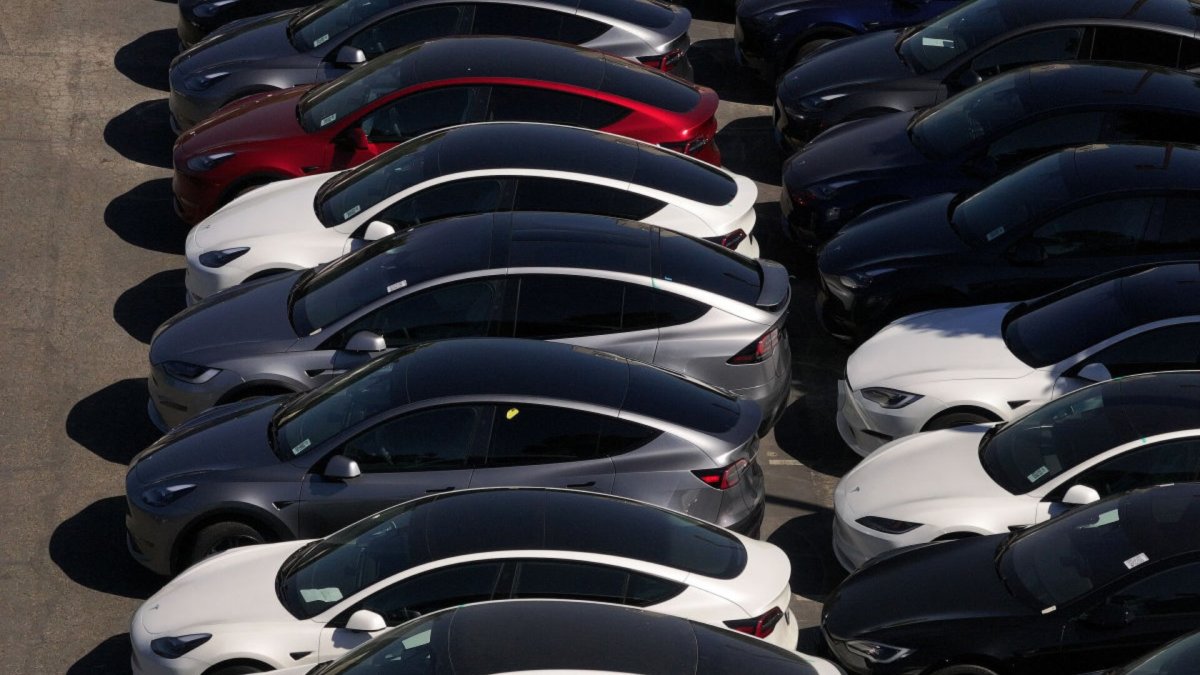 Over 100,000 Tesla Model Ys could be affected by a potentially dangerous issue.
Image source: Sullivan/Getty Images
NHTSA opens recall probe into Tesla Model Y door handles
On Tuesday, the NHTSA announced that it is in the second phase of its three-step process to issue a recall on the popular Tesla Model Y over an electrical issue that could cause the door handle to fail.
The government agency is investigating about 174,000 2021 Model Ys after receiving reports of parents being unable to open the doors of their vehicles with children trapped in the car.
Related: Ford keeps breaking records in the worst way with latest recall
“The most commonly reported scenarios involved parents exiting the vehicle after a drive cycle in order to remove a child from the back seat or placing a child in the back seat before starting a drive cycle. In those events, the parents were unable to reopen a door to regain access to the vehicle,” the NHTSA said.
In four instances, the parents were forced to break the back window to access the vehicle.
The NHTSA says its initial review suggests that the issue appears to arise when the electronic door locks don’t receive enough voltage from the vehicle.
The agency says repair invoices report that the affected vehicles had their low-voltage batteries replaced after the incidents. Still, none of the owners reported seeing a low-voltage battery warning before the door handles failed.
Reporting is the first step, and investigation is the second step. The NHTSA could then issue a recall shortly after it completes its investigation.
Related: Fire risk recall affects 60,000 vehicles from US car company
Last week, Bloomberg reported on how dangerous Tesla’s fully concealed door handles could be if the vehicle lost power after a crash.
“Tesla engineers went wildly in the direction of automation and overlooked what happens to the human body after a crash,” Charles Mauro, founder of Mauro Usability Science, a New York consulting firm that specializes in human factors engineering, told Bloomberg. “Musk’s idea is a computer on wheels, but the design of the door locks was overlooked.”
Over-the-air recalls are much cheaper than physical ones
It’s unclear whether the fix can be issued over the air, or whether this incident could add to Tesla’s physical recall ledger.
Over-the-air recalls are much cheaper than physical fixes for obvious reasons, as recent data from Ford show.
Ford says about a third of its recalls over the past three years have been software-related, and over-the-air recalls cost 95% less than physical ones.
Costs associated with recalls and customer satisfaction claims, what Ford calls field service actions (FSAs), account for about 40% of Ford’s warranty costs.
Related: Stellantis hits another speedbump amid turnaround attempt