
If you were like me, you spent a lot of time at the mall in the 1980s and 1990s looking for that signature look. In the ’80s, that meant heading to Chess King to look like Sonny Crockett on Miami Vice.
In the ’90s and 2000s, it meant visiting iconic stores like Gap, American Eagle, and Abercrombie & Fitch.
Those stores were so popular that they could be found in almost every mall nationwide. Abercrombie & Fitch was arguably the most exclusive and perhaps intimidating of them.
It leaned hard into the concept of cool clothes for beautiful people, hiring shirtless models to stand at its entrances and fostering purposefully aloof and unhelpful staff within stores to create a feeling of exclusivity.
In 2006, then-CEO Mike Jeffries infamously defended Abercrombie’s approach in an interview with Salon.
Candidly, we go after the cool kids. We go after the attractive all-American kid with a great attitude and a lot of friends. A lot of people don’t belong [in our clothes], and they can’t belong. Are we exclusionary? Absolutely.
The exclusionary approach worked in the 1990s and 2000s, but it became a significant problem once inclusivity became a household word. Jeffries was forced out of Abercrombie in 2014, and slowing sales fueled ongoing store closures, amplified first by shifting trends away from indoor malls and then, by Covid shutdowns.
While Abercrombie & Fitch boasted 1,096 total stores across its brands as recently as early 2010, it now operates fewer than 800 stores. The challenges remain significant, but Abercrombie & Fitch’s management hasn’t given up on the brand, and the company is experiencing a resurgence.
Abercrombie & Fitch has a storied history
Abercrombie & Fitch was founded 133 years ago in 1892 as a high-end sporting goods retailer by David T. Abercrombie. Its first store, in Manhattan, New York, was a favorite among many wealthy patrons, including Ezra Fitch, who liked the business so much that he bought into it in 1900 before buying out Abercrombie entirely in 1907.
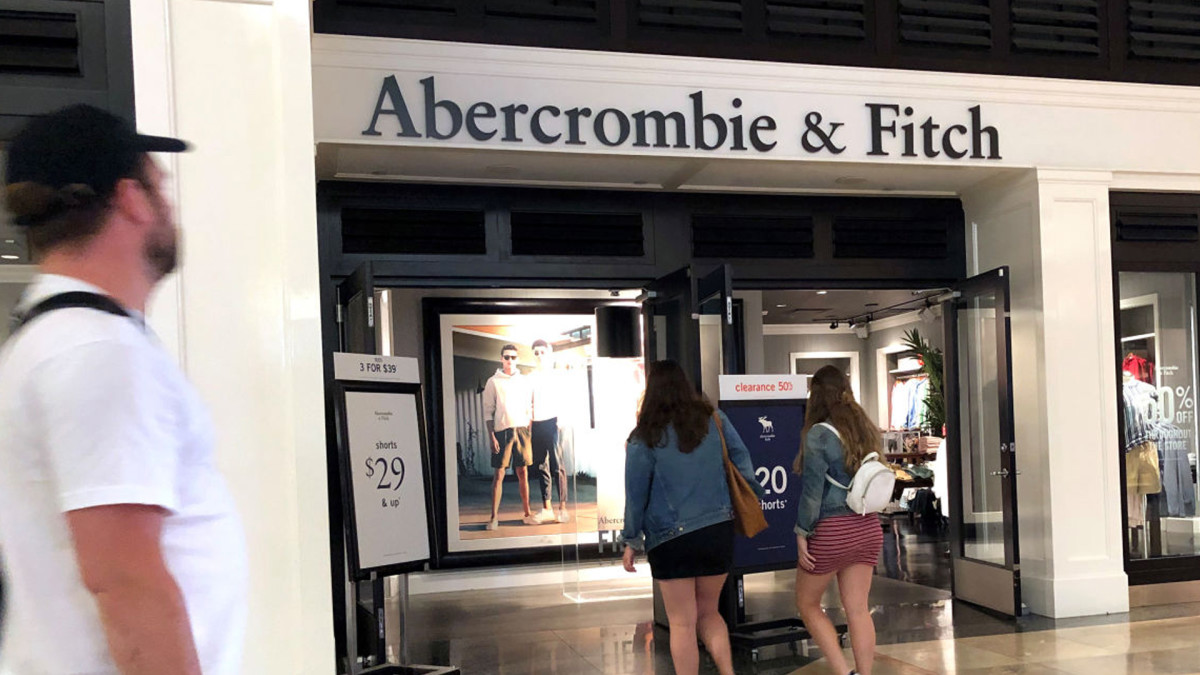 Abercrombie & Fitch has returned to opening new stores after closing hundreds of stores since 2010.
Image source: Justin Sullivan/Getty Images
Over its long history, Abercrombie & Fitch has seen its fair share of apparel trends come and go. By 1917, its store occupied 12 stories on Madison Avenue and East 45th Street, selling everything outdoor-related, from hot air balloons to fishing reels.
The company survived the Great Depression and expanded; however, it eventually went under, declaring bankruptcy in 1976. In 1978, sporting goods retailer Oshman’s bought it.
It languished under that banner until 1988, when Limited Brands, the company behind Victoria’s Secret and Express, bought it and embarked on a massive expansion in 1992, targeting teen apparel under clothing executive Mike Jeffries.
Jeffries’ preppy, “all-American” marketing plan worked, quickly turning Abercrombie and Fitch into a sought-after, high-priced retailer, with 67 stores by 1994, hauling in sales of $165 million. By 1996, it had grown large enough for Limited Brands to spin it off in its own IPO on the New York Stock Exchange, fueling even more growth.
In 1998, it launched Abercrombie Kids, and in 1999, sales surpassed $1 billion with 250 stores nationwide. It launched Hollister in 2000, targeting the Southern Californian surf-vibe, and by 2004, sales exceeded $2 billion.
Abercrombie hit hard by changes in customer behavior
The expansion hit a significant snag during and after the Great Recession; it closed stores in 2010 and 2011, and in 2012, the company announced plans to close 180 stores by 2015.
In 2013, Jeffries’ 2006 quote in Salon resurfaced, causing backlash and further pressure on the company.
After Abercrombie saw sales at stores open for at least one year retreat for 11 consecutive quarters and profit tumble 77% in fiscal 2013, Jeffries was shown the door in 2014. The Office of the Chairman then ran Abercrombie until current CEO Fran Horowitz was appointed CEO in 2017.
Horowitz worked to overcome headwinds, but the retailer still struggled to outmaneuver rivals, including low-cost fast-fashion players like H&M and big-box stores like Walmart and Target, which have pushed more deeply into apparel over the past 20 years.
Consumers’ widespread embrace of online shopping, including apparel, made the situation even more complicated. Online retail apparel sales have more than doubled since 2014, accounting for as much as 35% of all U.S. clothing sales in 2025.
Furthermore, a general move away from indoor malls, where most Abercrombie & Fitch stores were located, added to challenges.
Indoor mall traffic slumps, hurts Abercrombie
The Covid pandemic delivered a significant blow to indoor malls in 2020, but many indoor malls were struggling before that, largely because of Walmart’s major expansion in the 1990s to become a national chain.
Walmart’s rise contributed to mall anchors like Sears and Kmart closing thousands of stores before they went out of business. Kmart merged with Sears in 2005, and the merged company declared bankruptcy in 2018.
More retail:
- Major office supply retailer sold after it closed 1,000 stores
- AutoZone makes harsh decision customers won’t like
- Iconic retail chain closed 80% of its stores
Abercrombie cited troubles at mall anchors and the shift away from indoor malls in its 2014 annual report. In it, management wrote:
Our stores benefit from the ability of the malls’ ‘anchor’ tenants, generally large department stores and other area attractions, to generate consumer traffic in the vicinity of our stores and the continuing popularity of malls in the U.S…..Some malls that were in prominent locations when we opened stores may cease to be viewed as prominent. If this trend continues or if the popularity of mall shopping continues to decline generally among our customers, our sales may decline, which would impact our gross profits and net income.
The trend from indoor malls to standalone and outdoor malls was clear by 2019, when annual indoor mall visits were flat before collapsing by 41.1% in 2020, according to Placer.ai data.
Covid shutdowns contributed to Abercrombie closing 137 stores in 2020 and accelerating its e-commerce plan. CEO Horowitz wrote in the 2020 annual report:
We closed eight A&F flagship locations and 129 non-flagship stores, removing 1.1 million underproductive gross square feet or 17% from our global base.
As a result, online sales surged to 54% of Abercrombie’s total revenue from 33% in 2019.
Abercrombie reembraces growth
Since 2010, Abercrombie has closed many namesake stores, focusing instead on online retail and Hollister.
According to its annual reports, it boasted 555 Abercrombie & Fitch and Abercrombie Kids stores in early 2010, but that figure had slipped to 224 as of February 2022. Since 2015, Abercrombie & Fitch-branded locations have retreated to 278 from 393.
As a result, the total store count, including Hollister, fell to 789 in early 2025 from 1,096 in 2010.
Abercrombie & Fitch namesake store count each fiscal year:
- 2015: 393
- 2016: 379
- 2017: 355
- 2018: 330
- 2019: 319
- 2020: 308
- 2021: 238
- 2022: 224
- 2023: 233
- 2024: 247
- 2025: 278
Source: Abercrombie & Fitch annual reports. Data reflects each year’s stores at the end of January or the beginning of February.
However, the worst of store closures may be behind the company, given it’s slowly begun opening more Abercrombie & Fitch-branded stores than it closes.
The number of namesake stores bottomed at 224 in early 2022, but totaled 278 in early 2025. Similarly, the total number of stores, including Hollister, has grown to 789 from 729.
You might just call it a quiet comeback.
The increase stems from the company’s “Always Forward Plan,” announced in June 2022. That plan targeted brand growth that would deliver “Revenues of $4.1 to $4.3 Billion and a Sustainable Operating Margin Rate At or Above 8% by End of Fiscal 2025,” according to an Abercrombie statement in 2022.
The company’s strategy targeted 6% to 8% compound annual growth at Abercrombie & Fitch-branded stores, saying “Abercrombie & Fitch adults is expected to be the largest contributor to growth.”
It turns out Abercrombie underestimated its opportunity. In fiscal 2024, it exceeded the target with revenue of $4.95 billion, up 16% year over year. That was the highest annual revenue in the company’s 133-year history. The company’s net income surged 72% year-over-year to $10.69 per share from $6.22 in 2023.
“On the store fleet, we delivered 125 new store experiences, including 65 new stores, 12 rightsizes, and 48 remodels. We also closed 41 stores, finishing as a net store opener for the third consecutive year,” said Chief Financial Officer Robert Ball on the company’s fourth-quarter 2024 earnings call.
What’s next for Abercrombie & Fitch stores?
Abercrombie & Fitch is far healthier than it’s been in the past, and it doesn’t appear ready to take its foot off the gas pedal, given plans to open more stores this year and drive its brand into new channels.
In March, Ball said the company would open a net 40 more stores in 2025, and in August, Abercrombie announced that Abercrombie Kids clothing would be available at major department stores, including Bloomingdale’s and Macy’s, in time for back-to-school season, significantly broadening its reach.
In August, it reported its most recent quarterly results, showing revenue rose 7% year over year to $1.2 billion. This led it to boost its full-year sales forecast from at least 3% year-over-year revenue growth to 5% or more.
Of course, the company isn’t without risks or challenges. Many apparel retailers source clothing overseas, and this year’s newly enacted tariffs create a headwind. Ball said on the company’s earnings call in August that tariffs would cost it about $90 million this year.
Still, the company appears in good shape to manage those costs, stating that it doesn’t plan broad price increases this year to make up for them. Abercrombie & Fitch should remain handsomely profitable, targeting earnings per share of at least $10 this year.
We’re in a great position with a strong balance sheet, and we’ll continue investing across regions and brands to tap into global growth opportunities, concluded Ball.
That suggests plenty of financial flexibility to reinvest in its business, including opening more new stores.