
The world is changing rapidly, and artificial intelligence is at the center of these emerging, uncontrolled, and unpredictable trends. People are trying to integrate AI into everything and find new use cases to bring the future into the present.
What if you had the freedom to create your own gadgets? The ability to innovate and change the world? This is already possible with knowledge of programming and development boards.
Making products that do the computations close to the user, and with low latency, is called “edge computing.” The next evolutionary step for edge computing is AI.
However, creating devices that can run AI models requires development boards with powerful chips. And Qualcomm has just altered the game.
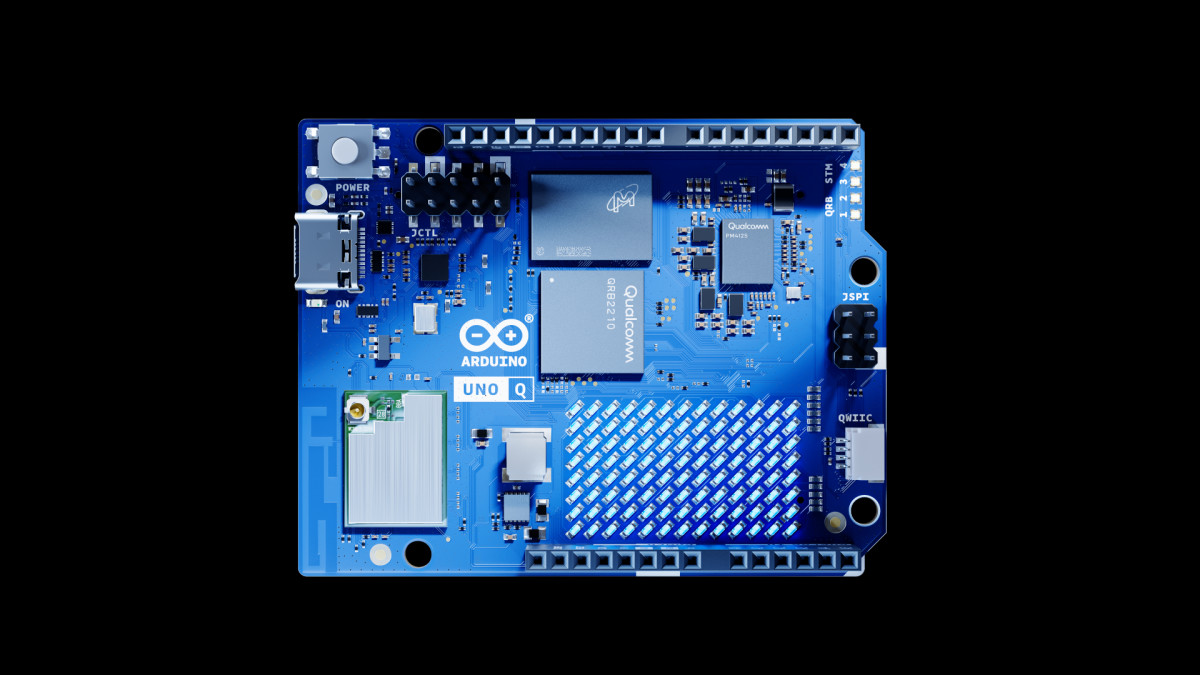 Qualcomm just acquired a maker of development boards.
Image source: Qualcomm/Arduino
Qualcomm to acquire Arduino
Qualcomm (QCOM) is in the process of acquiring Arduino, and the companies have been working for nearly a year on a very special project.
For the uninitiated, Arduino is a maker of development boards with a commitment to open-source solutions.
Compared to some other options on the market, its integrated development environment makes programming these boards easier for beginners. The company also has a strong focus on education, offering a range of courses.
Related: Analysts revamp Marvell stock price forecast on CEO comments
This acquisition will provide Arduino with access to powerful Qualcomm chips, as well as additional resources to support its vision and goals.
What makes this deal surprising is that Arduino has so far been focused on microcontrollers, and hasn’t been attached to any particular chip vendor.
Arduino customers will be relieved to know that Qualcomm confirmed Arduino will continue to have complete freedom regarding what microcontroller/CPUs it uses in its products. This means it will continue to support non-Qualcomm chips.
For Qualcomm, this acquisition represents a way to penetrate deeper into the embedded and IoT markets, as Arduino already has a huge community of developers that loves their software and their boards.
Qualcomm and Arduino launch UNO Q board
The companies are launching a new Arduino board, UNO Q. The board is equipped with a Qualcomm Dragonwing QRB2210 processor and a real-time STM32U585 microcontroller, enabling advanced computing with precise control.
Dragonwing will also be available as a standalone chip, like other Qualcomm chips.
As this chip has an Adreno GPU, the board is capable of video output.
But video output is a minor thing compared to its ability to run AI models. The board can be used for robotics, as it offers machine vision, sound recognition, and real-time responsiveness.
It will come in two versions: a base version with 2GB of RAM and 16GB of eMMC storage, and a version with 4GB of RAM and 32GB of eMMC storage, both featuring a USB Type-C port, WiFi, and Bluetooth.
Related: 47-year-old tech stock gets new price target on AI demand
Arduino is also releasing a new Arduino App Lab, a new integrated development environment made to consolidate the Arduino development across real-time OS, Linux, Python, and AI to make development faster and easier.
This new software, coupled with the UNO Q board, will open up a vast array of possibilities for inventors to create, the primary limiting factor being imagination.
It is important to note that the acquisition is still pending legal approval, which is typical for all acquisitions.
Qualcomm advances autonomous driving
“At the IAA Mobility event, the company showed off the Snapdragon Ride Pilot, co-developed with BMW, which makes its debut in the new iX3,” writes Moz Farooque for TheStreet.
“The system’s cutting-edge, to say the least, bringing hands-free, eyes-on autonomy up to 85 mph. Additionally, the technology efficiently handles lane changes, parking, and even some urban scenarios.”
More AI Stocks:
- The stock market laughed, then Palantir redefined the fight
- Goldman Sachs tweaks Nvidia’s stock price target with a twist
- Jeff Bezos sends blunt message on AI bubble
Snapdragon Ride Pilot has been validated in over 60 countries and is open to other automakers, not just BMW. It supports advanced driving levels ranging from the entry-level New Car Assessment Program to Level 2+ highway and urban navigation on autopilot capabilities.
Qualcomm also recently unveiled its Snapdragon X2 Elite Extreme and Snapdragon X2 Elite, with 80 TOPS of AI processing power for Windows PCs. Devices powered by the Snapdragon X2 Elite are expected to be available in the first half of 2026.