
T-Mobile (TMUS) appears to be rapidly planning drastic changes that will impact customers as it prepares for the upcoming takeover of its new CEO, Srini Gopalan, who is currently the company’s chief operating officer.
Gopalan will officially replace Mike Sievert as CEO on Nov. 1, while Sievert moves on to the newly created position of vice chair. As this major change looms, several leaked documents recently revealed that T-Mobile is contemplating bold policy changes.
One document indicated that T-Mobile is reportedly planning to make customers 100% dependent on its T-Life app to handle upgrades, new lines, account activations, etc., by January 2026.
Another showed that starting sometime this month, the phone carrier plans to start accepting damaged or broken devices as trade-ins for promos, but for a lower value compared to undamaged ones.
Last week, T-Mobile even updated its website to warn customers who don’t pay their bills on time that, starting Nov. 1, its late fee will increase from $7 to $10 (or 5% of the past due balance; T-Mobile will pick whichever is higher).
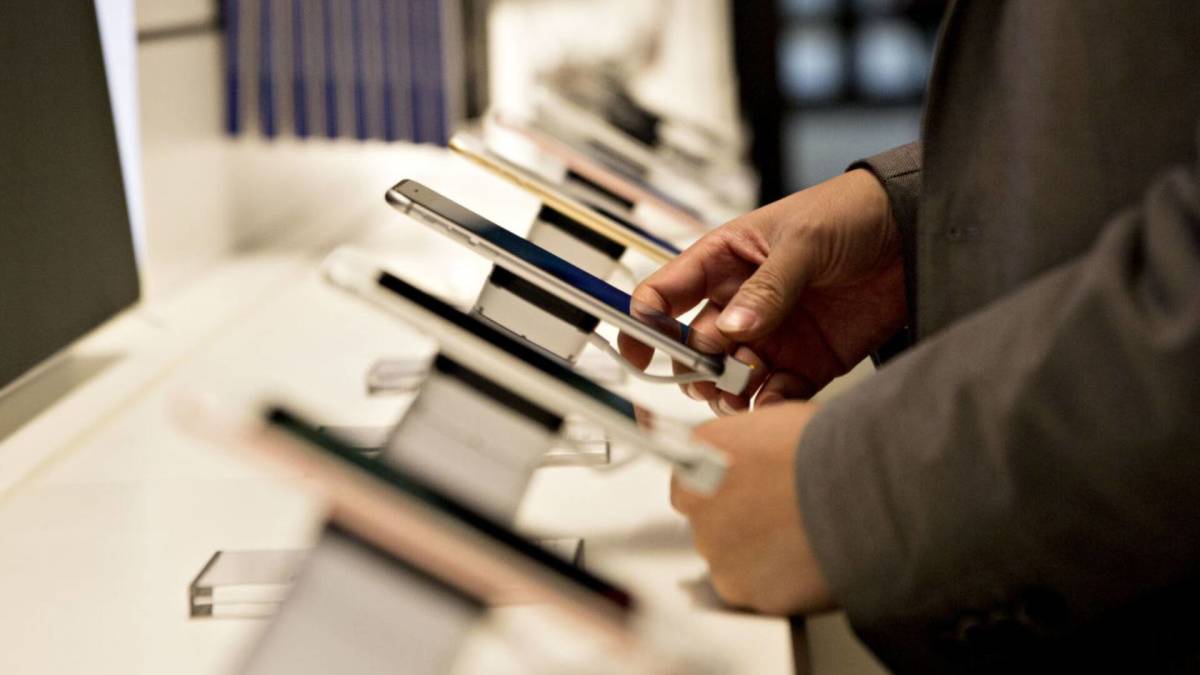 A shopper looks over a display of Apple Inc. iPhones at a T-Mobile U.S. store.
Image source: Bloomberg/Getty Images
T-Mobile plans a drastic network change that will impact customers
Now, T-Mobile customers should brace themselves for another major change. A new leaked document has revealed that the phone carrier is getting ready to phase out its LTE service (also known as 4G network), according to a recent report from The Mobile Report.
The document states that over the next two-plus years, T-Mobile will reframe LTE into 5G. It will retain a small channel of LTE across the nation until 2035 to support legacy devices such as smartwatches, car infotainment systems, and security systems.
For customers, this means that by roughly 2028, LTE-only devices will have extremely weak network performance. By 2035, T-Mobile’s remaining LTE channel will be eradicated, meaning those devices will no longer be supported.
Related: T-Mobile plans a harsh change for customers after new CEO starts
The change shouldn’t impact customers who purchased phones after 2019, since that is when the first 5G phone was released. Most phones that are sold today are compatible with 5G.
However, the change will negatively impact devices such as the Samsung Galaxy S10 5G and the LG V50 ThinQ, since both devices require an LTE and 5G signal to work. Also, customers with flip phones should upgrade soon, because most of those devices only support LTE.
T-Mobile’s decision to phase out LTE appears to be its way of preparing for the upcoming transition to 6G, which is expected to be finalized in 2029 and introduced by 2030.
T-Mobile’s 5G home internet service is seeing higher demand
The move from T-Mobile also comes during a time when its 5G home internet service is booming in popularity.
In its second-quarter earnings report for 2025, T-Mobile revealed that it added roughly 454,000 high-speed internet customers during the quarter, which is 12% higher than the number it welcomed during the same time period last year.
More Telecom News:
- DirecTV customers threaten to leave after latest warning
- T-Mobile suffers massive boycott from customers
- Verizon quietly backtracks on harsh change that angered customers
T-Mobile ended the quarter with 7.3 million high-speed internet customers.
According to a State of Consumer Trust Survey 2025 by Reviews.org, many consumers are exploring 5G internet service, also known as fixed wireless internet, as a more affordable alternative to traditional internet service.
“Although 5G home internet technically isn’t faster than cable or fiber internet, it offers a lot of value,” said Peter Holslin, managing editor at Reviews.org, in the survey. “5G internet packages are typically sold at fixed rates, with no extra fees for installation or equipment, and you often get other perks too like unlimited data and bundle discounts when you pair it with a cell phone plan from the same provider.
“Setup is easier because you don’t need to run any cable or wiring through your house, and usually customers can get solid speeds to cover common needs like streaming TV, online gaming, and making video calls,” Holslin added.
Related: Verizon angers customers with new tactic to boost loyalty