
When Nvidia (NVDA) CEO Jensen Huang speaks, Wall Street listens.
However, his latest prediction is a lot more unnerving than most, turning heads in both Washington and Silicon Valley.
In an interview with the Financial Times, Huang said China is likely to win the race to dominate AI.
He attributed China’s long-term success to the country’s lower energy costs, along with a more flexible regulatory environment. It’s a startling prediction, coming from a man whose company effectively fuels much of the world’s AI boom.
Additionally, his fortunes have been directly shaped by U.S. export restrictions aimed at slowing China’s growth.
Needless to say, Huang’s recent comments are a stark contrast to the typical narrative of American tech supremacy, even as red tape and “cynicism” in the West continue to hinder innovation.
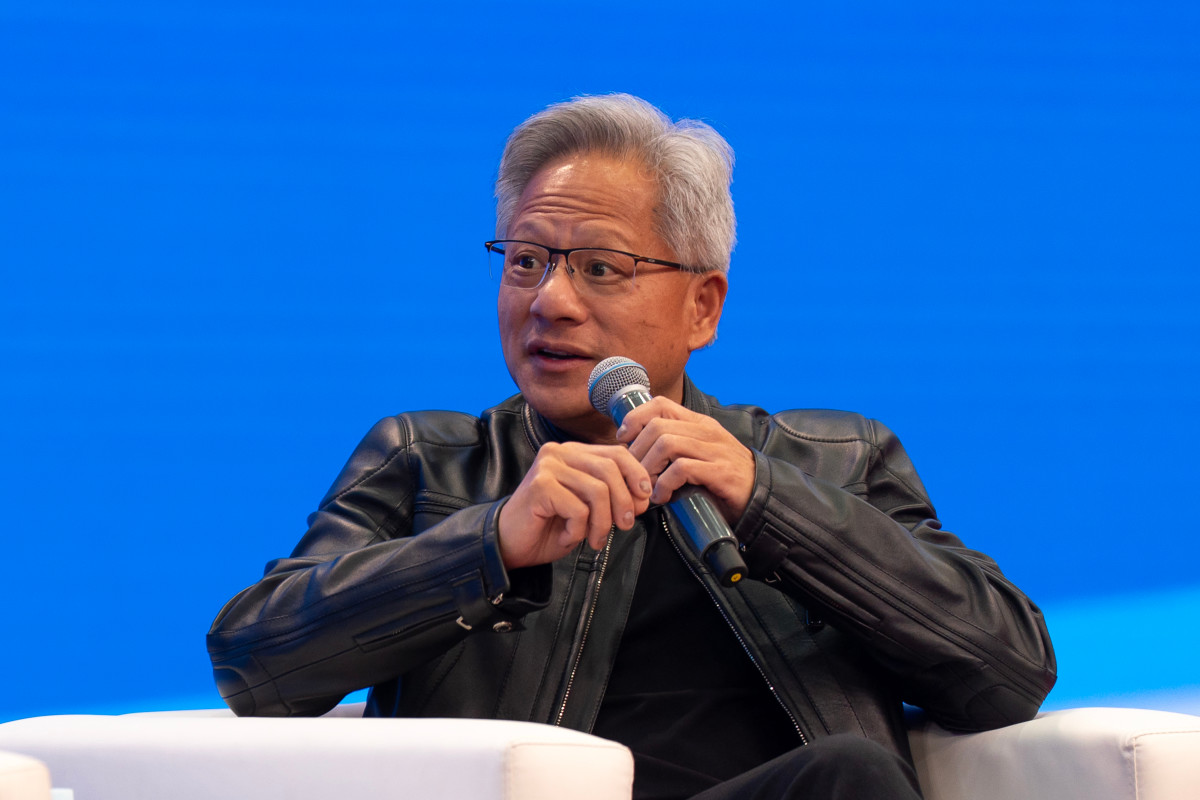 Nvidia CEO Jensen Huang, speaking at the FT Future of AI Summit, said China will surpass the U.S. in the AI race.
Nvidia CEO bets on China’s momentum
“China will ‘win’ the AI race,” Huang says, and it’s far from the geopolitical jab that some would interpret.
In his telling, the critical advantage depends on whoever can spin up data centers more quickly and cheaply. Naturally, that’s dependent on permissive rules, lower energy costs, and fewer stop signs.
More Nvidia:
- Nvidia makes a major push for quantum computing
- Nvidia’s next big thing could be flying cars
- Bank of America revamps Nvidia stock price after meeting with CFO
Huang’s never been one to shy away from contrarian takes.
He declared that “Moore’s Law is dead,” in arguing that “everyone is a programmer now,” later quipping that “the new programming language is called human.”
Related: Microsoft CEO drops blunt truth on AI
Nevertheless, he feels the West’s “cynicism” is effectively a drag on AI deployment, complicated by a patchwork of state-level mandates.
Strip away ideology and focus purely on the metrics, and China currently outpaces the United States in AI domination.
China plays offense while the U.S. stalls
Strip away all the sound bites, and it boils down to the stuff virtually every investor understands: inputs, outputs, and friction. Here’s where the gap gets real:
- Power is cheaper and subsidized: China’s industrial electricity averaged about $0.088/kWh (2024); several provinces are now cutting big data-center power bills by up to 50%. On the flip side, U.S. industrial users are paying 9.06¢/kWh in Aug. 2025 (8.57¢ YTD).
- Centralized build-out, efficiency targets: Beijing’s “East Data, West Computing” efficiently funnels money into pre-zoned hubs ($6.1 billion invested by mid-2024).
- U.S. grid costs are spiking where AI is hottest. In PJM (Mid-Atlantic), capacity auction prices surged to $329/MW-day, nearly a 10× surge, with analysts warning of 30% to 60% retail rate jumps by 2030.
- Patchwork compliance equals friction. There’s no U.S. federal privacy law; instead, there’s a 20-state (and growing) list of rules, along with local AI mandates.
- Slow hookups, local pauses: An analysis from Lawrence Berkeley National Laboratory showed that getting new power online takes time, with U.S. interconnection wait times now at a median of five years (2023 data).
Nvidia’s tightrope: Politics, profits, and policy
Huang knows exactly where the chips are being made and where the market’s growing, which is why the tech behemoth continues threading the needle between Washington’s rules and China’s demand.
In the most recent financial snapshot, China still accounted for roughly 12.5% of Nvidia’s revenue, a bite big enough that any political roadblock shows up in the numbers.
Related: Goldman Sachs offers subtle twist on AMD stock post-earnings
Before the ban, executives and analysts often pegged China’s contribution even higher, at roughly 20% to 25% of data-center sales.
Huang hasn’t exactly been subtle about the stake, saying the U.S. can’t afford to cede China’s colossal developer base, and voicing hope to sell Blackwell chips there someday. It’s essentially a balancing act, where the goal is to protect crown-jewel tech, while keeping America’s lead intact.
Key moments in the Nvidia-China policy timeline
- Oct. 7, 2022: U.S. issues sweeping export curbs in constricting advanced GPUs (A100/H100) to China.
- Oct. 17, 2023: BIS tightens rules, closing A800/H800 workarounds, after which Nvidia unveils H20/L20/L2 for China.
- July 15-16, 2025: Washington green-lights H20 sales to resume; Chinese buyers scramble.
- July 29, 2025:Reuters reports a surge in H2O orders, linked to broader U.S.-China trade talks on rare earths.
- Oct.-Nov., 2025: Huang says he hopes to sell Blackwell to China; White House says not now for top-tier Blackwell.
Related: Cathie Wood sells another $7.69 million in a trendy stock