
- The chain is walking back a major investment that will cost it $2.6 billion.
- It has already shared plans to close dozens of stores.
- New partners will be filling some of the void.
Usually, a company automates in order to save money.
Robots may come with a huge upfront investment, but they theoretically lower costs in the long run. And while they may break down and require maintenance, they don’t need coffee breaks, take holidays off, or call in sick.
Using fewer people seems to be something most retailers want, but implementation has been a challenge.
“Automation isn’t a magic wand that can fix all issues. If automation initiatives try to automate workflows that are not currently working properly or undergoing change, the writing is on the wall. This is not only a waste of time and effort; it causes additional problems,” Retail TouchPoints shared.
In many cases, automation simply does not deliver the desired result.
“Business automation projects have a 33% complete failure rate, with another 40% delivering significantly less ROI than projected,” according to a study from eMasterLabs.com.
Now, Kroger, which has invested heavily in automating its e-commerce business, has pulled back from those efforts, claiming it will save money.
Kroger closing three automated warehouses
Kroger will close three robotic delivery warehouses in Florida, Maryland, and Wisconsin. The company plans to move orders from those locations to its stores and will use Instacart, DoorDash, and Uber Eats to reach customers in as little as 30 minutes.
“Kroger expects these updates to have a positive effect to eCommerce operating profit of approximately $400 million in 2026,” the company shared in a press release.
The move will force the company to take a $2.6 billion write-off in its third quarter.
Kroger did not provide a lot of detail, but said its automated fulfillment network was not meeting financial expectations. It does not expect to lose any sales based on the changes.
Kroger is not abandoning automation.
“In geographies where Kroger sees a higher density of demand, the company will continue to take advantage of automated customer fulfillment to increase customer engagement, capacity, and improve productivity and profitability,” it shared.
More Retail:
- Trump’s tariff cuts may make popular luxury items cheaper
- Google makes holiday shopping easier than ever
- Major retailers have jacked up prices due to tariffs
- US shoppers give retailers an early holiday present
The chain does still plan to invest in automation, but will be more selective.
“As part of its comprehensive hybrid fulfillment network, Kroger will also pilot capital-light, store-based automation in high-volume geographies to improve fulfillment capabilities and elevate the in-store customer experience,” the company added.
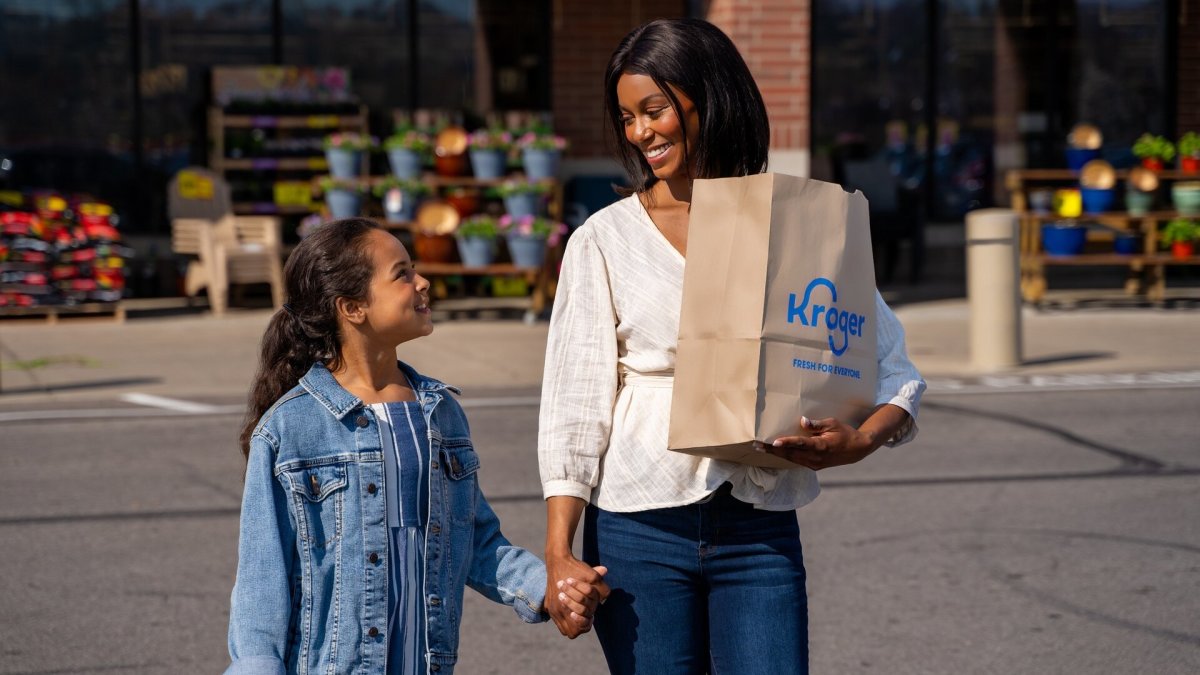 Kroger’s changes won’t impact in-store shopping.
Kroger
Timeline of Kroger’s automated warehouse (e-commerce) facilities:
- May 2018: Kroger enters a partnership with Ocado to build 20 automated Customer Fulfillment Centers (CFCs) in the U.S. Source: Food Logistics
- Nov 2018: Kroger and Ocado confirm two additional automated “sheds” (CFCs) to expand capacity. Source: Kroger Investor Relations
- March 2021: Kroger opens its first automated Ocado-powered CFC in Monroe, Ohio (335,000 sq. ft.). Source: Warehouse Automation
- June 2021: Kroger brings online a second CFC in Groveland, Florida, and a third in Forest Park, Georgia. Source: Warehouse Automation
- June 2021: Kroger opens a 340,000-square-foot CFC in Pleasant Prairie, Wisconsin. Source: Warehouse Automation
- 2022: Kroger expands its fulfillment network to three new U.S. cities, adding more automated capacity. Source: Kroger Investor Relations
- March 2024: Kroger shuts down three spoke cross-dock facilities (part of its e-commerce hub-and-spoke network) in Austin, San Antonio, and South Florida. Source: Supply Chain Dive
- Kroger will close automated centers in Florida, Maryland, and Wisconsin in January.
The company expects the changes will add $400 million per year to its bottom line.
“This will be used to improve the customer experience through lower prices and better store conditions while also improving operating margins,” it shared in the press release.
Earlier this year, Kroger shared plans to close 60 grocery stores over 18 months.
Kroger had already scaled back automation
Interim CEO Ron Sargent made it clear during Kroger’s second-quarter earnings call that automation was not delivering the desired results in every case.
“We’re examining all aspects of our business to drive greater efficiency, including a full site-by-site analysis of our Kroger automated fulfillment network. Where we have seen strong demand in high-density areas, these facilities deliver better results than those facilities where density is lower, and customer adoption has been slower,” he said.
Sargent made it clear that nothing was off the table as he reviewed the company, and it’s worth noting that Kroger has only opened eight of the 20 planned automated facilities.
“We continue to evaluate all options across all facilities to improve profitability while continuing to provide a great customer experience,” he added.
Barclays analysts who listened to the call noted Sargent’s less bullish stance on automation.
“We thought the tone on [automated warehouse] investment was cautious, with more focus seemingly on using existing store footprint,” Reuters reported.
Kroger had been ahead of the curve
While Amazon has invested heavily in automation, most grocery chains have not.
“An assessment of available automation technologies shows that they can already operate a typical retail grocery store with up to 55 to 65% fewer hours. The critical components include electronic shelf-edge labels, self-checkout terminals, shelf-scanning robots, and partially automated backroom unloading. These technologies have been proven at scale and offer internal rates of return higher than historical retail hurdle rates — yet few retailers are moving quickly to implementation,” according to a McKinsey study.
Retailers do see these problems. Simbe and Coresight Research teamed up to survey 150 retail decision-makers across the U.S. to assess industry pain points and technology adoption. That study, “The State of In-Store Retailing: Opportunities To Redefine Operations,” contained the following insights.
- Everyday operational challenges remain widespread across retail. An overwhelming number of retailers report significant challenges with core business functions, including managing out-of-stocks (92%), executing price and promotions (96%), planogram compliance (93%), and assortment planning (93%).
- Retailers report in-store inefficiencies costing at least 4.5% revenue. Over 70% of respondents lost at least 5% operating margin in each area of out-of-stocks, price and promotion execution, planogram compliance, and allocation and assortment planning. On average, retailers lost 4.5% of revenue to these inefficiencies. Addressing these issues would drive an additional revenue opportunity for retailers of $127.9 billion in 2024, growing to $143.3 billion in 2027, Coresight Research estimates.
- Misexecuted promotional campaigns are the most challenging in-store inefficiencies. The majority of respondents have seen high mispricing rates (75%) and improperly executed promotional campaigns (81%), and nearly one in five retailers report a mispricing rate of more than 15%.