
The stock market is retreating amid rising concerns that the Federal Reserve is trapped by its dual mandate, the S&P 500’s valuation has become too high, and the AI frenzy is overblown, resetting investor expectations for that technology.
Recent data show that a slowdown in the jobs market is underway and tariff costs are being passed along to consumers in the form of higher prices. The potential for cash-strapped customers to retrench, pushing the US economy into stagflation, casts a shadow over stocks, as expectations for revenue and profit growth drive the valuation of stock prices.
Since April’s low, stock market pullbacks like the one we’re witnessing in the S&P 500 and Nasdaq Composite, which are down about 3.4% and 4.4% respectively over the past five trading days, have led risk-tolerant investors to “buy the dip.”
Annual S&P 500 returns since 2020:
- 2025: 12.5% (ytd)
- 2024: 23.3%
- 2023: 24.2%
- 2022: -19.44%
- 2021: 26.9%
- 2020: 16.3% Source: MacroTrends.
The possibility that investors engage in bargain hunting has caught Wall Street’s attention, prompting questions for market veterans like Goldman Sachs President John Waldron, about what could happen next.
At the New Economy Forum 2025 in Singapore, Waldron was asked about the recent selloff. He has been navigating markets at Goldman Sachs for more than 25 years, starting his tenure there in investment banking services. Today, Waldron serves as president and chief operating officer of the esteemed 156-year-old investment bank, providing him with valuable insight into the markets.
Given Waldron’s extensive experience, it might be worthwhile to consider his perspective on the current state of the stock market.
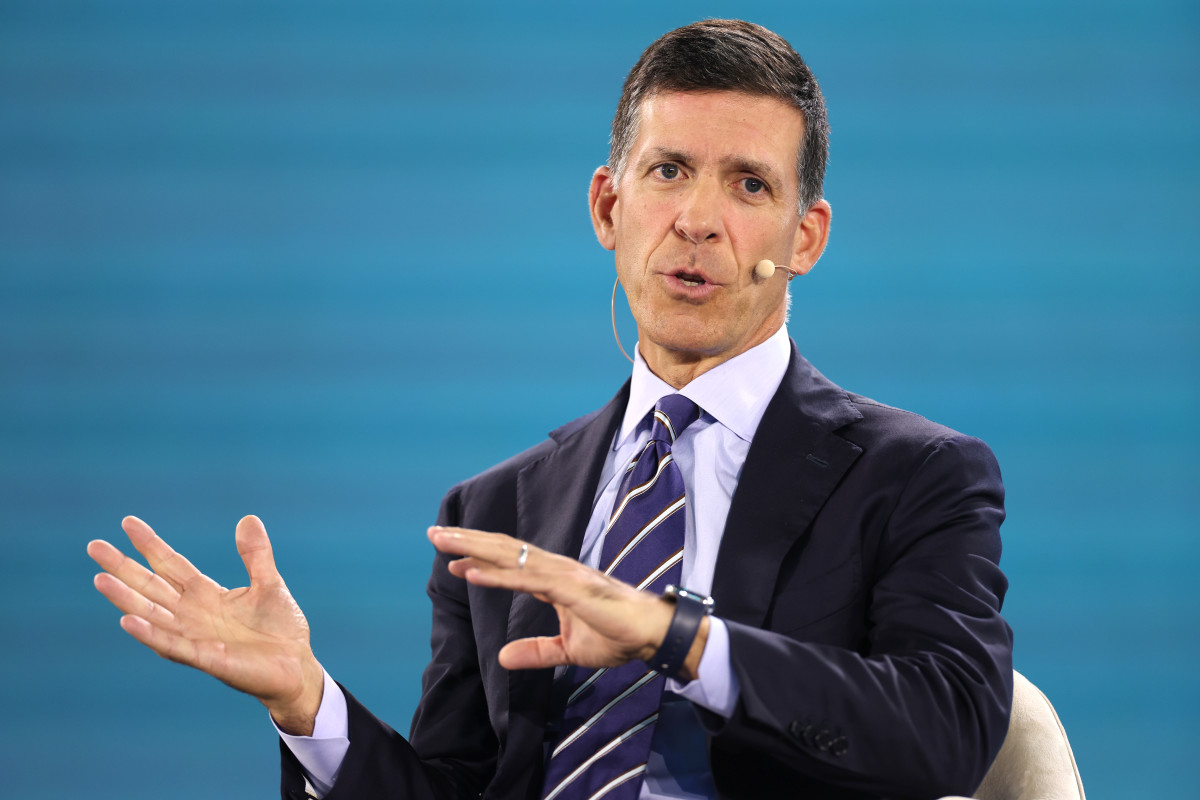 Goldman Sachs’s John Waldron weighed in on the recent stock market drop.
Photo by Bloomberg on Getty Images
Stocks struggle as Fed risks falling behind the curve
The S&P 500 and Nasdaq Composite have delivered impressive gains since they bottomed on April 9, when President Trump paused most reciprocal tariffs to allow for trade negotiations.
The benchmark S&P 500 and tech-heavy Nasdaq returned 38% and 57% from the April low to their recent peak in October, due mainly to hopes that tariffs would settle at lower rates than feared, and amid surging AI spending and optimism that the Fed would have plenty of time to cut rates to prevent stagflation. That’s a period of both slow economic growth and higher inflation, or worse, a recession.
More Wall Street:
- Stanley Druckenmiller’s latest buys suggest shifting tech trend
- Goldman Sachs unveils stock market forecast through 2035
- Dalio’s Bridgewater quietly reshapes its portfolio amid bubble warnings
- Peter Thiel dumps top AI stock, stirring bubble fears
The Federal Reserve is governed by a dual mandate to target low inflation and unemployment, two often contrary goals that can cause the central bank to fall behind the curve when it comes to shifting its monetary policy.
For example, increasing interest rates slows economic activity, lowering inflation. But it also leads to layoffs, which we’re currently experiencing.
After incorrectly stating in 2021 that inflation would be transitory, Fed Chairman Jerome Powell eventually implemented the most restrictive and hawkish interest rate hikes since then-Fed Chairman Paul Volcker fought back inflation in the early 1980s.
Those moves have caused inflation to retreat from its 8% peak in 2022, but they’ve also slowed the jobs market. Fewer jobs are being added to the economy this year, according to ADP, and year-to-date, layoffs have totaled about 1.1 million workers, according to Challenger, Gray & Christmas, up 65% from the year-earlier period. As a result, the Bureau of Labor Statistics’ unemployment rate has risen to 4.3% from a low of 3.4% in 2023.
According to a study by Resume.org, four out of 10 companies laid off workers in 2025, and 60% expect to cut workers in 2026.
Related: Next Fed interest-rate cut could slide into 2026
The Fed cut rates by 1 percentage point in the final months of 2024 to shore up the job market, but Trump’s tariff plans forced it to the sidelines over fears that more cuts would fuel inflation, even as tariff-related price hikes hit consumers.
As a result, the job market has continued to worsen, leading the Fed to finally acquiesce and cut its benchmark Federal Funds Rate by a quarter percentage point in September and October. That’s even as the Consumer Price Index rose to 3% in September from 2.3% in April, before most tariffs were enacted.
What happens next to the economy is uncertain, but increasing unemployment and rebounding inflation isn’t a great recipe. As a result, consumer confidence has collapsed. The University of Michigan’s Survey of Consumers Index fell to its second-lowest level since 1978 in November.
Goldman Sachs’s Waldron delivers blunt take on stock drop
John Waldron’s longtime presence on Wall Street means he has seen many market pops and drops, including the internet bust, the Great Recession, Covid-19 and the 2002 bear market.
In short, Waldron has been there, done that, making his take on market pullback worth considering. Asked by Bloomberg whether stocks could retreat further, he said:
Waldron says the pullback is healthy because stocks have “run quite a bit this year,” suggesting that some froth needs to come out of the market.
Fund managers’ optimism has skyrocketed, as they reported the lowest cash on the sidelines — 3.7% — in recent memory, according to Bank of America’s latest Fund Manager Survey, shared with TheStreet.
Buying the dip in the S&P 500 has been effective since April, but the pain that portfolios experience while stocks find their bottom can be hard to withstand. It can take years to recover losses, so investors are justified in being cautious.
Related: Bank of America raises alarm on worker pay
“Cash levels of 3.7% or lower has occurred 20 times since 2002, and on every occasion stocks fell and Treasuries outperformed in the following 1 to 3 months,” noted Bank of America analysts.
The S&P 500’s rally has been underpinned by earnings growth, so there’s little evidence that consumer behavior is yet taking a toll on bottom lines. Still, investors might want to wait for the turn rather than try to catch the absolute bottom.
That’s particularly true for AI stocks and the Magnificent 7, a collection of technology stocks that has seen valuation measures surge this year in ways that hark back to the internet boom or to the early 1970s. That was when the “Nifty 50,” a collection of 50 leading stocks, became regarded as “one decision” stocks: buy. Money was concentrated within them to pocket seemingly never-ending gains, setting up a significant market drop after they peaked in 1972.
What will happen next is a bit unclear. Powell said that a December interest rate cut might not be on the table, suggesting the risk of a yet-again sidelined Fed even as consumers struggle.
“The technicals are kinda more biased for more protection and more downside,” said Waldron. “I think there’s probably a bit more bias to the negative.”
The good news? Waldron doesn’t necessarily think we’re on the cusp of a reckoning.
“I don’t know that it will be that much more pronounced from here.”
Related: Goldman Sachs revisits gold price forecast for 2026