
A three-team race appears to be developing at the top of the autonomous vehicle market.
Tesla Robotaxi, Amazon’s Zoox, and Alphabet’s Waymo have all made headlines recently as each attempts to top the rest.
In July, Zoox cut the ribbon on a new serial production facility for purpose-built U.S. robotaxis in Hayward, California, near Silicon Valley.
“Zoox’s Hayward, the CA facility, is 220,000 square feet (~3.5 American football fields) and, at full scale, has the capacity to assemble more than 10,000 robotaxis per year,” Morgan Stanley analyst Bran Nowak, who has seen the facility, says.
Meanwhile, Tesla CEO Elon Musk has made autonomous driving one of the key pillars of the company’s future. “I think we will probably have autonomous ride-hailing in probably half the population of the U.S. by the end of the year,” Musk said during the opening remarks of Tesla’s second-quarter earnings call.
This week, Tesla received approval to operate a ride-hailing service in Arizona. Tesla Robotaxi now has approval to operate in Austin, the San Francisco Bay Area, and Arizona.
So now it’s Waymo’s turn to one-up Tesla, and on Nov. 20, the Alphabet subsidiary announced that it is expanding to several cities.
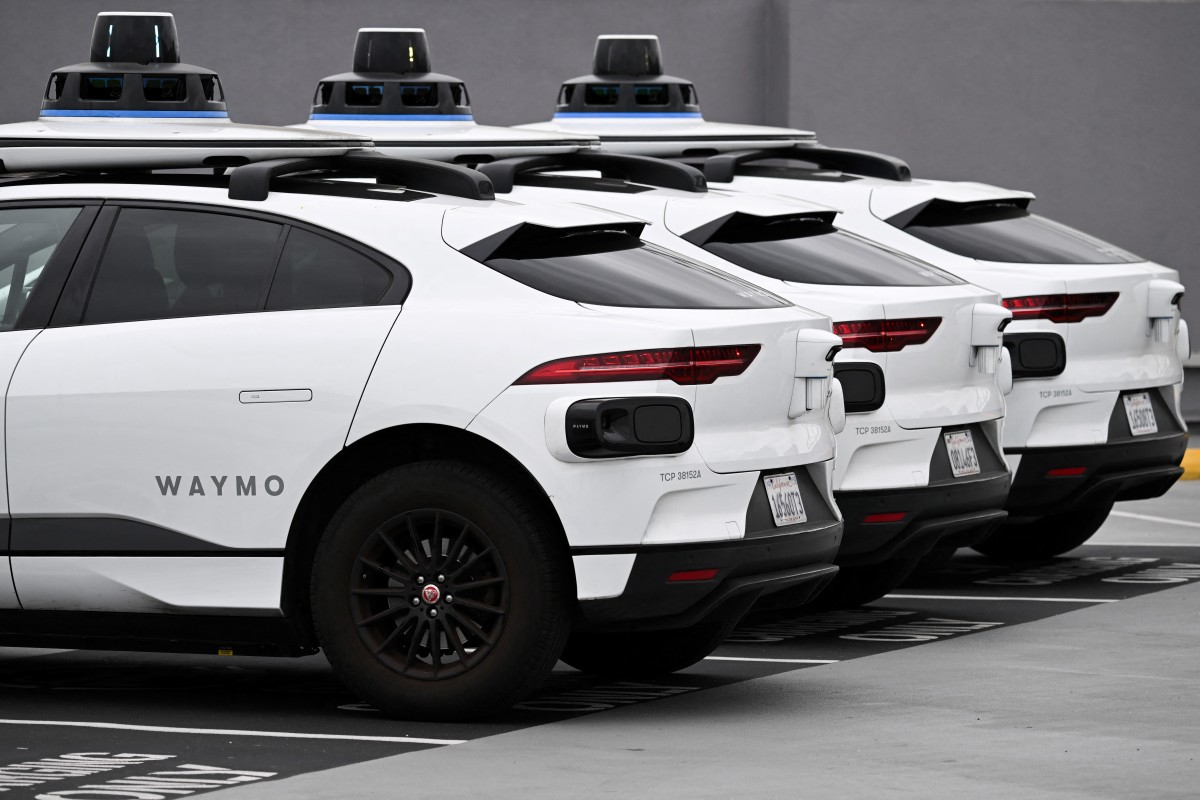 Waymo has a fleet of at least 1,500 AVs on the road today, with plans to add 2,000 more in 2026.
Photo by PATRICK T. FALLON on Getty Images
Waymo expands to Minneapolis, Tampa, and New Orleans
Earlier this month, Waymo announced plans to expand to San Diego, Detroit, and Las Vegas in the coming months.
The company says it will begin operations in San Diego next year, in Detroit “soon,” and in Las Vegas next summer.
On Nov. 20, the company announced plans to expand to three more cities.
Waymo quick facts:
- Founded in 2009.
- Passed the first U.S. state self-driving test in Las Vegas, Nevada, in 2012. Source: IEEE Spectrum
- Spun out from Alphabet as a separate subsidiary in 2016.
- As of July 2025, Google indicates that Waymo One is available 24/7 to customers in Los Angeles, Phoenix, and the San Francisco Bay Area.
- The current Waymo fleet features over 1,500 vehicles. By 2026, the company expects to add 2,000 more.
- Surpassed 100 million miles of autonomous driving in July 2025.
Related: Waymo makes huge announcement about these 3 cities
Waymo announced plans to expand operations to Minneapolis, Tampa, and New Orleans as it ramps up its reach in the U.S.
The company will launch in the new markets with human-driven vehicles as it follows the playbook it uses every time it expands to a new city. Waymo typically begins with detailed mapping and data collection, followed by supervised autonomous testing, then restricted public access, and finally, fully driverless rides.
Waymo is the only autonomous vehicle operator in the U.S. that offers rides with no safety drivers or in-vehicle attendants.
Robotaxis in Austin must have a safety monitor in the front passenger seat, while San Francisco requires one to be in the driver’s seat during trips.
Waymo began operating fully autonomous vehicles in Miami on Nov. 18 and said it will begin operations in Dallas, Houston, San Antonio, and Orlando “over the coming weeks, ahead of opening our doors to riders next year.”
Waymo continues to outpace its rivals
Waymo has been testing its autonomous vehicles on U.S. roads since 2012, so it has had more time to develop than its rivals.
While Tesla has the advantage of having millions of vehicles on the road to potentially train its AI, Waymo relies on a much smaller fleet of about 1,500 vehicles.
Related: Amazon’s Zoox makes a move on Tesla Robotaxi territory
Waymo was founded in 2009, and by 2012, it had passed the first U.S. state self-driving test in Las Vegas, Nevada, IEEE Spectrum reported.
As of July 2025, Waymo One is available 24/7 to customers in Los Angeles, Phoenix, and the San Francisco Bay Area. Waymo partners with Uber in Austin and Atlanta. The company recently announced plans to expand into other cities such as Boston and Seattle.
Waymo says it has “regularly tested in Detroit during winter weather to develop our capabilities in snow and ice. We’ve made great strides in our efforts to operate in heavier snow — including testing in Michigan’s Upper Peninsula — and look forward to the 6th generation Waymo Driver navigating Detroit streets this winter.”
As it is “returning” to Las Vegas, Waymo points out that Nevada is the sixth-most dangerous state for driving, and Las Vegas accounts for 43% of the state’s car crashes.
Waymo safety issue prompts NHTSA probe
Earlier this year, Tesla Robotaxi took some heat after a video surfaced of an autonomous Tesla ignoring a school bus stop sign, speeding past the vehicle, and hitting a child dummy in a simulated test.
Now NHTSA is probing Waymo for a similar issue.
NHTSA opened a Preliminary Evaluation to investigate an estimated 2,000 Waymo 5th-gen automated driving system-equipped vehicles.
The agency is investigating “traffic safety violations relating to stopping when encountering a school bus, particularly when the bus is boarding or offboarding students.”
The investigation arose following a media report that showed the vehicle failed to remain stopped when approaching a school bus that was stopped with its red lights flashing and stop arm deployed.
NHTSA’s notice explained what happened:
The notice also indicated: “During this maneuver, the Waymo AV passed the bus’s extended crossing control arm near disembarking students (on the bus’s right side) and passed the extended stop arm on the bus’s left side.”
No safety operator was in the vehicle at the time of the incident.
“Operations involving Waymo’s ADS currently accumulate approximately two million miles weekly. Based on NHTSA’s engagement with Waymo on this incident and the accumulation of operational miles, the likelihood of other prior similar incidents is high,” NHTSA said.