
Well, of course they called it “the Jetsons Act.”
Pennsylvania State Sen. Marty Flynn recently reintroduced Senate Bill 1077, which would create a new legal category of vehicles that can operate both on public roads as motor vehicles and in the air as aircraft.
The legislation is also known as the Jetsons Act after the 1962-63 animated series, which was set in a comical version of the future and featured robots, aliens and, yes, flying cars.
Humanity has been working on flying cars for more than a century, starting in 1917 with the Curtiss Autoplane, which is widely considered to be the first attempt at a roadable aircraft.
While the Autoplane was able to lift off the ground, it never achieved full flight. Still, people never gave up trying to get their wheels in the air.
Some 147 flying-car companies are out there, according to Tracxn, a market and investment tracker. On average, the past 10 years have seen nine new companies launched every year.
The electric vertical take-off and landing, or eVTOL, market could be valued $1 trillion by 2040, according to JPMorgan.
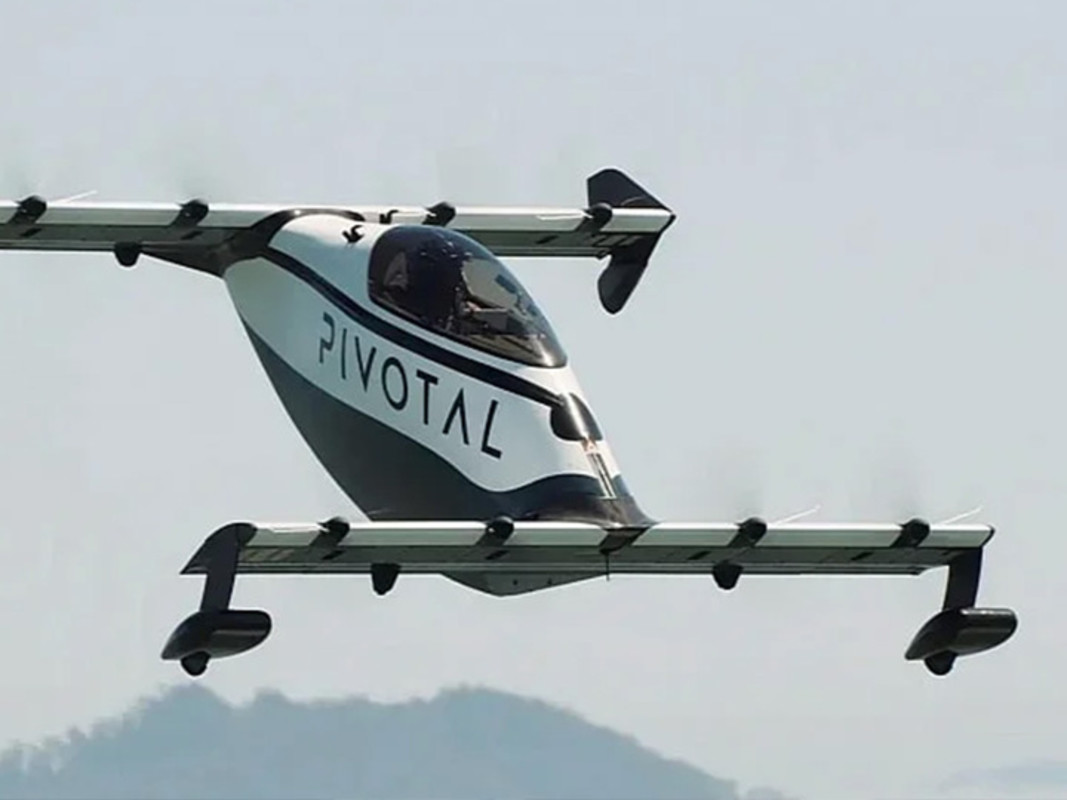
California startup Pivotal Aero recently completed a public flight test of its single-seat all-electric flying car.
Pivotal
Pivotal Aero recently completed a test flight of its electric flying car.
Companies working on flying vehicles
Priced around $190,000, the vehicle is aimed at individual owners rather than air-taxi fleets.No pilot’s license is needed, but federal regulations restrict flights to daylight hours and to noncongested areas.
More Tech Stocks
- Investors hope good news from Nvidia gives the rally more life
- Palantir CEO Karp just settled major debate
- Spotify just solved a major problem for listeners
- Amazon lawsuit could be a warning to other employers
In early November the Chinese electric-vehicle maker XPeng (XPEV) held its AI Day 2025, which included its latest lineup of “flying cars” under its Aridge brand, Electrek reported.
CEO He Xiaopeng noted that its products are more accurately described as low-altitude eVTOL aircraft, which are powered by electricity and can take off and land vertically like a helicopter.
The A868 uses an aerospace-grade hybrid system based on Xpeng’s Kunpeng Super Range platform, promising roughly 310 miles of range, a top speed of 224 mph, and a six-seat layout targeting business travelers.
Joby Aviation (JOBY) and Saudi Arabian civil aviation authorities unveiled plans to quickly deploy the company’s electric air taxi in the kingdom.
The company also signed an agreement with Saudi firms Red Sea Global and Helicopter Co. The deal calls for Joby to complete precommercial evaluation flights of its electric air taxi in the Middle Eastern nation in first-half 2026.
In September, Joby, Santa Cruz, Calif., unveiled a long-term collaboration with Ras Al Khaimah Transport Authority and Skyports Infrastructure to launch a passenger air taxi service network in the emirate by 2027.
“Saudi Arabia continues to lean in on the adoption of fast, clean and quiet air travel,” JoeBen Bevirt, founder and CEO of Joby Aviation, said in a statement.
After a potential passenger hails an aircraft by using either the Uber (UBER) app or Joby’s app, the aircraft will pick up and drop off as many as four passengers at specialized takeoff-and-landing points known as vertiports.
Four are planned for Dubai, including in the city’s Al Maktoum International Airport. Once passengers land, they will be taken to their destinations by car.
Aviation expert has doubts; the FAA speaks on the subject
Joby is also set to become Nvidia’s (NVDA) launch partner for IGX Thor, the chipmaker’s new Blackwell-based industrial AI platform.
Joby Aviation and other companies “are adopting IGX Thor to build and deploy advanced AI solutions that enhance safety, improve efficiency and enable new levels of automation in factories, warehouses and transportation systems,” Nvidia says.
Related: Nvidia’s next big thing could be flying cars
Not to be outdone, Tesla (TSLA) CEO Elon Musk has alluded to a Tesla Roadster that could perhaps fly using what he called some “crazy” technology with an unveil potentially by year-end.
In June, President Donald Trump signed three executive orders that the White House said in a statement would “accelerate domestic drone production.”
The orders created a pilot program to test flying cars for EMS, air taxis, cargo, and defense logistics, the White House said.
Robert Ditchey, a Los Angeles-based aviation expert, has some doubts about air taxis flying over America.
Ditchey told NBC that he didn’t think an air taxi service “was ever going to happen” in American cities because of both the volume of air traffic and the cost of running such a service.
A former U.S. Navy pilot who served as an executive on four American airlines, Ditchey explained that there was “a risk of collision in and around the airports that air taxis are flying from. The other thing is you have homes and houses and buildings and businesses.”
“They’re dangerous,” he said. “We have had helicopters fail and crash on top of buildings in Los Angeles. They’re dangerous not from a fire point of view but in terms of landing on top of people and buildings.”
The Federal Aviation Administration has said it completed updating its regulations to allow for aircraft in the powered-lift category to operate safely within the National Airspace System.
Last year, the agency issued its final rule for powered-lift operations that outlined pilot and instructor certification requirements as well as operational rules.
In defense of the flying-car effort, Joby CEO Bevirt says on the company’s website: “Absolutely everything that we do is grounded by our principal value of safety. We believe that new technology should be held to a higher standard than what has come before it.”
Related: Golden parachutes benefit executives, court controversy