
American voters had had enough after four years of consistent Covid-induced inflation, sweeping the Democratic Party out of the White House and out of control in the Senate in 2024.
The economy was the most important issue for voters heading into the November vote. According to an October 2024 Gallup poll, 52% of voters listed the economy as the most important issue out of 22 listed.
Another 38% listed the economy as “very important,” making it a significant factor for nine out of 10 voters.
Voters viewed then-candidate Donald Trump as better equipped to handle the economy, with 54% in favor compared to 45% for his rival Kamala Harris.
However, new polling cited by CNN indicates that Trump’s grip on economic issues has taken a significant hit in the minds of the public.
President Joe Biden’s administration was able to reduce inflation from 9.1% to 3% in June 2023, but the rate of increase has remained stubbornly static since then.
While inflation has significantly slowed since its 2022 peak, President Trump’s tariff-war economic strategy has arguably prolonged the pain.
Prices were still 3% higher in September 2025 than they were in September 2024, according to the Bureau of Labor Statistics.
Goods and services are more than 24% more expensive than they were before the Covid pandemic began in February 2020, according to Bankrate.
U.S. Department of the Treasury Secretary Scott Bessent went on NBC’s “Meet the Press” Sunday, Nov. 23 with a message for inflation-weary Americans and to defend the Trump administration’s economy ahead of the busy holiday retail season.
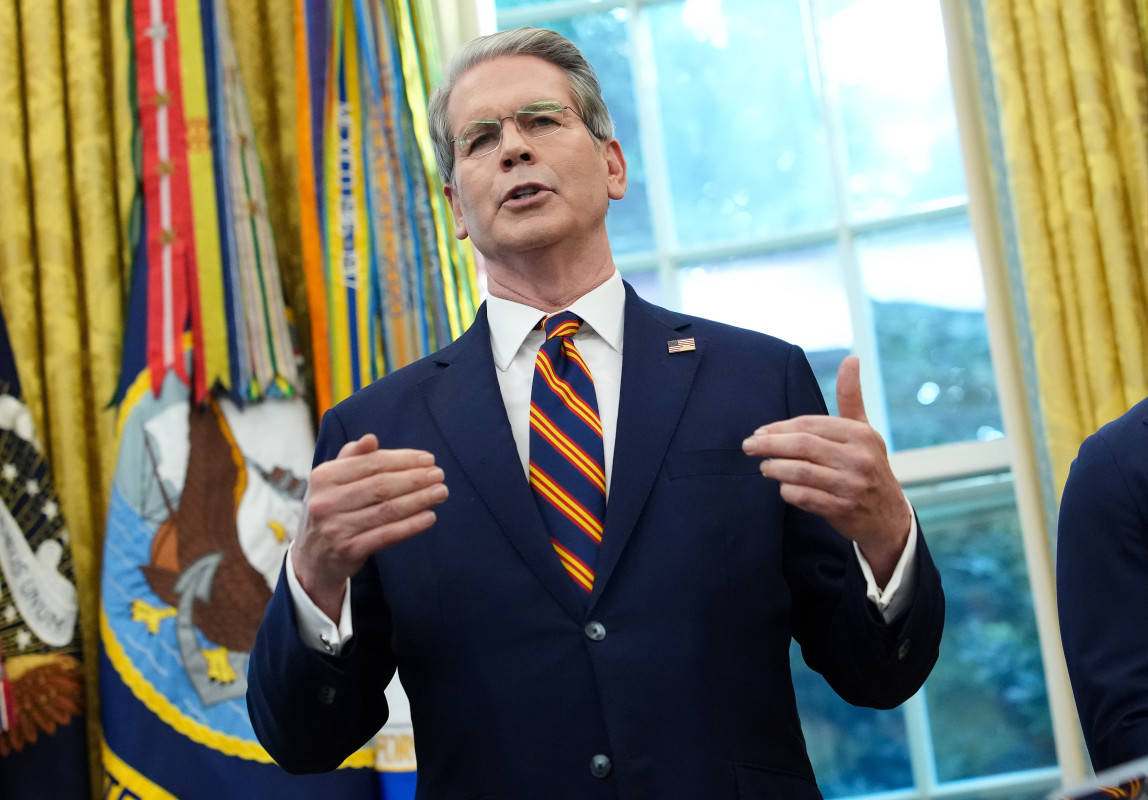 U.S. Treasury Secretary Scott Bessent continues to defend his tariff war in the face of stubborn inflation.
Photo by Kevin Dietsch on Getty Images
Scott Bessent defends president from U.S. inflation criticism
Last week, CNN reported, Vice President JD Vance told the friendly crowd at a Breitbart News event: “We get it and we hear you, and we know that there’s a lot of work to do. As much progress as we’ve made, it’s going to take a little time for Americans to feel that.”
Vance’s comments on the economy acknowledge a reality that the president has consistently denied in his own public remarks: Americans are still feeling the pain from tariffs.
Related: BofA sees consumer pain increasing from controversial economic policy
On Nov. 23, Secretary Bessent took a different tack.
“No, no, no, no, no. They weren’t. So inflation hasn’t gone up,” Bessent told host Kristen Welker, who asked him about rising prices on staples like coffee, bananas, and bacon.
One of the biggest criticisms of Biden’s economic policies was the administration’s seeming obliviousness to the hardships Americans were facing at the grocery store. Bessent promised not to repeat that mistake.
“The one thing that we’re not going to do is do what the Biden administration did and tell the American people they don’t know how they feel. They are traumatized and – over the Biden inflation,” Bessent said before immediately contradicting himself.
“We have slowed inflation.”
Welker reminded Bessent of the fact that the inflation rate was 2.4% in April, before Trump and Bessent announced their global tariff war, and was sitting at 3% in September.
Related: Scott Bessent’s net worth: Trump’s Treasury Secretary’s wealth in 2025
Instead of acknowledging this reality, Bessent turned inflation into a partisan political issue.
“Kristen, I can tell you that the Council of Economic Advisers has a study. You know the best way to bring your inflation rate down? Move from a blue state to a red state,” Bessent said. “Blue state inflation is half a percent higher. And that is because they don’t deregulate. They keep prices up. Energy is higher.”
How “blue state” inflation compares to “red state” inflation
While Bessent claims that President Trump, unlike his predecessor, operates in reality, his assertion that so-called red states have lower inflation isn’t backed up by government data.
California has the largest state economy in the U.S., with a 2024 GDP of about $4.1 trillion.
Related: Shocking September jobs report defies historical precedent
Californians pay an estimated $1,278 per month in additional costs compared to 2021, according to the Republican led Joint Economic Committee State Inflation Tracker. While this increase is on the high end of the spectrum, it isn’t the highest, and its cumulative inflation rate of 20.1% actually places it in the middle of the pack.
Meanwhile, in a heavily red state like Utah, citizens are paying $1,289 in additional costs a month, with a cumulative inflation rate that is 21.8% higher than prices were in 2021.
Big red economic centers such as Texas, Florida, Arizona, Tennessee, and Nevada all have higher cumulative inflation rates than does California. Lower-economic-output red states including Mississippi, Alabama, South Carolina, and Georgia have significantly higher cumulative inflation rates.
Meanwhile, traditionally blue states in the Northeast have some of the lowest cumulative inflation rates in the country. New York, New Jersey, and Pennsylvania’s 19.2%, along with Massachusetts, Maine, and Connecticut’s 17.9% place those states as the lowest in the country.
In the Midwest, the average inflation rate is above 20%.
Treasury Secretary offers detail to support inflation claim
The devil is in the details of any economic discussion, and Treasury Secretary Scott Bessent broke down inflation by economic sector to make his point about inflation being under control.
“If you look at the data, that imported goods, the inflation has actually been flat. Inflation is up because of the service economy and services. So that has nothing to do with tariffs. And many of the food items where the inflation is coming down,” Bessent said.
When Welker contradicted this assertion with facts — banana prices are up nearly 7%, coffee prices are up nearly 19% — Bessent turned metaphorical.
“Kristen, how much does your arm weigh?” Bessent asked a perplexed Welker, who, of course, didn’t know the answer to the rhetorical question.
“But you know how much you weigh, and you get on the scale every morning. Inflation is a composite number. And we look at everything. So we are trying — we try to push down the things we can control,” Bessent said.
What Bessent didn’t say is that the administration is controlling the things it can control by lowering tariffs on those staple items.
President Donald Trump has issued two separate Executive Orders over the past 10 days to lower tariffs on Brazilian agricultural products, in an effort to curb inflation.
As of November 20, some agricultural exports from Brazil, like coffee, are exempt from the 40% tariffs Bessent and Trump placed on the country after declaring a national emergency to address the “unusual and extraordinary threat” that Brazil reportedly presented to U.S. national security.
The administration has also reduced tariffs on food staples, such as beef and tomatoes.
Even as Bessent defends his tariff war in the face of stubborn inflation, the administration is lowering tariffs to bring prices down, allowing Americans to have a happy Thanksgiving.