
Amazon has become the largest e-commerce company by making shopping as easy as possible. That means selling more products to more people, faster than anyone else.
To achieve this, it has made significant moves in the past, including acquiring national grocer Whole Foods to cut into Walmart’s grocery dominance, building its own internal delivery service from scratch, automating warehouses, and introducing a third-party marketplace that allows it to sell more items at various price points.
It’s even experimented with drone delivery and autonomous driving technology, which could conceivably help it someday with last-mile delivery.
Amazon’s goal: Own the customer across all SKUs, regardless of where they live.
So far, the company’s roadmap has panned out, given that most Americans shop at Amazon, and its annual revenue has surged to $638 billion in 2024 from $281 billion in 2019 before Covid further accelerated online shopping.
Amazon facts at-a-glance:
- Amazon sells over 600 million products.
- Over 275,000 drivers deliver for 1,700 Amazon delivery service partners.
- 111.7 million households shop on Amazon.
- Amazon customers spend $31 million every hour.
- U.S. Amazon shoppers place about 8.84 million orders every day.
- Amazon customers order an estimated 25.9 million products per day.
- Average Amazon shoppers make 73 purchases annually, roughly once every five days. Source: Capital One Shopping
Amazon’s dominance may have you thinking that it’s pulled every lever possible, but the company isn’t resting on its success. It continues to innovate, and there are plenty more opportunities for the company to win our business.
Its latest move is to challenge convenience stores head-on, and if it pans out, it could significantly change the way we shop and challenge DoorDash and Instacart.
Amazon Now targets convenience stores and on-demand delivery market
The company is quietly testing Amazon Now, a rapid delivery service that aims to deliver items to shoppers in less than half an hour.
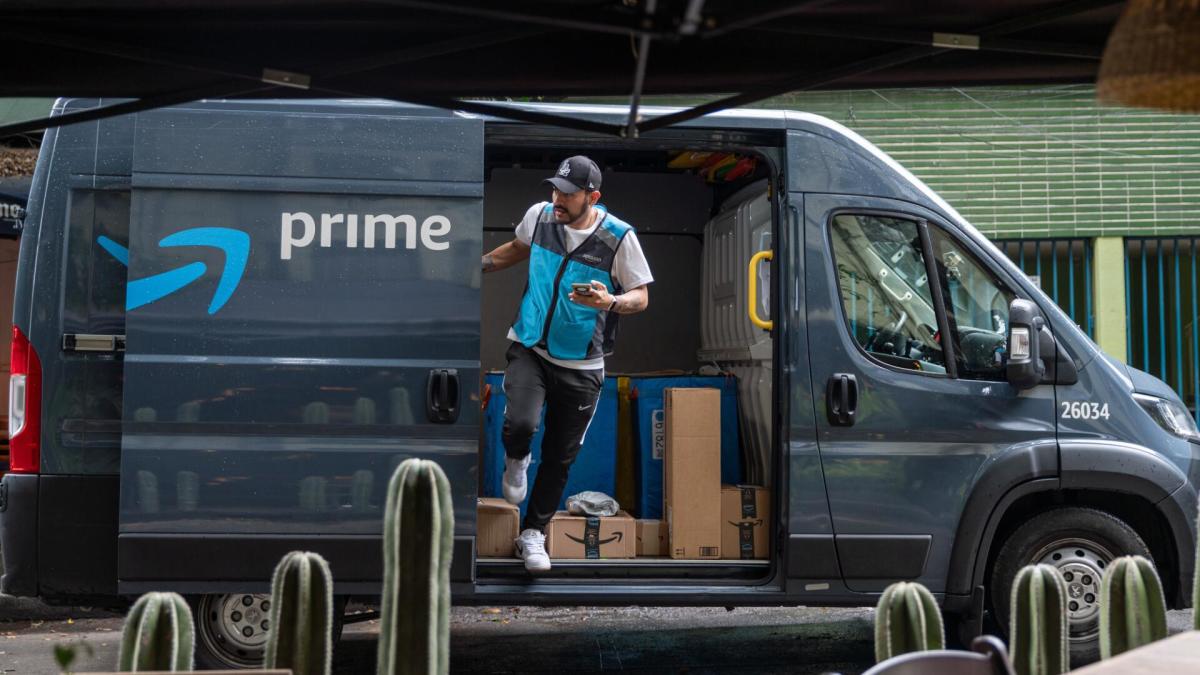 Amazon is testing ultra-fast 30-minute delivery in select markets.
Bloomberg/Getty Images.
The service is currently limited to select neighborhoods in Seattle, where Amazon is headquartered, and Philadelphia, where the company operates 50 warehouses, including its new 140,000-square-foot “last-mile” distribution center.
How Amazon Now works
- If you live within the test areas, the “30-minute delivery” option is available in the navigation menu.
- Thousands of items are available, including:
Milk
Eggs
Fresh produce
Toothpaste
Cosmetics
Pet treats
Over-the-counter medicines, and more
- The service costs $3.99 per order for Prime members $13.99 for non-Prime members
- A $1.99 “small basket fee” applies to orders below $15
- Orders are fulfilled by small, local facilities closer to the neighborhoods served.
- Delivery is via Amazon’s internal delivery drivers, such as Amazon Flex. Source: Amazon
Amazon has already established itself in the grocery sector, and essentials are among its fastest-growing and top-selling products this year:
Amazon Now’s focus on select high-frequency, high-demand products typically sold by convenience stores and grocery stores may help it win more market share while also challenging third-party delivery services, such as DoorDash or Instacart.
Amazon’s new feature could further open door to billions in sales
By opening small fulfillment centers and providing ultra-fast delivery services, Amazon can more deeply penetrate a massive market.
- There are 152,255 convenience stores in the United States.
Single-store operators account for roughly 60% of all stores.
Source: NACS
- Convenience store sales total $860 billion per year.
Average customers spend $7.80 per order.
The average convenience store had 1,491 transactions per day in 2023.
Source: NACS
- Grocery store market size was $873.4bn in 2024. Source: IBISWorld
Amazon has already made attempts to win market share in this industry through its Amazon Go and Amazon Fresh stores, with mixed results.
The company has downsized its Go footprint to focus on selling its “Just Walk Out” shopping technology to other retailers. There are only 16 Amazon Go locations nationwide, according to ScrapeHero, down from 30 in 2023. ScrapeHero reports that there are 58 Amazon Fresh stores.
More Retail Stocks:
- Costco CFO makes rare pricing promise
- Home Depot faces growing consumer boycott calls ahead of holidays
- Target’s efforts to make amends with customers hit a snag
- Amazon lawsuit could be a warning to other employers
Still, excluding Whole Foods and Amazon Fresh, Amazon generates approximately $100 billion in grocery sales annually, making it one of the industry’s largest players, behind Walmart, the nation’s largest grocer, and in the ballpark of major grocery chains like Kroger.
“We have a very large grocery business. If you look at our entire grocery business, if I don’t even count Whole Foods Market and Fresh, in the last 12 months to over $100 billion of gross merchandising sales, which would make us a top 3 grocery in the U.S.,” said Amazon CEO Andy Jassy on its earnings call in October.
Despite the limited size of the Amazon Now test, a more expanded rollout, if successful, could pressure DoorDash and Instacart, which rely on membership and delivery fees. Instacart’s revenue totaled $3.4 billion last year, while DoorDash’s revenue was $10.7 billion.
Instacart gets most of its revenue from grocery delivery. DoorDash doesn’t break out revenue by grocery, but has said that 25% of its most active customers order groceries, and that grocery delivery is an important of its business.
“I think every grocer is recognizing that DoorDash is now the leader in order volume in this category and the leader in acquiring new customers,” said DoorDash founder and CEO Tony Xu on its November earnings call.
There’s reason to think that Amazon Now’s rapid delivery will expand to more locations. Amazon’s same-day delivery, including perishables, started small in a few markets only but has grown significantly.
Related: Costco sees shift in member behavior
“We were really taken aback at the adoption, not just the number of people that started buying perishables from us very quickly, but how often they came back downstream to buy perishables and groceries from us in the future,” said Jassy. “And so we’ve now expanded that to 1,000 cities around the U.S. and will be in 2,300 by the end of the year. And it’s really changing the trajectory and the size of our grocery business.”
Wall Street weighs in on Amazon Now test
Bank of America thinks that Amazon Now could become a more important driver for Amazon. In a research note shared with TheStreet, analysts wrote:
The analysts see little near term impact on Instacart and DoorDash given the small size of the test. Still, it may signal a bigger push that could impact the companies later on.
“While we expect Amazon to continue to move more items toward same-day shipping over time, Amazon Now seems experimental for now,” wrote the analysts.
Instead, they view Amazon Now as part of a continuing grocery ramp in 2025, that could pay off over time by more deeply embedding Amazon within customers daily shopping, opening the door to more add-on purchases.
“We believe Amazon Now adds an offering that should complement existing same-day grocery capabilities with very small basket convenience items. As a result, we believe Amazon can continue driving important customer frequency benefits and a lock-in effect not possible with other verticals,” said the analysts.
Related: Kroger announces more closures and cuts ahead of the holidays
