
Wall Street always loves a good consensus, especially when the stock market’s rip-roaring.
That’s exactly when Bank of America’s fresh 2026 forecast becomes all the more interesting.
According to a Business Insider report, while every major Wall Street firm dishes out a double-digit target for the S&P 500 next year, BofA analysts are pumping the brakes.
Considering the S&P 500 closed at nearly 6,830 on Dec. 3, BofA’s year-end 7,100 S&P 500 forecast points to roughly a 4% upside.
Investors have clearly gotten used to big 15%-20% annual gains, which is why a 4% call feels borderline contrarian.
Yet in a year when Wall Street’s celebrating the AI boom as a limitless tailwind, Bank of America is quietly pointing to a small pocket of turbulence ahead.
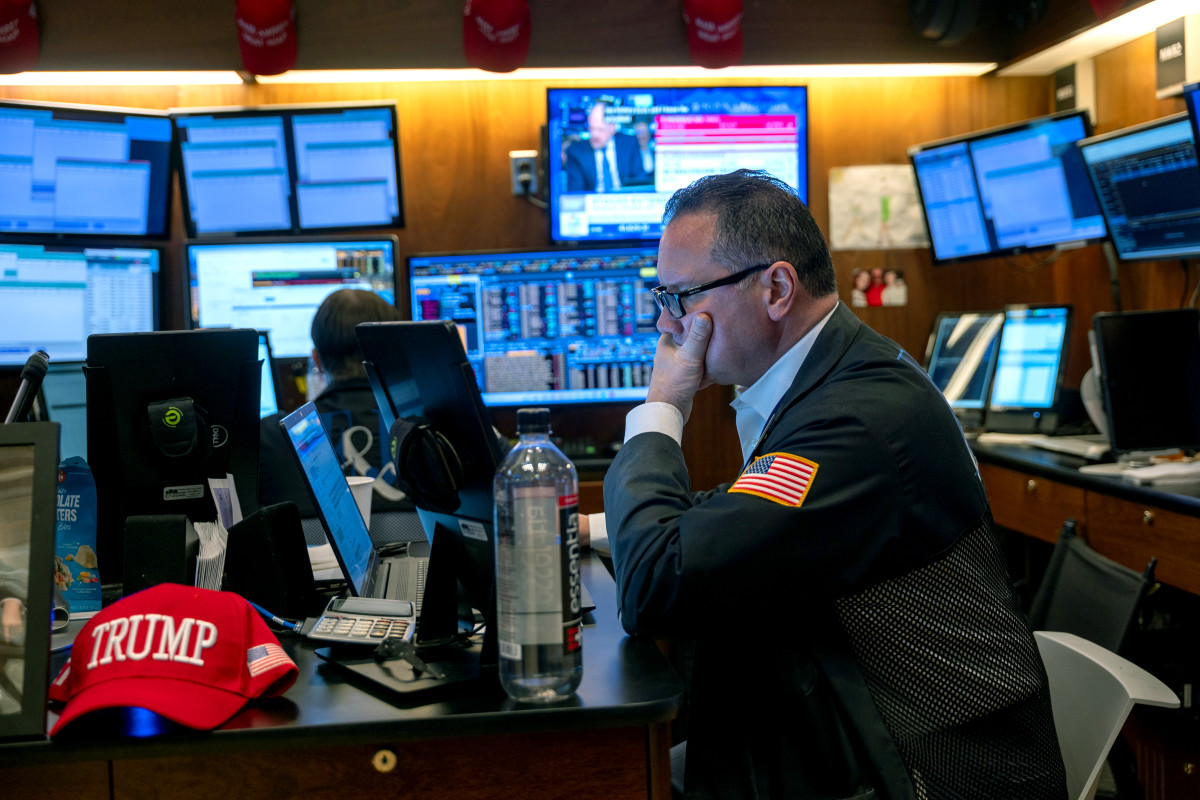 Bank of America breaks from the pack with a new 2026 stock market outlook.
Photo by Spencer Platt on Getty Images
Bank of America breaks from the pack with a muted 2026 forecast
Mr. Market rarely rewards those who stray from the herd, especially when optimism runs high. That’s why BofA’s new 2026 outlook is so striking.
Here’s how the forecasts stack up:
Wall Street’s 2026 targets (at a 6,830 S&P 500 baseline)
- Deutsche Bank: 8,000 —17% upside; the Street’s biggest bull, which continues leaning on robust earnings.
- Morgan Stanley: 7,800 —14% upside; expects AI capex and a “rolling recovery” to drive gains.
- JPMorgan: 7,500 —10% upside, built on 13% to 15% EPS growth from an AI “supercycle.”
- Goldman Sachs: 7,600 —11% upside; sees steady momentum into late 2026.
- HSBC: 7,500 —10% upside, supported by ongoing AI investment despite a volatile economy.
- RBC: 7,750 —13.5% upside, a 12-month view that still implies mid-teens gains.
BofA says market’s liquidity is tapped out
BofA’s core argument is that the market simply has less fuel left.
Businesses aren’t boosting buybacks as they did in the past, and Big Tech giants are investing in AI infrastructure instead of returning cash to shareholders.
Related: Major bank unveils S&P 500 target for 2026
The Fed isn’t supplying extra liquidity, either.
With fewer buybacks, heavier capital expenditures, and the ongoing quantitative tightening, BofA feels the stock market may soon run on thinner oxygen than most investors are accustomed to.
Additionally, Bank of America’s Chris Hyzy, in a recent CNBC interview, framed 2026 as a year in which discipline will likely be a more apparent theme.
He joked about the market being in an “elf rally on the way to a Santa Claus rally,” but quickly grounded the analogy in math.
That said, here’s the data supporting BofA’s sharp take:
- Fewer buybacks: Q2 2025 S&P 500 buybacks hit $234.6 billion, clocking in 20%below the Q1 record of $293.5 billion, according to S&P Global, and essentially flat year over year. Also, Goldman Sachs estimates $550 billion in H1 buybacks, but Q2’s flat growth shows that the buyback impulse has peaked.
- More capex:Wired reports that Microsoft, Alphabet, Meta, and Amazon collectively plan roughly $370 billion in 2025 capex, predominantly on AI and data-center spending.
- Less liquidity: The Fed’s balance sheet has dropped from $9 trillion to $6.6 trillion, with $2.2 trillion in securities runoff since June 2022.
The “AI air pocket”: not a bubble, but not safe, either
BofA isn’t calling for an AI bubble like some analysts are, but it’s warning about something potentially more disruptive in an “air pocket.”
Think of it as a point where the market loses lift, but not exactly its altitude. The excitement is still palpable, but the momentum doesn’t support the current speed.
A big reason BofA is hesitant to use the word “bubble” is that some fundamentals actually appear solid.
Related: Morgan Stanley drops eye-popping price target on Nvidia stock
Earnings growth continues to support today’s elevated valuations, for the most part.
To support that argument, FactSet’s latest Earnings Insight shows that in Q3 2025, S&P 500 earnings jumped 13.4% year over year, its fourth consecutive quarter of double-digit expansion.
Also, unlike previous hype cycles, the IPO calendar isn’t overflowing with speculative newcomers.
For perspective, Renaissance Capital has counted 195 U.S. IPOs so far in 2025, which have ended up raising a whopping $36.4 billion.
More Wall Street:
- Stanley Druckenmiller’s latest buys suggest shifting tech trend
- Goldman Sachs unveils stock market forecast through 2035
- Dalio’s Bridgewater quietly reshapes its portfolio amid bubble warnings
- Peter Thiel dumps top AI stock, stirring bubble fears
Though that’s a superb pickup (nearly 40% more deals and 26% more proceeds compared to last year), it’s nowhere near the 397-deal, $142-billion blowout of the pandemic-fueled investing mania, Renaissance Capital notes.
However, the flip side of that ledger is tough to ignore.
Hyperscalers continue to shift into more asset-heavy models, demanding gigantic, front-loaded spending.
Corporations continue issuing staggering amounts of AI-related debt without a clear, near-term monetization path, where earnings pressure essentially becomes the default setting.
Related: Short-seller Michael Burry takes aim at another major tech stock