
A number of companies have learned that taking a political stance, or even implying one, can have unintended consequences. President Donald Trump has not hidden the fact that he favors businesses that take actions matching his publicly stated policies.
“Trump clearly thinks he can and should bend American companies to his own will should not be surprising: he’s already done it to Carrier Corp. (to some extent) and appears to be trying to do it to Boeing, via Twitter,” Vanity Fair’s Bess Levin wrote.
That remark was made following Trump’s comment that he could easily talk companies into staying in the United States rather than moving overseas.
“Hey, Reince, I want to get a list of companies that have announced they’re leaving,” he called out (referring to former Chief of Staff Reince Priebus). “I can call them myself. Five minutes apiece. They won’t be leaving. O.K.?”
Doing something because Trump likes it, or disagreeing with the president, has consequences, as does taking any sort of political stance.
“Political stances usually alienate a significant fraction of the company’s customers, employees, investors, and other constituents,” Utpal Dholakia wrote on the Rice Business School website.
Being political, or even appearing to be, can undermine a company.
“This is because every large company, whether it is Dick’s Sporting Goods, United Airlines, or Papa John’s Pizza, is sure to have constituents across the political spectrum. Taking a stance that favors one partisan group upsets and alienates customers, employees, and investors from the other group,” he wrote.
That’s a risk Costco has been willing to take on multiple occasions.
Costco has been quietly political
While Costco never makes openly political statements, the chain has done things that would put it on Trump’s naughty list, so to speak. The president has been vocally against diversity, equity, and inclusion (DEI) programs.
As one of his first acts in office during his second term, Trump signed an executive order that ended the use of DEI in the federal government. He framed it as being “the most important federal civil rights measure in decades,” according to a White House press release.
“President Donald J. Trump signed an historic Executive Order that protects the civil rights of all Americans and expands individual opportunity by terminating radical DEI preferencing in federal contracting and directing federal agencies to relentlessly combat private sector discrimination. It enforces long-standing federal statutes and faithfully advances the Constitution’s promise of colorblind equality before the law,” the press release continued.
Many companies, including Target, gave in to pressure from the president and dropped their DEI programs.
Costco was not one of those companies, and its board communicated its thoughts on DEI to shareholders before a Jan. 23 vote on eliminating the chain’s DEI policies. Before that vote, Costco’s board of directors sent a notice to shareholders encouraging them to vote against it.
“Our efforts at diversity, equity, and inclusion remind and reinforce with everyone at our company the importance of creating opportunities for all,” said Costco’s board of directors in the notice. “We believe that these efforts enhance our capacity to attract and retain employees who will help our business succeed.”
More Retail:
- Costco CFO makes rare pricing promise
- Home Depot faces growing consumer boycott calls ahead of holidays
- Target’s efforts to make amends with customers hit a snag
- Amazon lawsuit could be a warning to other employers
Over 98% of Costco’s shareholders voted to keep the DEI policy in place, CBS News reported.
Now, Costco finds itself running the risk of angering Trump once again, as it has sued for the return of money it paid in tariffs, which the company said are not legal.
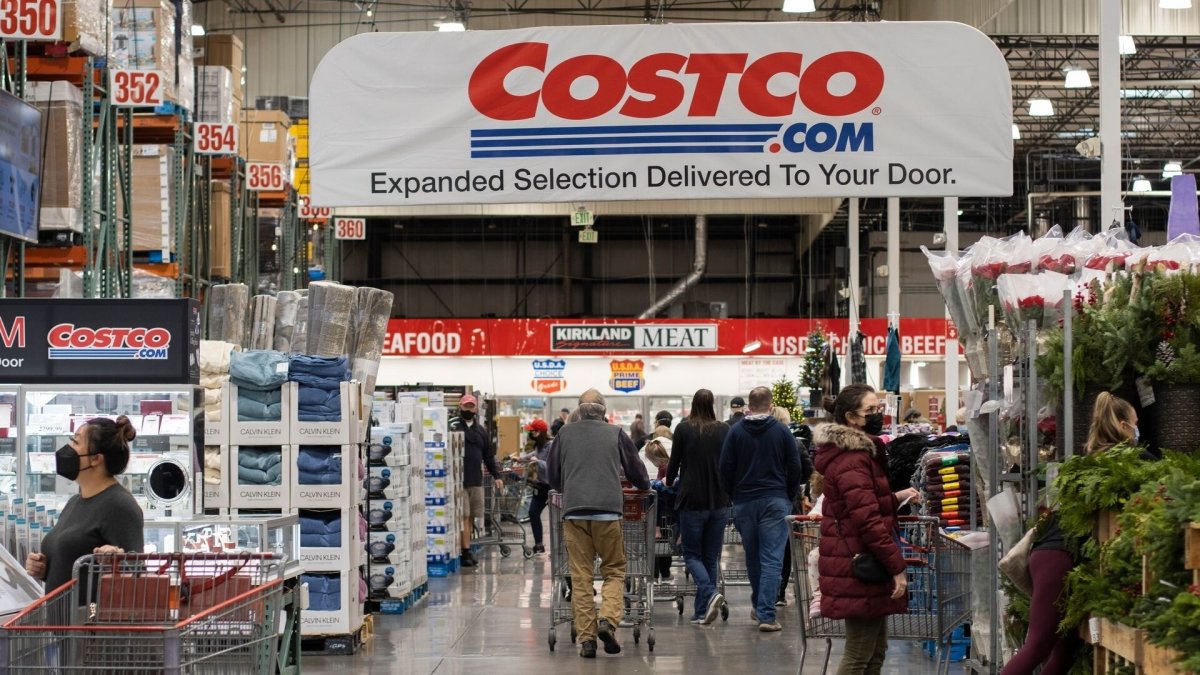 Costco has been willing to go against President Trump if it means helping its members.
Shutterstock
Costco challenges Trump’s tariffs in court
Costco has not publicly commented on the lawsuit, but CFO Gary Millerchip has been clear about how tariffs have impacted that warehouse club and its customers.
“Tariffs raise costs so that’s not something that we see as a positive in general,” he said during Costco’s first-quarter 2024 earnings call.
He made it clear that tariffs are bad for American consumers.
“With that being said, I’ll quote my predecessor, Richard. He’d say ‘when it rains, it rains on everybody,'” the CFO added.
“We’re very happy. We have billions of dollars coming into our Treasury — billions — from China. We never had 10 cents coming into our Treasury; now we have billions coming in,” President Trump said, according to a White House transcript.
Except, of course, no money has come into the U.S. treasury from China paying tariffs. Instead, the American companies importing from China have paid those and, in many cases, passed those costs onto their customers.
It’s important to understand that tariffs are paid by the importer — usually a U.S.-based company,” Professor Chad Syverson, an economist at the University of Chicago Booth School of Business, told History. “Those costs are then often passed down the supply chain, ultimately to consumers.”
Costco has been paying those tariffs, and now it wants its money back.
Costco files a lawsuit
- In late 2025, Costco filed a lawsuit in the U.S. Court of International Trade challenging the tariffs imposed under the International Emergency Economic Powers Act (IEEPA). They argue that the law does not clearly authorize broad tariff orders, The Guardian reported.
- By doing so, Costco is trying to preserve its right to obtain refunds for duties it already paid, in case the Supreme Court rules the tariffs unlawful, according to the lawsuit.
- Costco said roughly one‑third of its U.S. sales come from imported goods — but only a subset of those are non‑food imports (which are most affected by tariffs), shared The Washington Post.
Costco is not alone in suing over tarrifs.
“Since November, nearly 100 businesses have filed lawsuits with the intention of securing refunds should the U.S. Supreme Court declare the president’s global tariffs policy illegal. Justices expressed skepticism during oral arguments last month, questioning whether President Donald Trump possessed the power to impose such expansive duties on international imports,” Oregon Live reported.
Key court cases and terms on tariffs
- International Emergency Economic Powers Act (IEEPA), 50 U.S.C. § 1701 et seq.: The law under which the tariffs were imposed. Relevant for understanding the statutory basis (or limits) of the executive’s tariff authority. Source: Supreme Court
- V.O.S. Selections, Inc. v. United States (2025, in the U.S. Court of International Trade, CIT): May 28, 2025, decision invalidating the “worldwide reciprocal tariffs,” holding that IEEPA does not authorize sweeping tariffs. Source: Foley Hoag
- Learning Resources, Inc. v. Trump (2025, District Court for the District of Columbia): A lawsuit by small businesses challenging the tariffs; the court granted a preliminary injunction, finding IEEPA does not authorize these tariffs. Source: Justia
- Public court filings/opinions: District Court Memorandum Opinion in Learning Resources, Inc. v. Trump (Civil Action No. 25‑1248): The formal legal document laying out the plaintiffs’ arguments (that IEEPA does not authorize tariffs), the Court’s reasoning, and its preliminary injunction order. Source: Justia