
When you buy a house, the price usually corresponds to certain metrics. My wife and I, for example, recently looked at homes in the greater West Palm Beach area.
Anything in our price range in a good location needed significant work. In most cases, that meant a new roof, impact windows, and an air conditioning system that might last a year or two.
The farther we moved from the center of town, the nicer the homes got, with less work being needed. Price was one thing, but value was another entirely.
When you buy stocks, the same logic applies. Yes, you can get more shares in a company that’s trading for under $10 a share, but that comes with its own set of risks.
“Stocks trading under $10 can be attractive for investors looking to scoop up some cheap shares. Unfortunately, quality stocks trading for less than $10 are few and far between. Stock prices at this level can be a red flag for investors that something serious is wrong with a company. Many of these stocks have challenged underlying business models or difficult near-term outlooks,” Wayne Duggan wrote for U.S. News and World Report.
Value and price are not the same thing in the stock market
If you collect baseball cards, 100,000 Wade Boggs cards worth $1 each are not the same as a vintage Babe Ruth trading for $100,000. It would be hard, if not impossible, to monetize 100,000 cheap cards, while a market exists for high-end cards.
With stocks, that’s usually the case. Not every stock that trades below $10 is a struggling company with a real risk of going out of business, but being priced that low is almost always a warning sign.
“Long ago, Ben Graham taught me that — ‘Price is what you pay; value is what you get.’ Whether we’re talking about socks or stocks, I like buying quality merchandise when it is marked down,” Warren Buffett wrote in the 2008 Berkshire Hathaway letter to shareholders.
Stocks don’t need to be complicated
In my decades covering the stock market, some of which I spent making actual stock recommendations, I watched people take an easy process and make it hard. Everyone wants to get rich quickly, which isn’t actually how the stock market works.
That’s something two famous Buffett quotes illustrate:
- “The stock market is a device for transferring money from the impatient to the patient.” Source: Goodreads
- “Someone’s sitting in the shade today because someone planted a tree a long time ago.” Source: AARP
Basically, the secret to getting rich in the stock market is finding good stocks and buying and holding them for a very long time.
That’s not exciting. There’s no story to tell from holding onto Coca-Cola shares for decades, but the payoff is obvious.
Most stock market news is actually noise. What happens on any single day rarely matters or changes the long-term thesis for a stock.
Financial news outlets like CNBC can’t say that because it makes them irrelevant. Jim Cramer needs to fill an hour with hot takes, so he has to make it seem as if a new earnings report contains information that changes everything, when that’s rarely true.
It’s something Motley Fool founder David Gardner sums up in his book, “Rule Breaker Investing.”
“The ‘Rule Breaker Investing’ philosophy is more relevant to investors today because it rejects the fear-based habits of chasing dips and timing trades, offering instead a mindset of conviction, curiosity, and long-term belief in human progress. Instead of reacting to volatility, Gardner urges investors to trust the process of progress itself — to hold, learn, and participate in the very innovation that shapes the future,” Nasdaq.com reported.
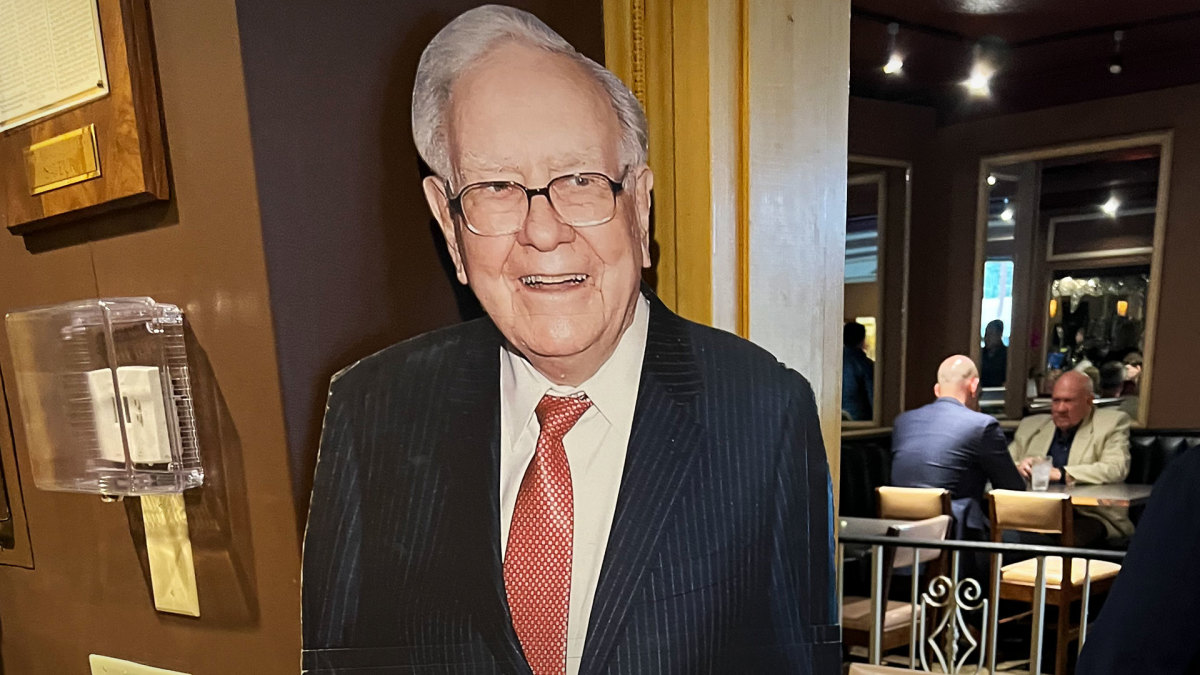 Buffett’s standee is a fixture at Gorat’s, his favorite steakhouse.
Daniel Kline/TheStreet
Buy the stocks you know
“Know what you own, and know why you own it,” famed investor Peter Lynch shared in his book, “One Up On Wall Street: How to Use What You Already Know to Make Money in the Market.”
Basically, Lynch is saying, don’t chase investments you don’t understand. Start your investing journey by looking at the products and services you use in your daily life.
I, for example, own Walt Disney, Starbucks, Amazon, and Costco through various retirement holdings. Those are all brands I interact with. They’re also companies whose products and services I use regularly, and whose business models I understand.
Not every company you use in your daily life is a good investment. You have to look at management, operating philosophy, and financial history to make that decision, but starting where you know makes a lot more sense than chasing penny stocks you read about on Reddit.
Gardner, whose podcast I’ve been lucky enough to appear on, and who guested on my show on Motley Fool Live back during the Covid pandemic, offers simple advice that goes against the approach of investors like Cramer.
More Warren Buffett:
- Buffett’s Berkshire snaps up major tech stock, trims favorite
- Scott Galloway cites Warren Buffett; makes major U.S. action case
- Buffett sends moving 2-word message to Berkshire Hathaway investors
- Warren Buffett’s Berkshire takes $6 billion out of the stock market
“Let your winners run high… what goes up ends up going upper,” he wrote in his latest book.
This is a common Gardner sentiment that ignores the ups and downs any stock goes through. It’s also a warning that selling your winners usually robs you of future gains rather than locking in profits.
“The heart of ‘Rule Breaker Investing’ is a call to see the world with clearer eyes and longer horizons. Gardner invites us to think differently — to let winners run, to stay calm when others waver, to study people as closely as we study numbers, and to back the innovators who are expanding what’s possible. Each principle in ‘Rule Breaker Investing’ builds upon the next, seeking to help investors form a mindset grounded in curiosity and conviction,” Eric Trie wrote about Gardner’s philosophy.
Cheap stocks are not a bargain
If you wait for the price of a stock you like to fall to a certain number, you may never end up buying it.
“It’s far better to buy a wonderful company at a fair price than a fair company at a wonderful price,” Buffett wrote in Berkshire Hathaway’s 1989 letter to shareholders.
Even the Oracle of Omaha had a hard time learning this lesson.
“Charlie understood this early. I was a slow learner. But now, when buying companies or common stocks, we look for first-class businesses accompanied by first-class managements,” he added.
Related: Bank of America revises 2026 inflation forecast ahead of CPI