
Tom Lee has had a front row seat to more than a fair share of stock market pops and drops. Lee, a veteran Wall Street analyst who has tracked the stock market since the 1990s, is the founder of Fundstrat, a respected equity research firm that advises money managers and high-net worth investors.
His extensive stock market experience means he has navigated the internet boom and bust, the Great Recession, the Covid pandemic, and 2022’s bear market. Those experiences taught him valuable investing insights about why stocks rise or fall — knowledge that helped him spot an opportunity to be bullish earlier this year despite the S&P 500 losing nearly 20% this spring.
“But to me, everything that happened over the weekend, including the Sunday further explanations, all of this is unequivocally positive for stocks,” said Lee on April 14 after President Trump paused implementing reciprocal tariffs, kickstarting the rally.
The S&P 500 has rallied over 40% since its April intraday low. Yet the Federal Reserve has been constrained by its dual mandate, compelled by a weak labor market to cut rates even as inflation climbs. Companies are managing skyrocketing import taxes resulting from President Donald Trump’s tariff policy, and many Americans are under pressure as layoffs increase and pay raises decline.
Lee’s latest stock market forecast suggests those trends aren’t as concerning as many think. In fact, Lee offered six reasons why investors ought to stay bullish heading into 2026.
Longtime fund analyst offers bullish forecast
Lee’s market optimism defies bear-market arguments that the U.S. economy faces stagflation, a period of slow growth and higher prices, or a looming recession.
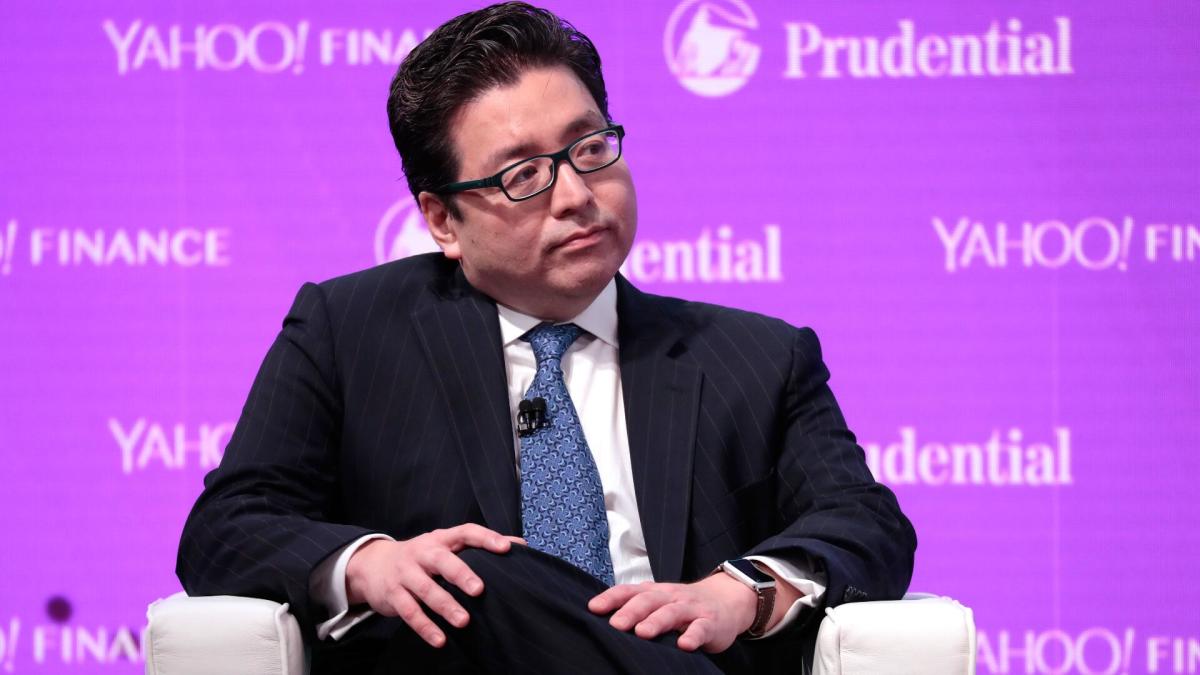 Fundstrat analyst Tom Lee offered six reasons why stocks could finish the year higher.
Cindy Ord/Getty Images.
The unemployment rate has increased to 4.4% from a low of 3.4% in 2023, according to the Bureau of Labor Statistics‘ unemployment report. Meanwhile, layoffs this year surpassed 1.1 million in November, a 54% increase from the same period last year, according to Challenger, Gray, & Christmas. Still, Lee believes there’s plenty to support higher stock prices.
In a Fundstrat research note shared with TheStreet, Lee said investors shouldn’t be concerned about December’s “shaky start,” pointing out that November also began on uncertain footing, yet finished the month having recovered losses, trading up 0.1%.
“I think December is going to do even better than that,” said Lee.
When all is said and done, Lee thinks that the S&P 500 could finish the year between “between 7,000 to 7,300 points,” up from 6,870 currently.
Lee says there are six reasons why he’s bullish:
- The Fed will likely cut interest rates: The FOMC meeting on December 10 could bring with it a third consecutive quarter percentage point rate cut, supporting corporate profits by making borrowing cheaper. The CME’s Fed Watch tool puts the probability of a rate cut this month at 87%.
The Federal Reserve doesn’t control lending rates or the stock market, but its Fed Funds Rate does influence them. The FFR is the rate at which banks lend each other overnight reserves, and when it falls, Treasury yields and bank lending rates tend to fall as well. As a result, borrowing costs for businesses and households decrease, boosting spending, GDP, and ultimately corporate profits —the lifeblood of stock market returns.
More Wall Street:
- Stanley Druckenmiller’s latest buys suggest shifting tech trend
- Goldman Sachs unveils stock market forecast through 2035
- Dalio’s Bridgewater quietly reshapes its portfolio amid bubble warnings
- Peter Thiel dumps top AI stock, stirring bubble fears
If the Fed reduces interest rates this week, it will bring the total cuts to 1.75% since the fall of 2024.
Lee also points out that the Fed has stopped quantitative tightening, a process of selling bonds on its balance sheet, which puts upward pressure on Treasury yields and loan rates. The decision to stop selling bonds is “quite dovish for stocks,” said Lee.
- U.S. economy is healthy with room to grow: GDP is tracking above 3% and the Institute for Supply Management (ISM) is below 50.
GDP sank in Q1, but rebounded, growing 3.8% in the second quarter. The Atlanta Fed‘s GDPNow tool estimates the third-quarter GDP at 3.5%.
“We’re going to finish the year, despite the Schumer shutdown, with 3% real GDP growth,” said Treasury Secretary Scott Bessent in an interview on CBS News’ ‘Face the Nation.’
While an ISM reading below 50 shows contraction, it also indicates slack given the GDP figures, suggesting to Fundstrat’s Lee that there’s “pent up demand” bubbing under the surface of the economy.
The November ADPEmployment data showed the economy lost 32,000 jobs, far worse than economists’ projections for it to have added 40,000 workers. This suggests that the Fed’s likely path remains supporting labor markets, particularly since PCE inflation, while growing 0.2% excluding volatile food and energy, is in line with forecasts.
Inflation is expected to moderate as we progress further into 2026, with PCE inflation retreating from its early-year peak by the fourth quarter.
Bank of America’s core PCE inflation forecast for 2026:
- Q1 2026: 3.1%
- Q2 2026: 3.1%
- Q3 2026: 3.1%
- Q4 2026: 2.8% Source: Bank of America “U.S. Economic and Equity Strategy Outlook, Dec. 2025”
- Government shutdown is over: Lee reminds us that investors were operating without good data in November because of the impasse in D.C. Now that workers are back to crunching data, investors will have more clarity, removing an overhang of uncertainty, and “restoring visibility,” allowing them to better model for what could happen next.
- Many investors are offside: Investors have doubted the market in 2025, which has led many portfolio managers to be too conservative, causing their returns to suffer. According to Lee, 78% of fund managers are trailing benchmarks, suggesting to him that managers will be “performance chasing” into year’s end, hoping to close the gap.
- Stocks got oversold: The relative strength index is used by professional investors to gauge sentiment. It measures the average price gain to the average price loss over a period (usually 14 days), and readings below 30 indicate an oversold condition. Lee notes that the market’s RSI last month was its lowest “since April’s Liberation Day-driven low when stocks bottomed.”
- Seasonality: Lee says, “investors should expect a rally by the year-end,” based on history.
According to the Stock Trader’s Almanac, December is historically the third-best month for S&P 500 returns, with an average gain of 1.5%. Lee’s calculations show that when stocks are flat or lose ground in November, December tends to yield a “stronger December performance,” with a median return of 3.5%.
Related: Longtime fund manager offers 2-word stock market prediction for 2026