
U.S.-based automobile original equipment manufacturers have been quite vocal on the European auto industry in recent weeks as the European Commission is set to release its new climate and green energy proposal on Wednesday, December 10.
Last week, Stellantis chairman John Elkann spoke publicly about the legislation. He said the auto industry has shared its own package of proposals to help shape the legislation, as concerns persist that the EU will strengthen its emissions targets and mandates to phase out the sale of internal combustion engines.
November Ford sales by brand
- Ford F-150 Lightning: 1,006 (-72%)
- Ford Mustang Mach-E: 3,014 (-49%)
- Ford SUVs: 55,888 (-3.7%)
- Ford Bronco: 11,045 (+7%) Source: Ford
“There is another way to cut emissions in Europe in a constructive and agreed way, restoring the growth we have lost and people’s needs,” Elkann said. If it doesn’t, he says, the European auto industry risks an “irreversible decline.”
Ford CEO Jim Farley also spoke about the legislation recently, but his angle had more to do with Chinese competition and how the European auto industry is losing ground.
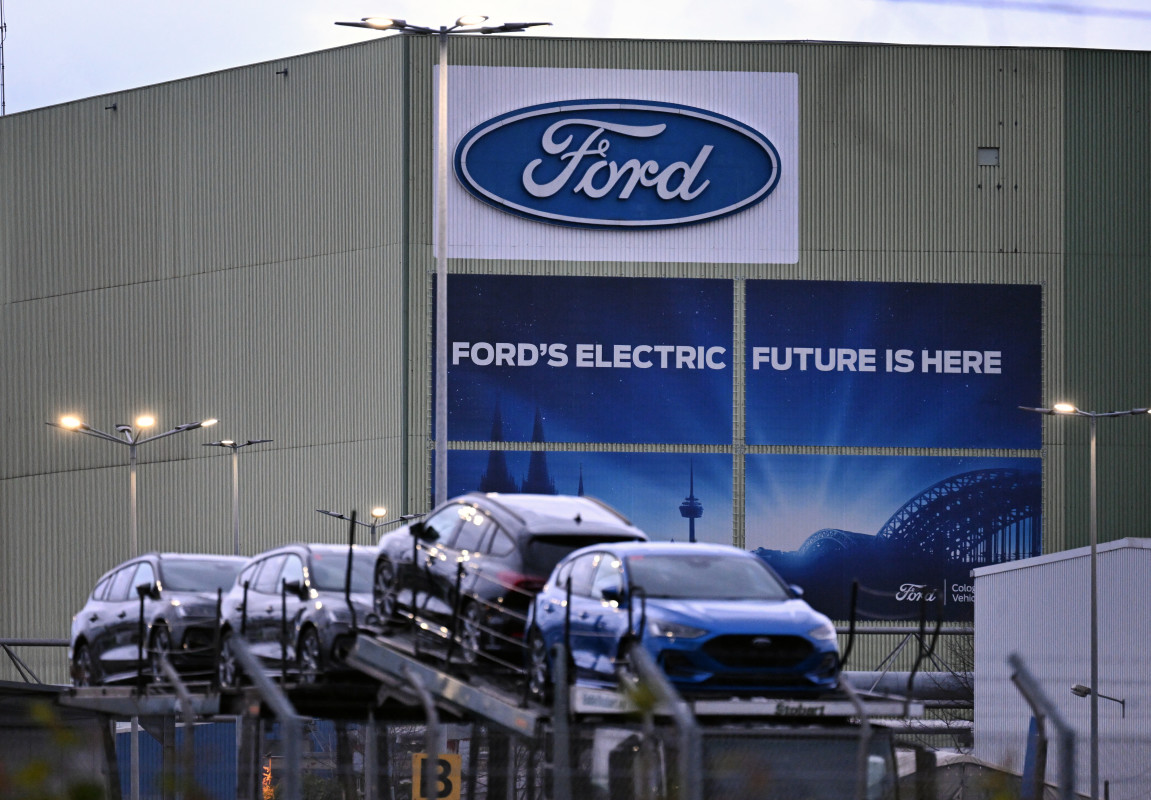 Ford wants to bring a new style of EV to Europe by 2028.
Photo by INA FASSBENDER on Getty Images
Ford CEO Jim Farley warns Europe about Chinese competition
On Dec. 8, Ford CEO Jim Farley penned an op-Ed in the Financial Times entitled “Europe is risking the future of its auto industry.”
In the letter, Farley said the auto industry was looking at Europe “with concern – again” as it awaits the latest update to emissions rules. The central thesis of his argument is that the EU cannot mandate EV demand.
Related: Ford CEO Jim Farley has a stark warning for Europe
“The elephant in the room is that European customers — both individuals and businesses — simply are not buying EVs in big numbers,” Farley said.
But some of the op-Ed was also directed at foreign EV competition from China.
According to Farley, Europe’s rules are opening the door for increased competition from state-subsidized EVs from China to dominate the market. Chinese brands have doubled their market share in the region in just 12 months, reaching a record 5.5% in August.
This is having a ripple effect on Europe’s automotive production, as the region lost 90,000 auto-industry jobs in 2024 alone, according to Farley, and EU vehicle production remains 3 million units below pre-Covid levels.
On Dec. 9, Ford unveiled a new European partnership to offer an alternative to a Chinese takeover.
Ford teams up with Renault to build EVs in Europe
“We face a flood of state-subsidized EV imports from China, structurally designed to undercut European labor and manufacturing,” Farley said. “China has more than enough manufacturing overcapacity to sell to every new vehicle customer in Europe.”
On Dec. 9, he announced Ford’s alternative: a strategic partnership with Renault Group.
Ford Model e losses by year
- 2025: $3.6 billion (year to date)
- 2024: $5.1 billion
- 2023: $4.7 billion
- 2022: $2.2 billion
Related: GM CEO Barra joins Ford in backing controversial White House policy
Under the partnership, Ford will use a Renault plant in northern France to produce two planned small EVs that are expected to hit the European market in 2028. The two companies will also jointly develop Renault and Ford brand vans for the continent.
The EVs will be based on the Renault Ampere platform but will have “authentic Ford-brand DNA and intuitive experiences.”
“The strategic partnership with Renault Group marks an important step for Ford and supports our strategy to build a highly efficient and fit-for-the-future business in Europe. We will combine Renault Group’s industrial scale and EV assets with Ford’s iconic design and driving dynamics to create vehicles that are fun, capable, and distinctly Ford in spirit,” Farley said.
Ford has a solution for EU automotive issues
Ford CEO Jim Farley has given considerable thought to the issues plaguing the European auto industry, and he offered several solutions in his Dec. 8 op-ed.
“We need to incentivize this transition. European manufacturers have invested hundreds of billions in EVs,” Farley said. “Governments must match that commitment with consistent incentives to buy them and a charging infrastructure that extends beyond wealthy urban centers into rural areas.”
Europe aims to achieve a 55% reduction in fleetwide CO2 emissions by 2030 and a complete elimination by 2035. Those emission standards for new passenger and light commercial vehicles in the EU have been in place since 2023.
However, as EV adoption has stalled, those targets have seemingly become unattainable. So, in May, the standards were amended to include an averaging provision for the 2025-2027 period, allowing manufacturers to comply with the targets by averaging their performance over the three years.
Farley said they should eliminate regulations that treat vans “like luxury sedans.” Farley called the tax on commercial vehicles a tax on the “backbone of Europe’s economy.”
“These are tools for plumbers, florists, and builders. Aggressive carbon targets on commercial vehicles unfairly penalize the small and medium-sized businesses that generate more than 50% of Europe’s GDP,” Farley said.
Related: Stellantis warns this issue could destroy the European auto industry