
Morgan Stanley just handed Tesla (TSLA) stock investors a classic Wall Street head-scratcher.
Although it downgraded the EV giant’s stock to equal weight (equivalent of a hold), it paired it with a price-target bump to $425 from $410.
On paper, that may sound bullish, until we look at the math.
Tesla closed around $439.60, but even though the price target is higher, it actually implies a 3.32% downside.
In other words, Morgan Stanley bumped the price target but thinks the stock should trade lower than it does today. That kind of mixed signal usually doesn’t happen by accident.
At its core is valuation.
Morgan Stanley analysts argue that Tesla is priced for perfection, at sky-high multiples that factor in a wishful AI and humanoid-robot future.
On the other hand, the core auto business continues to push through softer demand and fading tax credits, all against the backdrop of a cooling EV market.
The contrast, where there’s optimism in the narrative but turbulence in the fundamentals, is exactly why this call matters.
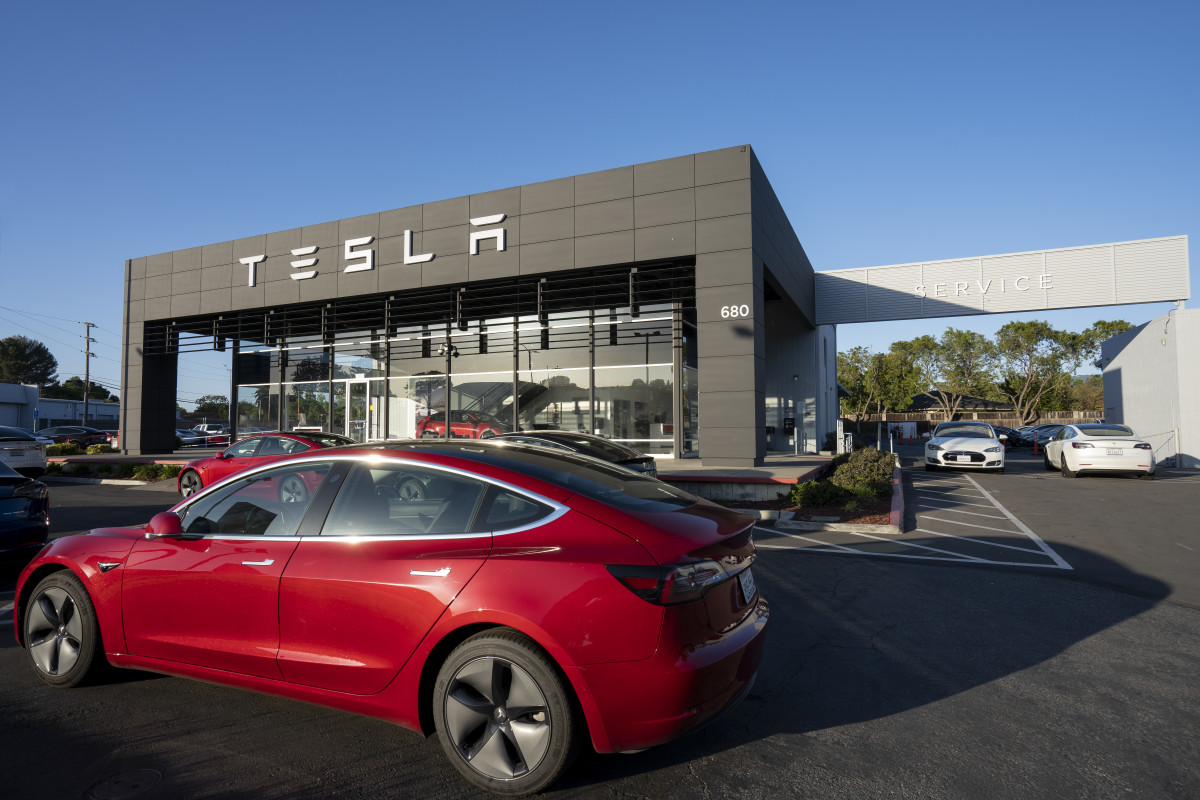 Tesla shares wobble after Morgan Stanley delivers a bullish number with a bearish message.
Photo by hapabapa on Getty Images
Morgan Stanley sends a mixed message
Morgan Stanley’s latest call has everything to do with confronting Tesla stock’s full valuation.
Analyst Andrew Percoco and his team cut Tesla stock to the equivalent of a hold, their first downgrade since June 2023, even with a higher price target at $425.
In his note, he argues that Tesla stock has already priced in the robotics and AI transformation that its CEO, Elon Musk, keeps selling.
In fact, Tesla CEO Elon Musk interacted with X (formerly Twitter) users in early 2024, as reported by Futubull.
Here’s the problem: Percoco feels that at nearly 276x forward non-GAAP earnings, Tesla sits near the very top of the S&P 500’s valuation ranks. According to Seeking Alpha, that’s 1,500% higher than the sector median at 17x.
Though he sees value in Tesla’s much-talked-about humanoid-robot strategy, he’s also expecting North American EV sales to drop 12% next year, which tightens the runway significantly.
Additionally, it’s worth noting that Percoco takes over for longtime Tesla watcher Adam Jonas.
Percoco, in his own right, is a 5-star analyst tracked by TipRanks and carries a 67% average return per rating.
Wall Street’s consensus average price target for Tesla stock is at $393.29, implying an 11% downside from current levels.
The broader EV reset behind the call
Morgan Stanley’s Tesla price target reset was essentially part of a sweeping EV reset.
It is part of a re-rating risk, where the bank’s calling for shifting exposure away from pure-play EV makers and toward businesses better equipped for a slower, incentive-light market.
Here’s where the call broadened out:
- Rivian: Cut from equal weight to underweight with a $12 price target, on the back of “EV winter” pressure. The loss of the $7,500 federal tax credit is a significant factor. At the same time, the substantial cash burn linked with the R2 launch in 2026, as described in a Rivian press release, opens the door for billions in expected EBIT losses and negative free cash flow.
- Lucid: Hit even harder, as the bank downgraded the stock to sell/underweight, with its target slashed from $30 to $10, as bottom-line strength in the cooling luxury EV segment looks elusive.
- General Motors: Upgraded to buy, price target lifted to $90, underscoring the view that legacy automakers with powerful ICE and hybrid portfolios could actually benefit as policymakers roll back EV incentives.
EV momentum meets a hard freeze
For the better part of the past decade, it’s been only onward and upward for the EV market.
In the past couple of years, however, the EV story has begun to show cracks, and the latest data make that clear.
Related: SoftBank billionaire quietly unveils project of staggering size
According to Cox Automotive, U.S. EV sales struck a record 438,000 units in Q3 2025, up nearly 30% year over year.
That was primarily driven by buyers rushing to claim the $7,500 EV tax credit that was removed back in September, CNN reported.
The old $7,500 EV tax credit was a built-in rebate and perhaps the biggest catalyst for the EV market’s expansion over the years. It offered a direct cut to what car buyers owed the IRS if their vehicle met eligibility criteria.
More Wall Street:
- Stanley Druckenmiller’s latest buys suggest shifting tech trend
- Goldman Sachs unveils stock market forecast through 2035
- Dalio’s Bridgewater quietly reshapes its portfolio amid bubble warnings
- Peter Thiel dumps top AI stock, stirring bubble fears
Now with that removed from the equation, the forward-looking reports tell a much colder story. Morgan Stanley is calling for an “EV winter,” projecting a 20% drop in U.S. EV volumes in 2026.
In fact, S&P Global already sees the sluggishness, with November U.S. auto sales dropping 8% and BEV share slipping to 5.3%.
Moreover, an EY survey reported on by Automotive World recently showed that interest in combustion engines is up 13 points, while interest in EVs and hybrids has fallen sharply due to tariffs and policy noise.
Tesla’s whiplash year in review
Tesla’s 2025 has been a unique year, to say the least, one where the stock and the fundamentals tell entirely different stories.
Through the first half, the company appeared broken, with deliveries sagging, pricing remaining unstable, and every headline seeming to involve Elon Musk instead of cars.
However, in an amazing turn of events, the back half flipped the script as investors priced in more of the AI and Robotaxi narrative and Musk re-centred himself on Tesla’s core business. Here’s how the year actually split in two:
- Stock swing: By March, shares were down somewhere between 40% and 50% year to date; by September, it clawed back into the green with its six-month gain at almost 50%.
- First-half fundamentals: Q1 and Q2 sales dropped 9% and 12% year over year, as deliveries tanked 13% in both quarters; free cash flow collapsed 89%.
- Second-half mismatch: Q3 hit a record 497,000 deliveries (amid a buying frenzy fueled by a fading tax credit), but profit still fell, tanking roughly one-third as expenses surged.
Related: Michael Burry shares bold predictions for OpenAI, Palantir