
It looks like it’s one and done — for awhile at least.
The Federal Reserve, as widely expected, delivered a 25-percentage-point cut at its Dec. 10 Federal Open Market Committee meeting — its third reduction of 2025 — trimming the target range to roughly 3.50% to 3.75%.
In its announcement, the FOMC signaled a hawkish hint that it may be pausing cuts in the short term:
“In considering the extent and timing of additional adjustments to the target range for the federal funds rate, the Committee will carefully assess incoming data, the evolving outlook, and the balance of risks.”
Three policymakers on the 12-member panel had said they favored either a larger cut for the cooling labor market or none at all due to price pressures.
The quarterly Summary of Economic Projections released after the meeting showed policymakers expecting one more quarter-point rate reduction in 2026, according to the median forecast – relatively unchanged from September.
In addition, investors, businesses, and consumers learned what to expect in 2026 from the tone of Fed Chair Jerome Powell’s press conference remarks, which will shape expectations for interest-rate changes in 2026.
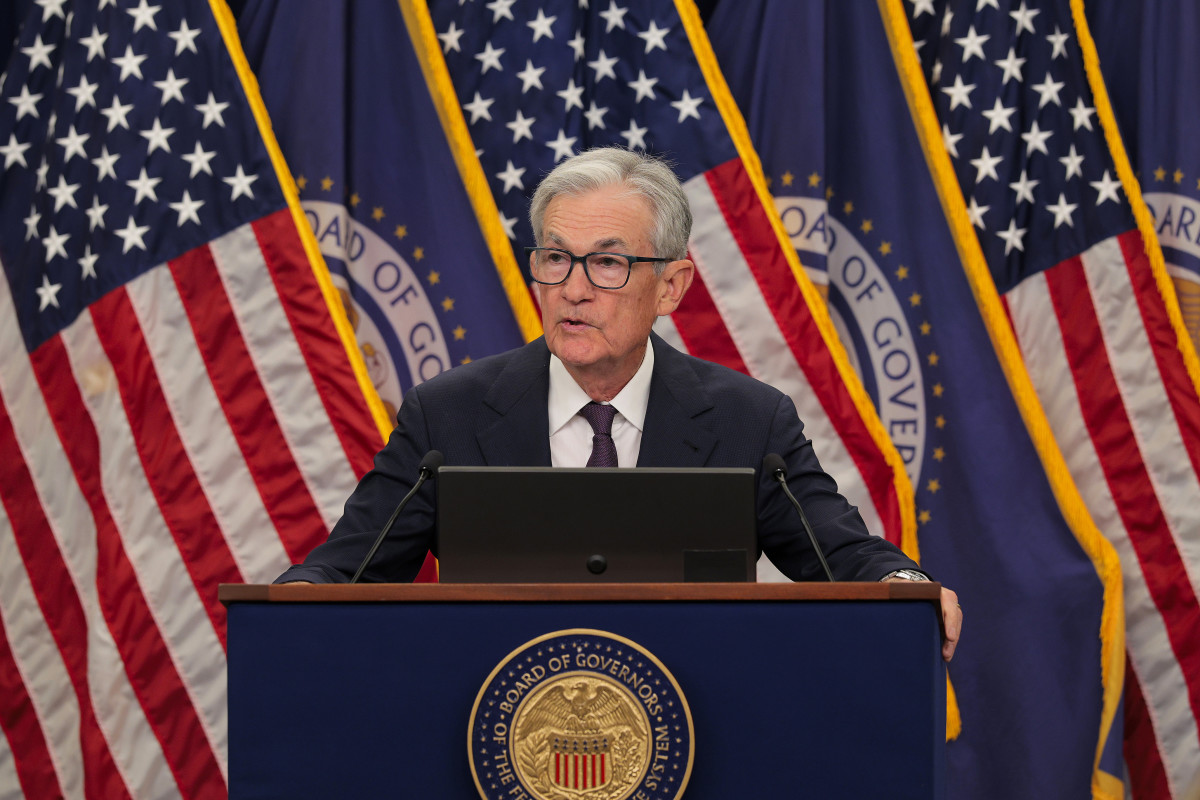 Federal Reserve Chair Jerome Powell’s tone at the press conference at the end of the Dec. 10 Federal Open Market Committee will set the pace for interest-rate activity for the upcoming year.
Photo by Chip Somodevilla on Getty Images
Fed’s dual mandate requires a delicate balance
The Fed’s dual congressional mandate requires it to balance inflation and job growth via interest rates.
- Lower interest rates support hiring but can fuel inflation.
- Higher rates cool prices but can weaken the job market.
The two goals often conflict, operate on different timelines, and are influenced by unpredictable global events.
The Fed had cut interest rates twice this year
The benchmark Federal Funds Rate controls the cost of short-term borrowing like credit cards and auto loans.
The FOMC held the rate steady for most of the year.
This “wait-and-see” approach was driven by caution over tariff inflation and trade policy.
It then lowered it by a quarter percentage point in both September and October over labor market concerns.
Powell steps down as chair in May, and President Donald Trump has said he will nominate someone who will push for more aggressive rate cuts.
Monetary policy set by inflation, jobs balance
The weakening labor market adds another layer of complexity to monetary policy.
Hiring has cooled and wage growth has slowed, yet unemployment remains low by historical standards.
Related: Fed considers bold change to nation’s banking services
Some officials see this as evidence the economy is cooling in a controlled manner, but others worry that deterioration could accelerate quickly if borrowing costs stay elevated for too long.
Plus missing data from the government shutdown means leading economic indicators for October and November won’t be released until after the FOMC meeting.
Former Cleveland Fed President Loretta Mester told CNBC Dec. 9 that she wouldn’t have voted for a rate cut in December or October if she were still on the FOMC.
“I hope they pause for a while,” Mester said, citing inflation concerns.
Powell focuses on tensions in the dual mandate
Powell hinted that the Fed had now done enough to bolster the threat to employment while leaving rates high enough to continue weighing on price pressures.
“A world where job creation is negative, I think we need to watch that situation really carefully, and make sure we’re not pushing down on job creation” with monetary policy, he said.
Powell deflected comments about the January FOMC meeting, saying monetary policy was “well positioned” despite tension on both sides of the mandate for officials to wait for more clarity on where the labor market and inflation are headed.
Powell reiterated his message from earlier this year that there is “no risk-free path for policy” given the challenges to both of the Fed’s goals for prices and employment.
In explaining the third rate of 2025, the Fed chair said it appears that most of the above-target inflation is driven by tariffs, which should have a transitory impact.
However, Powell said the labor market faces significant downside risks.
“Interestingly, everyone around the table at the FOMC agrees that inflation is too high and we want it to come down, and agrees that the labor market has softened and that there is further risk,” Powell said.
“Everyone agrees on that,’’ he added. “Where the difference is, is how do you weigh those risks and what does your forecast look like?”
The three dissents were the highest since 2019
Chicago Fed President Austan Goolsbee and Kansas City Fed President Jeffrey Schmid both dissented against the rate cut.
Fed Governor Stephen Miran dissented in favor of a jumbo 50-percentage-point cut.
Powell described the meeting’s discussions as “thoughtful’’ and “respectful.”
The Fed has cut interest rates by 1.75 percentage points in the last 15 months.
Ben Fulton, CEO of WEBs Investments, said his biggest concern “is the dissenting governors and if this will lead to no more cuts in 2026.’’
“Employment and inflation will continue to be under a microscope for the next year, it seems. May cannot come soon enough to end Powell’s reign and provide cheaper funding to small caps and individuals,’’ Fulton said. “Prepare yourself for enhanced rhetoric.’’
Every FOMC decision to lower rates is becoming more contested as rates move closer to a so-called neutral setting that neither sparks nor slows economic activity.
With each interest-rate cut, “you’re just going to lose the support of a few more participants, and you’re going to need data to motivate those participants to want to join with the majority to get a cut,” Jonathan Pingle, chief U.S. economist at UBS, told The Wall Street Journal.
Fed will begin buying Treasury bills
The central bank also announced it is going to buy $40 billion of Treasury bills a month beginning Dec. 12 through April to ensure that there is enough cash in the financial system.
The announcement came on the heels of the central bank’s decision earlier this month to stop shrinking the size of its balance sheet.
Jeffrey Hibbeler, director of portfolio management at Exencial Wealth Advisors, said the tweaking of the balance sheet was “prompted by somewhat tighter funding market conditions over the last few months.
“These purchases will be in short-term Treasury bills and are different than quantitative easing (QE), which focuses on longer maturities and seeks to take duration out of the market,’’ he said. “Nonetheless, high fiscal deficits are impacting bank reserve levels and to some extent Fed actions enable current deficit levels.”
John Luke Tyner, portfolio manager and head of fixed income at Aptus Capital Advisors, said one area that is being overlooked “is that as the Fed cuts rates, the impact on the deficit will be as if not more powerful on the way down than it was on the way up.
“Given we are basically a floating rate borrower (huge amount of recent issuance has been on the front end of the curve). This could prove another bullish potential catalyst for 2026,’’ Tyner said.
“As rates fall, nominal GDP should feel a boost (or at least remain elevated) as lending increases given a steeper yield curve. Between lower interest expense and higher tariff revenues, the debt ratio could be moving in the right direction which could keep the long end from rising,’’ he added.
“Dot plot” sets tone for future rate action
The SEP or “dot plot” will be closely scrutinized by investors for clues about the Fed’s broader strategy in the short- and long-term.
All 19 Fed officials mark a “dot” on a vertical scale representing the interest rate level they expect at the end of each coming year for the current year, the next two years, and the “long-run” rate.
If the median dot continues to show only a small number of cuts for 2026, it will signal to markets that policymakers remain wary of moving too fast to balance its dual mandate of stable prices and low unemployment.
But a wider spread of dots could indicate deeper disagreement.
Hibbeler said the December dot plot report similarity to September’s was understandable given the void of economic data following the government shutdown.
“Growth was upgraded in 2026 to 2.3%, mainly a function of shifting some from 2025 due to the shutdown. Inflation is projected to moderate somewhat next year, while the unemployment also declines slightly, which Chair Powell attributed to ongoing productivity gains,” he said.
Hibbeler said that while the FOMC forecasts one cut next year and another in 2027, “the new chair will undoubtedly be more dovish than Powell.”
The next FOMC meeting is Jan. 27-28, 2026.
Related: White House claims it has decided on a new Fed chair