
The techies are at it again on social media.
Autonomous driving is expected to be a trillion-dollar industry within the next decade, so everyone from Amazon to Alphabet to Tesla is fighting to become the driver of the next revolution in transportation.
Tesla compensation performance benchmarks for CEO Elon Musk
- 20 million Tesla vehicles delivered
- 10 million active FSD subscriptions
- 1 million Optimus robots delivered
- 1 million Robotaxis in commercial operation
Alphabet’s Waymo has taken the early lead in this race, having had a head start as one of the early developers of the technology.
Tesla CEO Elon Musk is used to getting his way, but based on a recent social media exchange, Waymo’s early lead may be getting under his skin a bit.
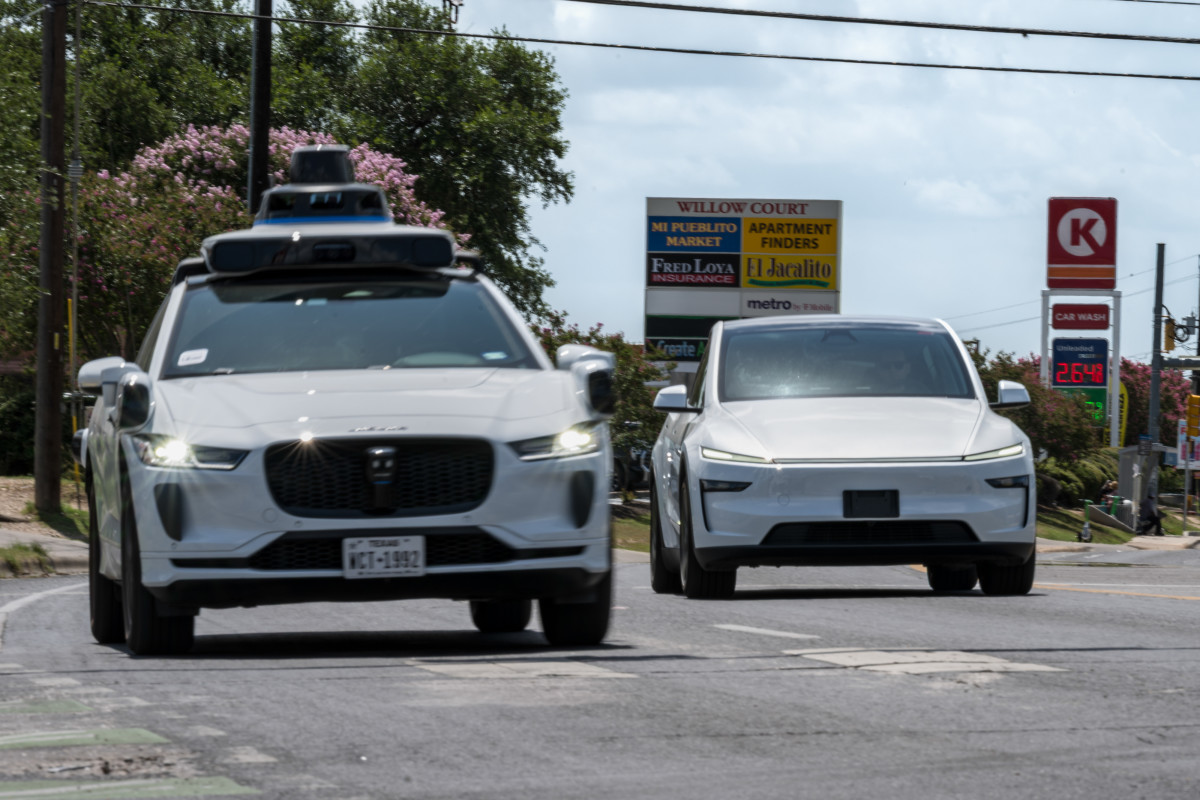 Tesla and Waymo are racing for the future of autonomous driving.
Photo by Bloomberg on Getty Images
Waymo takes the early autonomous lead
Waymo, which has been valued at approximately $45 billion, has tested its autonomous vehicles on U.S. roads since 2012, giving it more time to develop than its rivals.
As of July 2025, Waymo One is available 24/7 to customers in Los Angeles, Phoenix, and the San Francisco Bay Area. Waymo partners with Uber in Austin and Atlanta. The company recently announced plans to expand into other cities such as Boston and Seattle.
Waymo quick facts:
- As of July 2025, Waymo One is available 24/7 to customers in Los Angeles, Phoenix, and the San Francisco Bay Area.
- Founded in 2009.
- Passed the first U.S. state self-driving test in Las Vegas, Nevada, in 2012, IEEE Spectrum reported.
- Spun out from Alphabet as a separate subsidiary in 2016.
Related: Elon Musk has exciting update for Robotaxi fans
In July, the company celebrated driving 100 million fully autonomous miles. Waymo had reported travelling 71 million miles autonomously in March after reaching 50 million at the end of 2024.
Meanwhile, Tesla only debuted Robotaxi in Austin, Texas, in June, but the company has recently targeted expansion.
Tesla had fewer than a dozen Robotaxis active in the city at launch, resulting in long wait times for fans who wanted to use the service. Last month, Musk stated that the Tesla Robotaxi fleet in Austin was expected to double in December.
Related: History of Tesla & its stock: Timeline, facts & milestones
Elon Musk responds to Waymo’s brag on social media
Tech leaders have used X to brag about their company’s achievements since back when it was still known as Twitter.
This week, Jeff Dean, chief scientist for Google DeepMind and Google Research, bragged about Waymo’s three-pronged navigation sensor model that features cameras, LIDAR, and Radar, calling it the “most advanced, large-scale application of embodied AI today.”
A user then challenged Dean to prove that Waymo is indeed the most advanced embodiment of AI by comparing it to Tesla Robotaxi. Dean obliged, referring the user to Waymo’s Safety Impact page, which references statistics such as “91% fewer serious injury or worse crashes” and “92% fewer pedestrian crashes with injuries.”
Related: Waymo pumps the brakes as dangerous issue comes to light
As its owner, X is Elon Musk’s home turf, so his fans were quick to pounce.
“Wrong (huge fan and you are the GOAT). Have a Tesla with hardware 4. 95% of my drives are autonomous miles. It’s magical. I am sure you have tested the latest FSD release,” user @furnuwees said, to which Dean responded that FSD is different from truly autonomous driving.
But Dean didn’t stop there; he took a little shot using some of Tesla’s own PR.
“Tesla did report in April that they have accumulated 50,000 miles driving cars from the end of the factory line to the outbound logistics lot in their factories in TX and CA,” Dean tweeted.
Musk wasn’t going to let that disrespect slide.
“Waymo never really had a chance against Tesla,” Musk tweeted. “This will be obvious in hindsight.”
Tesla FSD/Autopilot isn’t the same as Tesla Robotaxi
Many respondents in the comments pointed to the more than 6 billion miles Tesla’s equipped with Full Self-Driving and Autopilot have driven autonomously as a counter to Dean’s assertion.
But there are two problems with that argument.
First, Tesla Robotaxi and Tesla FSD/Autopilot run on different software, according to Elon Musk, so the FSD miles don’t count for the Robotaxi platform.
And more importantly, Tesla FSD isn’t a level 4 autonomous platform. In fact, Full Self-Driving has to add (Supervised) to its name because drivers are legally required to pay attention and intervene in case of an emergency.
Waymo operates on a level 4 autonomous platform. Waymo became the first U.S. company to offer rides without a safety monitor in 2020, a feat Tesla Robotaxi still hasn’t achieved.
This week, Musk announced that he expects to eliminate the Robotaxi safety monitors in Austin by the end of the year, Autoevolution reported. But Musk has made bold claims about Tesla Robotaxi in the past that have not come to fruition.
Tesla Robotaxi rollout’s missed deadlines and broken promises
Musk was riding high off the Austin debut of the Robotaxi when he made a bold statement during the company’s second-quarter earnings call weeks later in July.
“I think we will probably have autonomous ride-hailing in probably half the population of the U.S. by the end of the year,” Musk said during the opening remarks of the call. “Assuming we have regulatory approvals, it’s probably addressing half the population of the U.S. by the end of the year.”
By the third-quarter call in October, Musk had struck a much more sober tone. He preached being “cautious about the deployment,” saying that the company’s goal now was to be “actually paranoid about deployment” because, as he put it, “even one accident will be front-page headline news worldwide.”
Still, ever the optimist, Musk said Tesla expected to be operating Robotaxi in “I think, about eight to ten metro areas by the end of the year.” However, he did add the caveat that the prediction is reliant on regulatory approval.
While Tesla will probably end the year with a few dozen Robotaxis in service, Waymo has about 2,500 on the road, accomplishing a goal it had for 2026 ahead of schedule.
However, Elon Musk and Tesla do have the advantage of having millions of Teslas already on the road. So if and when Robotaxi is ready for mass consumption, Tesla is one software update away from exponentially increasing its Robotaxi fleet.
Related: Waymo investigation could stop autonomous driving in its tracks