
By the end of 2025, calls on Tesla’s (TSLA) stock tell a now-familiar story.
On one side are the bulls — including Wedbush star analyst Dan Ives — who say Tesla should no longer be valued primarily as a maker of electric vehicles.
Thanks to the 2025 launch of its autonomous-driving robotaxis and other AI-driven initiatives, the company is one of Wedbush’s two “best physical AI plays over the next few years.”
Then there are those, such as “Big Short” investor Michael Burry, who say Tesla is ‘ridiculously overvalued’, similarly to, in his opinion, shares of Nvidia (NVDA), Palantir (PLTR) and other leaders of the AI-boom.
One thing is for sure: while Wall Street wrestles over whether today’s massive valuations reflect disruptive innovation or an AI-fueled bubble, some long-term investors are again trying to parse fundamentals from the noise.
In doing so, Tesla investors may want to pay attention to a key development in Europe, one that could reshape the continent’s auto industry for the next decade, yet is flying almost entirely under the market’s radar.
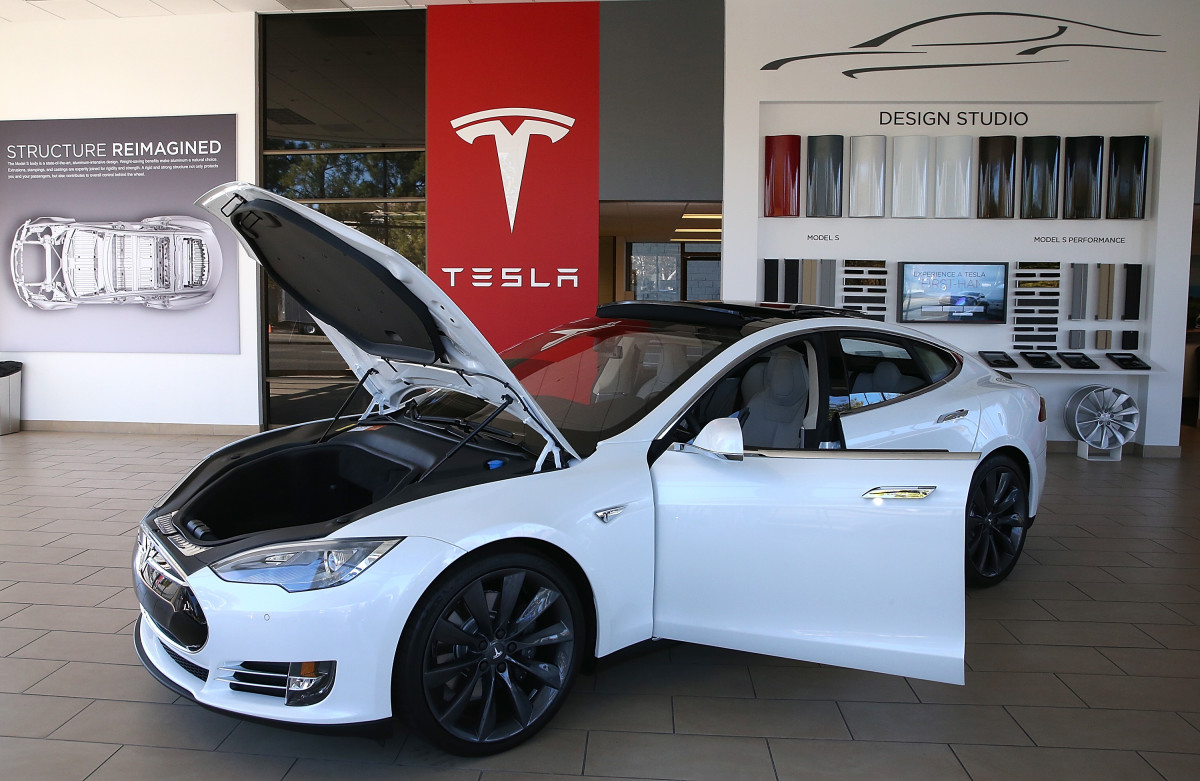 Tesla’s fundamentals are under scrutiny amid mounting struggles in Europe.
Photo by Justin Sullivan on Getty Images
Tesla is about to lose a key advantage in Europe
Tesla’s early foothold in Europe began in 2012, when the continent was still a burgeoning market for electric vehicles (EVs). Over the following 10 years, Tesla widened its prominence in what has since become the world’s second-largest market for EVs after China.
World’s top EV markets in 2024
- China: 6.4 million EVs sold
- Europe: 2.2 million EVs sold
- U.S.: 1.2 million EVs sold
- Rest of world: 1 million EVs sold Source: International Energy Agency
A turning point was achieved in 2022, with the opening of Tesla’s Berlin Gigafactory, which eventually led to the Model Y becoming Europe’s best-selling vehicle in 2023.
Tesla’s fall from grace in Europe
But in 2025, while Tesla’s stock may be marching to new highs, the automaker’s core business has endured a fall from grace in key European markets, such as France and Germany.
More Tesla:
- Tesla has more bad news for Cybertruck lovers
- Tesla fatal crash lawsuit takes a wild turn
- Tesla: what must happen for the $1 trillion payout
- Tesla accused of not following key law
Brand damage tied to CEO Elon Musk’s embrace of far-right politics has been widely cited as a factor in Tesla’s plunging regional sales. Yet, if nothing else, this only accelerated Tesla’s already-falling market share to the benefit of Chinese EV makers such as BYD (BYDDY).
While Musk has grown quieter on the political front in recent months, Tesla’s problems in Europe may still become more acute.
Landmark ban on carbon emissions will likely be watered down
On Dec. 16, the European Commission is expected to unveil adjustments to its landmark 2035 ban on sales of new combustion-engine (tailpipe emissions-producing) vehicles.
This comes in response to intense lobbying by once-dominant European automakers, who’ve asked Brussels for more flexibility in their electric transition while they face severe pressure from Chinese competitors.
While the EU is unlikely to abandon the zero-emissions target outright, analysts widely believe the rules will be softened in ways that directly benefit Europe’s legacy automakers — think Stellantis (STLA), Volkswagen (VOW3), BMW (BMW) and Renault (RNO) — and erode current advantages for pure EV makers, including Tesla.
Matthias Schmidt, who tracks European regulatory policy, says the changes will likely introduce carve-outs and incentives that effectively extend the life of plug-in hybrids (PHEVs) and other hybrid vehicles well into the late 2030s.
“We expect a window-dressing headline target… but with many adjustments,” Schmidt told TheStreet. “Those include ‘super-credits for small, affordable cars, which could be used to cancel out CO2-emitting PHEVs which [European automakers] want to keep beyond 2035.”
Hybrids may be short-term winners
In such a case, the immediate winners would be European and Asian automakers, such as Toyota (TM) and Hyundai (KRX), whose hybrid and PHEV lineups remain a large part of their business models.
Hybrids and PHEVs already make up the largest share of all “electrified” vehicle sales in Europe — outpacing pure EVs — and the EU’s softer approach is likely to push that trend even further.
These vehicles can be cheaper to produce, require fewer charging-infrastructure commitments, and remain popular with consumers who want some electrification without the cost or range anxiety of a pure EV.
Chinese automakers, too, stand to gain. While the EU recently imposed anti-subsidy tariffs on Chinese EV imports, Schmidt notes that the policy has not significantly slowed their market momentum.
“Any further delay in transitioning to EVs would give Chinese [automakers] that are already ahead of the game in terms of cost efficiencies… even deeper market share gains,” he said. “Tesla is effectively coming under increased pressure from Chinese new market entrants.”
And unlike Tesla, many Chinese manufacturers (BYD and MG) offer hybrids — a portfolio advantage that aligns neatly with the EU’s expected regulatory shift.
A quiet but meaningful revenue hit for Tesla
Tesla could also take a hit in an overlooked corner of its European business: emissions-credit sales.
Under current EU rules, carmakers that fail to meet fleetwide CO2 requirements must buy credits from manufacturers with surplus clean-vehicle output — most notably Tesla.
That revenue stream has been lucrative in recent years, with outside estimates suggesting Tesla may have generated anywhere from a few hundreds of millions to $1 billion per year from European automakers seeking to avoid penalties.
If European manufacturers are given broader latitude to sell PHEVs — and if
“super-credits” allow them to zero-out internal-combustion emissions on paper — their reliance on Tesla’s carbon credits will shrink.
That would cut into a revenue source that has helped bolster Tesla’s European profitability even as its market share has slipped.
Tesla still has a future in Europe
As the first pure-EV brand to gain mass acceptance in Europe, Tesla retains manufacturing scale, brand recognition, and existing market footholds that new entrants still must build.
But over the next several years — the horizon most relevant to regulatory shifts — Tesla is likely to face a much tougher competitive landscape in Europe.
Related: Tesla Robotaxi hits big milestone, but questions remain