
Bank of America’s Vivek Arya summed up the 2026 setup in a single line:
Nvidia is acting like it believes that and more.
The chipmaker didn’t want to wait for the next phase of the AI buildout to start, so it made a $20 billion deal with inference chip firm Groq. The agreement appears like an acquisition in terms of its economic impact, but it’s not one on paper.
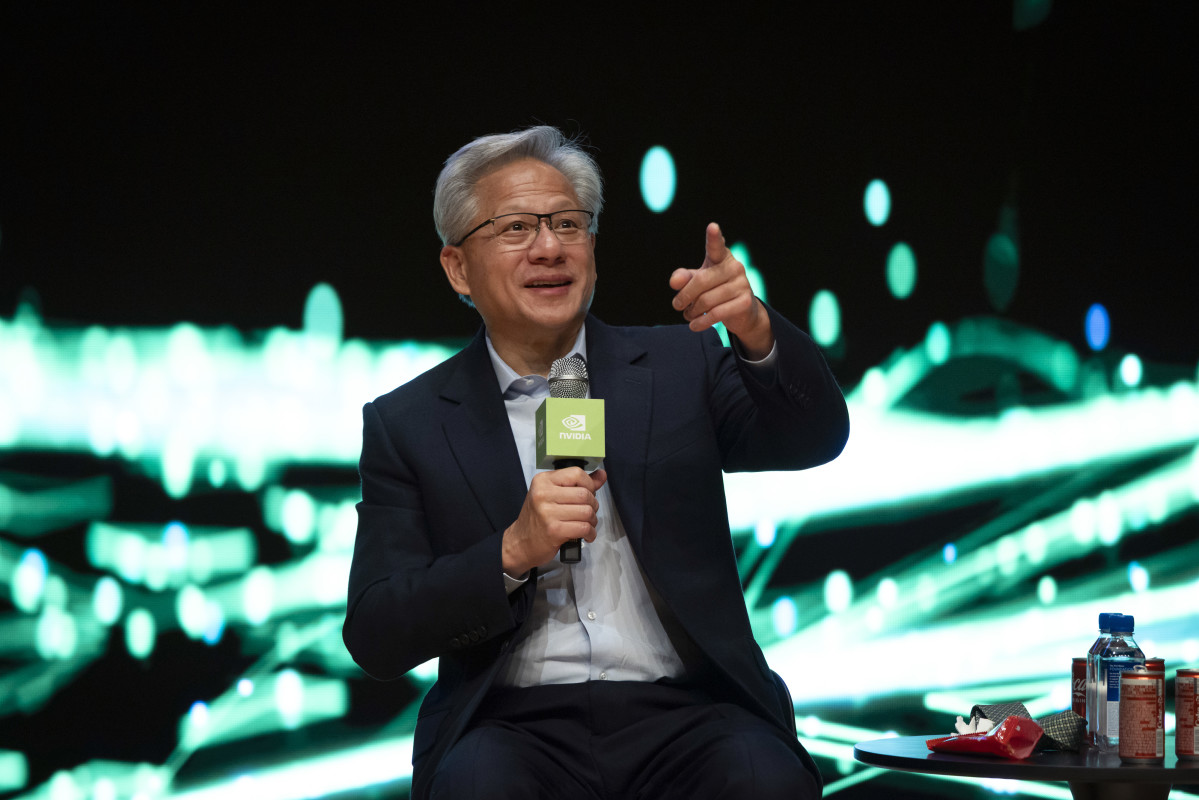 Nvidia’s Groq agreement looks less like a partnership and more like a strategic capture.
Photo by Woohae Cho on Getty Images
Nvidia gives Groq workers a payday
Axios says that Groq’s stockholders and employees are getting compensated as if they were leaving the company, even though no equity is changing hands. And Nvidia gets what it needs most for 2026: inference IP, talented engineers, and speed.
Axios’ reporting answers the question that immediately lit up social media: What happens to Groq employees if Nvidia “didn’t buy” the company?
More Nvidia:
- Nvidia’s China chip problem isn’t what most investors think
- Jim Cramer issues blunt 5-word verdict on Nvidia stock
- This is how Nvidia keeps customers from switching
- Bank of America makes a surprise call on Nvidia-backed stock
Axios adds that Groq stockholders will get cash payments for each share they own based on the $20 billion value, even though “no equity is changing hands.” The payments are set up like this: 85% up front, 10% in the middle of 2026, and the rest at the end of 2026.
Related: Novo Nordisk just pulled off something nobody saw coming
The terms are very generous for employees:
- It is likely that about 90% of Groq’s workers will go to Nvidia. They will get cash for vested shares and Nvidia stock that vests over time for unvested equity.
- Axios said that about 50 people in that category get their share faster and with cash.
- People who stay at Groq still get paid for vested shares and earn a package that is related to the company’s future.
- Axios claims that even new hires will profit because the usual one-year vesting cliff is being dropped, so employees who have been there for less than a year can still obtain liquidity.
Axios’ bottom line is so blunt: “Everyone gets paid. A lot.”
Groq’s inference edge is Nvidia’s prize
Groq’s own release frames the deal as a way to make “high-performance, low-cost inference” more widely available. It also says that Groq founder Jonathan Ross, President Sunny Madra, and other team members are joining Nvidia. It also says that Groq will be independent, with Simon Edwards taking over as CEO, and that GroqCloud will keep running.
Related: Alphabet makes a subtle Gmail shift ahead of 2026
The move is part of a larger trend in which Big Tech is looking for licensing-plus-talent deals to speed things up and make it easier to cope with rules.
This is Nvidia preparing for 2026, which will be all about “AI factories” and always-on inference (the term used to describe the continuous use of AI models, rather than their training).
Impact on Nvidia’s balance sheet, income statement
The $20 billion Groq deal that Nvidia just made is big news, but it’s not too much for a firm that makes money at Nvidia’s present rate. Nvidia has $60.6 billion in cash, cash equivalents, and marketable securities as of the conclusion of its quarter on Oct. 26. The free cash flow for that same quarter was about $22.1 billion. This means that the Groq price tag is about “one quarter of free cash flow” at the current run rate.
Related: This $40 PC fix might be the quietest MSFT signal for 2026
Nvidia is also still in a strong position to return cash, which is important. NVDA is aggressively buying back stock and giving cash back to shareholders while it builds up its AI infrastructure. This is one reason why most investors see this move as adding value rather than taking it away.
The timing of the cash payments is another aspect that is easy to overlook. The money that Groq stakeholders will get isn’t likely to come in one big check. The mechanism reported delivers around 85% of the money up front, 10% in the middle of 2026, and the rest at the end of 2026. That moves some of the cash effect into next year, which fits with the bigger notion that the payout is a strategic bet for 2026 and beyond, not merely a one-time headline.
Related: Warner faces a surprise new bid as investors do the real math
Finally, investors should closely monitor the “hidden” implications that may appear on the income statement in 2026.
The Groq employee transition is set up so that vested equity is paid out in cash and unvested equity is turned into Nvidia stock that vests over time. That’s a benefit for keeping employees, but it could also mean more stock-based pay and costs associated with integration. And depending on how Nvidia records the perpetual license, investors may see amortization or other non-cash expenses that are important for GAAP results even if cash flow is robust.
Nvidia’s deal is a blueprint for AI tie-ups
Investors should view the Groq structure as an indication that AI-driven dealmaking is evolving. The plan is straightforward: Get the essential IP, employ the leaders, and make sure the target stays “independent.”
It’s easy to see why this happens more often in 2026:
- It takes too long to examine AI infrastructure.
- Regulators have been wary of big mergers.
- Big companies can pay acquisition-level fees for “access” instead of “ownership.”
And the market conditions make it more likely. Coverage from Bank of America reveals patterns indicating significant chip growth in 2026, with Nvidia consistently being one of the largest companies to benefit from this trend.
Nvidia didn’t simply make a $20 billion purchase; it may have shown how major AI companies plan to expand in 2026: faster than regulators can stop them and with enough money to make “not an acquisition” feel like one.