
It’s no secret that tariffs, trade wars, and recession chatter have dominated the economic conversation over the past year.
Heading into 2026, though, Bank of America’s CEO isn’t buying into the panic.
In an interview with CBS News’ “Face the Nation with Margaret Brennan,” Brian Moynihan made a much quieter, contrarian argument that the tariff-induced shock engulfing markets last year is moving toward an endpoint.
For perspective, as of Dec. 26, 2025, the Nasdaq Composite has surged 22.2% year to date, the S&P 500 is up 17.9%, and the Dow is up 14.5%.
Related: Goldman Sachs resets bets on US economy in 2026
Contrary to what’s been making the rounds, Moynihan believes the tariff situation is starting to settle down.
He feels that once the dust settles around where the rates end up landing, businesses will adapt swiftly.
Costs will get priced in, and supply chains will adjust.
Moreover, Moynihan also points to steady consumer spending, ongoing wage expansion, and a loosening labor market that’s far from broken.
Even the Federal Reserve, he suggests, matters a lot less than Mr. Market thinks, as long as its independence stays intact.
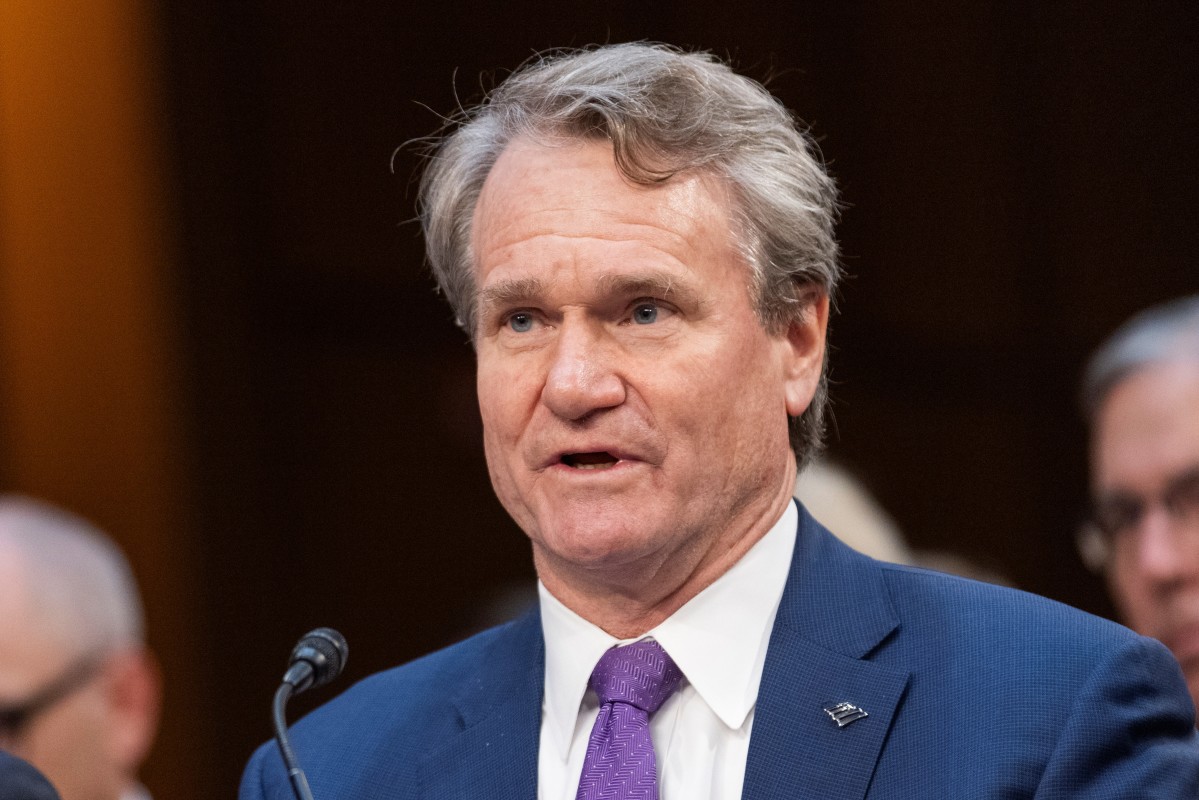 Bank of America CEO Brian Moynihan says the economy may be sturdier than recent market fears suggest.
Photo by Xinhua News Agency on Getty Images
Moynihan thinks the tariff shock is fading
Moynihan makes the case that the escalation period has passed, and that the market is dealing with something a lot more digestible.
In his view, tariff levels are actually clustering at this point.
To better understand why he frames it that way, it’s imperative to look at how 2025 unfolded.
How the 2025 tariff shock played out
- Jan. 1, 2025: A 50% U.S. tariff on Chinese chips took effect, adding early-year pressure.
- April 2-5 (“Liberation Day” shock): The U.S. announced a 10% minimum tariff on most imports, CNN reported, along with higher “reciprocal” rates on 59 countries.
- April-May (China spike and then truce): Some U.S.-China tariffs jumped to an eye-popping 125%, then a May 12 deal cut April hikes to 10% for 90 days (later extended).
- Late July: A 15% to 20% “world tariff” was floated, according to The Star, with the U.S.-EU landing at 15%, compared to a previously expected 30%.
- Aug. 1–7: Tariffs broadened to 10% to 41% on 69 partners, Reuters reported, taking the effective U.S. tariff rate near 18%, up from 2.3% the prior year.
Moynihan still feels China and North America (USMCA) are exceptions, but outside those lanes, the tariff story is mostly stabilizing.
The data behind 2025’s tariff turbulence
The crippling impact of 2025’s tariff shock can be gauged from a handful of hard numbers. The initial hit was quick and unsettling, to say the least.
With that said, here’s what the data say:
- Inflation impact: Earlier in the year, Yale’s Budget Lab estimated 2025 tariffs bumped the U.S. price level by 2.3% in the short-term, equal to nearly $3,800 per household (2024 dollars).
- Tariff level reset: By late 2025, the effective U.S. tariff rate surged to nearly 16 to 17%, compared to the low single digits before the shock took effect.
- Trade flows shifted: Tariffs generated north of $236 billion in sales through November 2025, as imports from China slid 25% in the first three quarters.
- Market reaction: After the April 2 announcement, the S&P 500 tanked nearly 15% at the trough, wiping away about $5 trillion in market value in just a few days, according to Reuters.
Labor and consumers matter more than tariffs right now
Moynihan is clear in that the real economic wild card sits elsewhere, with the big uncertainty for businesses currently being labor, and not trade policy.
He notes that for small and mid-sized businesses, the real challenge is figuring out whether they can hire and retain workers.
Labor availability, which is often linked to immigration-policy clarity, continues getting tougher to plan around.
Though tariffs typically lift costs at the margin, workforce uncertainty directly impacts growth decisions and long-term expansion.
More Experts
- Longtime fund manager sends blunt message on P/E ratios
- Jim Cramer issues blunt 5-word verdict on Nvidia stock
- What the White House decision really means for Nvidia
- Michael Burry shares bold predictions for OpenAI, Palantir
At the same time, consumer behavior just hasn’t cracked.
Moynihan said consumer spending through late November and early December was up a healthy 4% to 4.5% year over year.
On top of that, the early season-read data show strong growth, with Visa estimating holiday retail spending up 4.2% (November 1 to December 21 period).
More importantly, growth is still showing up across all income brackets, which is happening even as the affordability sentiment remains weak.
Additionally, the labor data help to explain why.
Wage growth is running near 3%, while the U.S. unemployment rate stood at 4.6% in November 2025, or about 7.8 million people, per the Bureau of Labor Statistics.
Job growth is cooling but intact, with 64,000 jobs added in November after an October decline linked to the shutdown impact.
However, at the same time, it’s apparently taking people longer to find work. Forbes indicated that continuing jobless claims increased to nearly 1.92 million (week ending December 13).