
McDonald’s has thrived despite a significant increase in competition since its early days as one of the pioneers of the fast-food space.
Back in the 1960s, only a handful of chains could be considered national. That number has grown each decade and, now, McDonald’s faces not only Burger King and Wendy’s as direct competitors, but higher-end burger chains like Shake Shack and Five Guys.
It also must compete with a deep roster of non-burger brands ranging from established players like KFC, Taco Bell, Chick-fil-A, and Chipotle to emerging brands, including Dave’s Hot Chicken and Raising Cane’s. You can also argue that players like Panera Bread, Starbucks, and Dunkin’ give consumers more options than they have ever had.
Even with growing competition, McDonald’s remains a market leader, with U.S. same-store sales rising 2.4% in the third quarter, according to its Q3 earnings release.
That’s growth that has left rivals like Arby’s, which has closed dozens of stores in 2025, struggling to compete.
McDonald’s has considerable advantages
“For any aspiring competitor, taking on McDonald’s means overcoming several huge hurdles. These barriers are what keep the threat of a new global rival from being high,” Eat Healthy 365 shared.
Some of those barriers include:
- Brand Equity and Loyalty: McDonald’s has spent decades and billions of dollars building one of the most recognized brands on Earth. A new company simply can’t replicate that trust and nostalgia overnight.
- Economies of Scale: With over 40,000 locations worldwide, McDonald’s buys supplies in immense quantities. This allows them to get potatoes, beef, and buns at a much lower cost per unit than a startup could ever hope for. This cost advantage is directly passed to the consumer through their value menu.
- Supply Chain and Distribution: The company’s global supply chain is a masterpiece of logistics. They have a network of farmers, bakers, and distributors dedicated to supplying their restaurants with consistent products daily. A new entrant would have to build this complex network from scratch.
- Prime Real Estate: For decades, McDonald’s has secured the best and most convenient real estate locations—busy intersections, highway exits, and urban centers. These premium spots are either unavailable or prohibitively expensive for newcomers.
That puts even large rivals like Arby’s in a challenging position.
Here’s why Arby’s has struggled
Arby’s built its business around roast beef sandwiches, but it’s far removed from the days when it literally carved roast beef sandwiches in its stores (something the chain did in its early days).
Having observed the fast-food space for more than 30 years, I’ve noticed that Arby’s no longer slices roast beef in-store, which alters the product experience compared to traditional roast beef chains. While prices remain reasonable, the balance between value and quality is less compelling.
Miracle Restaurant Group, an Arby’s franchisee since 2005, filed for Chapter 11 bankruptcy in 2024, according to PacerMonitor. Some of the issues noted in the filing documents offer insight into why Arby’s locations have struggled.
“In the court filing, manager Donald Moore cited inflationary pressures on commodity and labor costs that outpaced price increases, leading to a significant erosion in variable cash flow. In 2023 and the first half of 2024, negative same-store sales and disappointing performances from newer stores (built within the past three years) led to extremely low or negative cash flows,” the company shared, QSR Magazine reported.
More Restaurants
- Taco Bell and KFC work on simplifying their restaurants
- Chick-fil-A making major change to 425 restaurants nationwide
- Bankrupt beer and pizza restaurant chain closes locations
- Restaurant chain famed for rude waiters closes multiple locations
Arby’s is not publicly traded, but its parent company does report some financials.
“In 2024, Arby’s parent company, Inspire Brands, reported $29.5 billion in total sales, but the fast food chain had the weakest performance among its six sister brands. According to the report, Arby’s sales declined by 6.3% in 2024, and the chain closed 48 locations last year — including its most famous location in Los Angeles,” All Recipes reported.
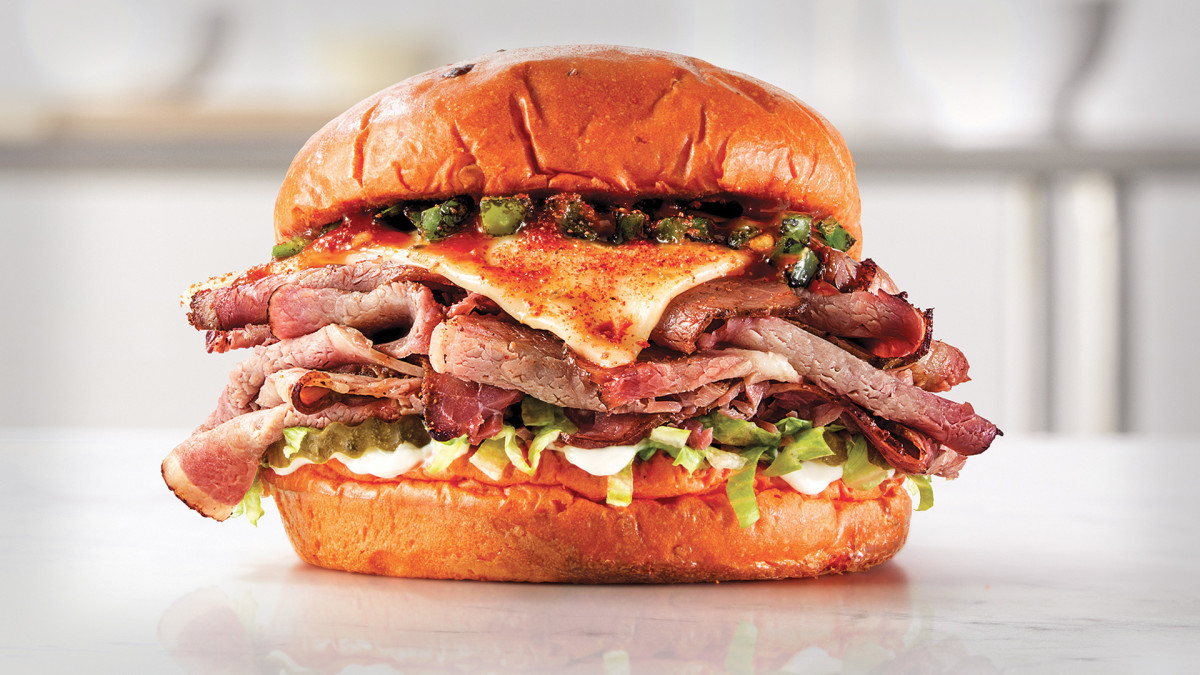 Arby’s core product is still roast beef sandwiches.
Arby’s
Arby’s has been closing restaurants
- 48 restaurants closed in 2024, about 1.4% of U.S. locations, with sales down 6.3%, according to MoneyDigest.com.
- At least 14 more closures in 2025, across Tennessee, Florida, California, New Jersey, Maryland, Delaware, South Carolina, and Washington, according to The Independent.
- As of late 2025, several former Arby’s sites are being converted to other brands, reflecting broader marketplace shifts, reported the Jacksonvile Daily Record.
- The closures highlight rising operating costs and soft consumer demand affecting the wider fast-food sector, according to MoneyDigest.com.
- No official nationwide closure plan announced, but more locations could close as chains adjust to 2025 market pressures, added MoneyDigest.com.
Food prices have been going up
Prices for food away from home rose 3.7% between September 2024 and September 2025,” according to data from the U.S. Bureau of Labor Statistics.
With inflation, rising costs affect chains and consumers alike, and 62% of Americans surveyed reported eating less fast food in 2024, according to a QSR Magazine survey.
Another survey from LendingTree in May 2024 showed similar results:
- Americans love fast food, but costs are forcing them to curb their cravings. 3 in 4 Americans typically eat fast food at least once a week, but the majority (62%) say they’re eating it less due to rising prices. In fact, 65% of Americans have been shocked by the high price of a fast-food bill in the past six months.
- Are burgers the new Birkins? 78% of consumers view fast food as a luxury because it’s become increasingly expensive. Additionally, half of Americans say they view fast food as a luxury because they’re struggling financially.
- Americans are opting for food at home. While 67% of Americans agree fast food should be cheaper than eating at home, 75% say this isn’t the case.
Major fast‑food closures in 2025 (U.S.)
- Wendy’s is planning to close hundreds of U.S. locations starting in late 2025 and into 2026, with estimates of roughly 240–360 restaurants slated for shutdown. Closures target underperforming units as part of a portfolio overhaul, according to comments made during Wendy’s third-quarter earnings call.
- Jack in the Box has already closed at least 72 stores in 2025, with plans to shutter 80–120 more by year‑end and up to 150–200 total closures by mid‑2026 under its restructuring strategy, according to an SEC 8-K filed by the chain.
- Burger King itself isn’t announcing a systemwide closure count for 2025, but a Burger King franchisee with 57 restaurants filed for Chapter 11 in April 2025, signaling ongoing footprint shrinkage and risk to local units. reported TheStreet’s Kirk O’Neil.
These Arby’s locations closed in 2025
- California: Arby’s closed at least two California stores this year, according to newspapers there, with one in Fresno and another in Victorville.
- Delaware: A restaurant in Talleyville closed earlier this year.
- Florida: Four Jacksonville-area stores closed in early 2025.
- Maryland: At least one Arby’s closed in Laurel in March.
- New Jersey: An Audubon Arby’s closed in January.
- South Carolina: A North Charleston location closed in July.
- Tennessee: Three Arby’s locations in Cordova, Germantown and Memphis.
- Washington: One Pullman, Washington store closed back in June.–≠
Related: Starbucks store hours for New Year’s Eve and New Year’s Day 2026