
The bold American move to snatch Venezuelan strongman Nicolas Maduro and his wife has given stocks a boost as they enter this week.
The gains came as Venezuelan opponents to Maduro’s presidency celebrated all weekend around the world — from Australia to England, Spain to Florida and New York.
So did President Donald Trump and his administration.
Madura and his wife Celia Flores were seized at the presidential compound in Caracas early Saturday, Jan. 3, helicoptered to the giant amphibious ship USS Iwo Jima standing by off the Venezuelan coast, and then flown directly to New York that night.
The couple may make their first U.S. court appearances on drug trafficking charges on Monday.
The celebrations inevitably wound down, and, as they did, the questions came fast and furiously. The answers may come later.
In early trading on Jan. 5, the Dow Jones Industrial Average was up about 0.69%. The Standard & Poor’s 500 Index was up 0.58%. The Nasdaq was up 0.61%.
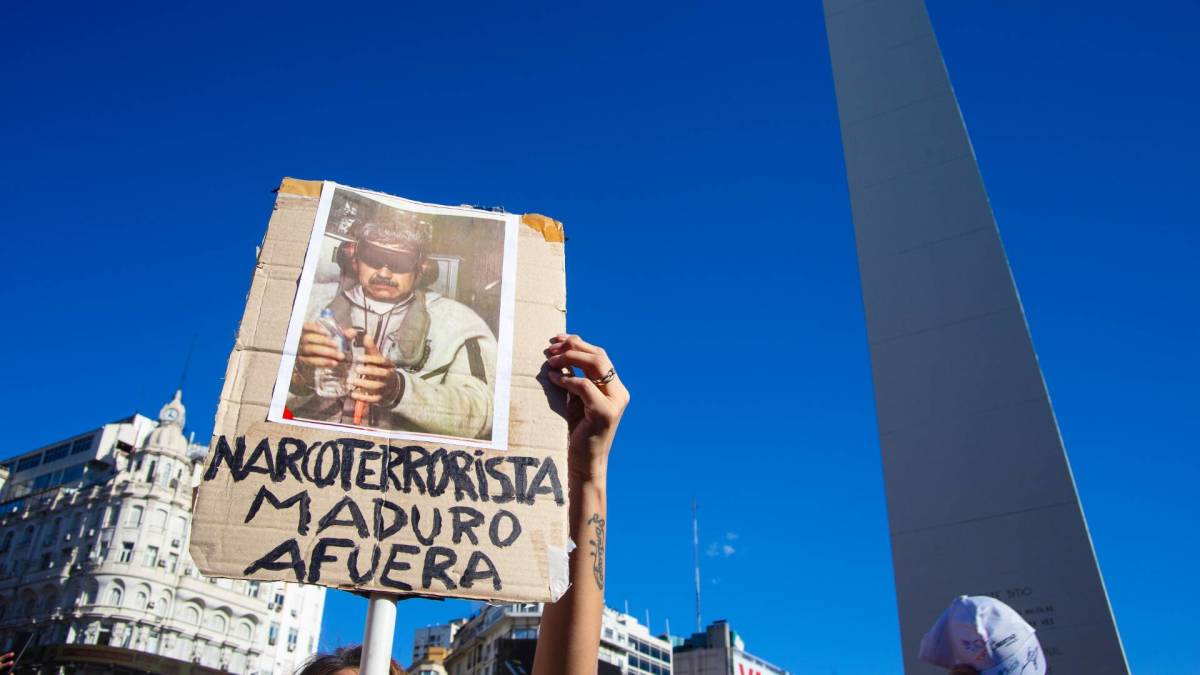 Venezuelans celebrate President Nicolas Maduro’s arrest.
Bordoni/NurPhoto via Getty Images
After Maduro’s seizure, there are so many questions
One can’t say the smaller gains were the product of the U.S. military’s capture of Maduro.
Instead, the Venezuela event was the financial equivalent of a hand grenade tossed randomly into a crowd of mostly bullish investors who have been expecting a big year for stocks in 2026.
To recap quickly, promised U.S. forces bombed Caracas, Venezuela’s capitol, stormed the presidential compound early Saturday and flew off with Maduro and his wife in handcuffs. They are now in custody in Brooklyn, awaiting arraignment this week.
President Trump said the United States would now “run” Venezuela, get a stable government organized and then start to get Venezuela giant oil reserves into production again. And that started the questions.
Who would actually run Venezuela?
The American position Saturday morning, Jan. 3, was that Venezuelan Vice President Delcy Rodríguez was cooperating, The Washington Post reported. Not long after, Rodríguez demanded that Maduro be released. Later, President Trump, on the way to playing golf, said, “If she doesn’t do what’s right, she is going to pay a very big price, probably bigger than Maduro,” The Atlantic reported.
Would American troops be on the ground?
Not clear. The thinking was they would be stationed off Venezuela’s 1,700-mile-long coast. For how long? Also not clear.
How many personnel were involved in the weekend’s raid?
One way or another, maybe 15,000.
Is that enough to run/manage/monitor the country?
That is the $64,000 question. Venezuela’s population of maybe 28.5 million, nearly the same as California’s, is a challenge to serve. (The economy has slumped so badly in recent years that millions fled.) If the country’s civil structure falls apart, the U.S. experience in Iraq suggests the number of military and others could grow rapidly. And one has to worry that the U.S. could be stuck in Venezuela much longer than now seems to be the case.
Venezuela’s oil is the key
This is the elephant fact: Venezuela has the world’s largest proven oil reserves, some 300 billion barrels in deposits, mostly near the coast, according to the EIA.
That’s number one globally, ahead even of Saudi Arabia. For many years, Venezuelan oil was tops among crudes exported to the United States, mostly to refineries along the Gulf of Mexico engineered to deal with thick oil laden with sulphur.
More Wall Street
- Analyst who nailed 2023 bull run sets S&P 500 target for 2026
- Longtime fund manager sends blunt message on P/E ratios
- Nasdaq’s near 24-hour trading plan sparks Wall Street backlash
- Every major analyst’s S&P 500 price target for 2026
Who would be in charge of Venezuela’s oil?
President Trump suggested Jan. 3 that U.S. companies would be invited back in. U.S. companies controlled most oil resources until they were expropriated in 1976.
But Venezuelan oil production has fallen perhaps 70% since 2000, according to Canadian Broadcasting company CBC, even as reserve estimates grew. Causes include soft oil prices, embargoes against Venezuelan exports, corruption, and mismanagement. Only Chevron Corp. (CVX) still operates in the country.
Frankly, many more questions remain about this situation, and weeks or months of confusion lie ahead.
The big unknowns are whether drug cartels will try to disrupt matters or whether widespread opposition to the U.S. presence will emerge in and around the country.
U.S. stocks slide as 2025 moves into 2026
The market finished lower last week, as worries about job growth and inflation seemed to bother investors.
The S&P 500 ended the week down 1%. The Nasdaq was off 1.5%, and the Dow itself was off 0.7%.
But it was a light week of trading, the second in two weeks, because of the holiday season. The year 2025 was bullish, with the S&P 500 up 16.6%. The Nasdaq added 20.4%.
It was the third straight year of gains for the S&P 500, but a report from S&P senior analyst Howard Silverblatt noted the 2026 gain was also lower for a second straight year.
In 2024, the S&P rose 23.2% and 24.2% in 2023.
Is the Santa Claus rally in trouble?
If you love market trivia, we must now say a classic Santa Claus rally is at risk.
The phenomenon was first named by the late Yale Hirsch of the Stock Trader’s Almanac and posits that S&P 500 gains over the last five trading days of one year and the first two of the next can lead to stocks rising for the year.
The days to watch in 2025-2026 were Dec. 24 through Jan. 5. As of Friday, Jan. 2, the S&P 500 was down 1.06% over the first six days of observations. So, the market needs to perform on Monday, Jan. 5.
The phenomenon is accurate about 69% of the time. But the stock market rises about 70% of the time.
The better indicator may be the January Barometer, also devised at the Stock Trader’s Almanac, which argues that an up market in January means an up market for the year. The Almanac says it has been right about 83% of the time since 1950.
It has been wrong now and then, perhaps most famously in 2003.
The S&P 500 fell 2.74% in January 2003, ahead of the Iraq War that toppled Saddam Hussein. But the successful military campaign ignited a huge rally that saw the S&P 500 rise nearly 16% by mid-June. The end of 2003 saw the index up 26.4%.
U.S. stocks had five years of gains through 2007. Then, the Great Recession extracted a 38% price for all that fun.
In 2025, the index was up 2.75% in January. But the April tariff panic soon followed. The S&P roared by nearly 42% and ended the year up 16.6%.
Related: How Netflix could benefit most by losing the Warner Bros. deal
Big reports ahead on jobs, housing, consumer confidence
After all that, important reports set for release this week may also affect markets. But as Kim Wallace of 22V Research wrote in a note cited by Bloomberg, Venezuela assures “a lively start” to understanding U.S. economic policy.
Much attention will be paid to how the market deals with Venezuela, especially as Maduro makes court appearances this week.
Also, watch how the bond market behaves. The 10-year Treasury yield, a key component of mortgage rates, was at 4.17% on Friday, Jan. 3, up from 4.14% a week earlier. The 30-year mortgage rate is about 6.2%.
The big report — the jobs report for December — is due Friday, Jan. 9. The consensus estimates are:
- Fewer jobs created: About 54,000, down from 64,000 in November.
- A higher unemployment rate: 4.7%, up from 4.6% in November.
The BLS will also report on Wednesday, Jan. 7, regarding November job openings, quits, and layoffs.
Also on tap: The Institute for Supply Management’s December surveys of manufacturers and service providers will offer clues about employment in those industries.
At week’s end, the U.S. government will report on October housing starts, while the University of Michigan issues its preliminary January consumer sentiment index.
Related: U.S. migration trends: Why Americans are leaving some states and flocking to others