
Goldman Sachs just dropped its biggest AI-driven calls so far this year, as it lifted Taiwan Semiconductor Manufacturing’s stock price target in a big way.
The bank bumped its Taiwan-listed target to NT$2,330 from NT$1,720, a move that may seem relatively modest until you do the math.
TSMC’s U.S.-listed ADR represents five Taiwan shares, which equate to an ADR target of roughly $370–$375, representing a 35% increase compared to Goldman’s previous call. With TSMC stock trading near $319.61, that suggests a potential 16% to 17% upside.
After years of covering semiconductor cycles, a move this aggressive often suggests the bottleneck is becoming tougher to ignore.
Mr. Market is clearly upbeat about its potential to surprise in 2026, having risen almost 10%in the past month, while the S&P 500 has remained largely unchanged.
The primary reason for this is TSMC; AI demand is growing well beyond current expectations, and with it powering the infrastructure behind it, there’s still a lot to be excited about with the stock.
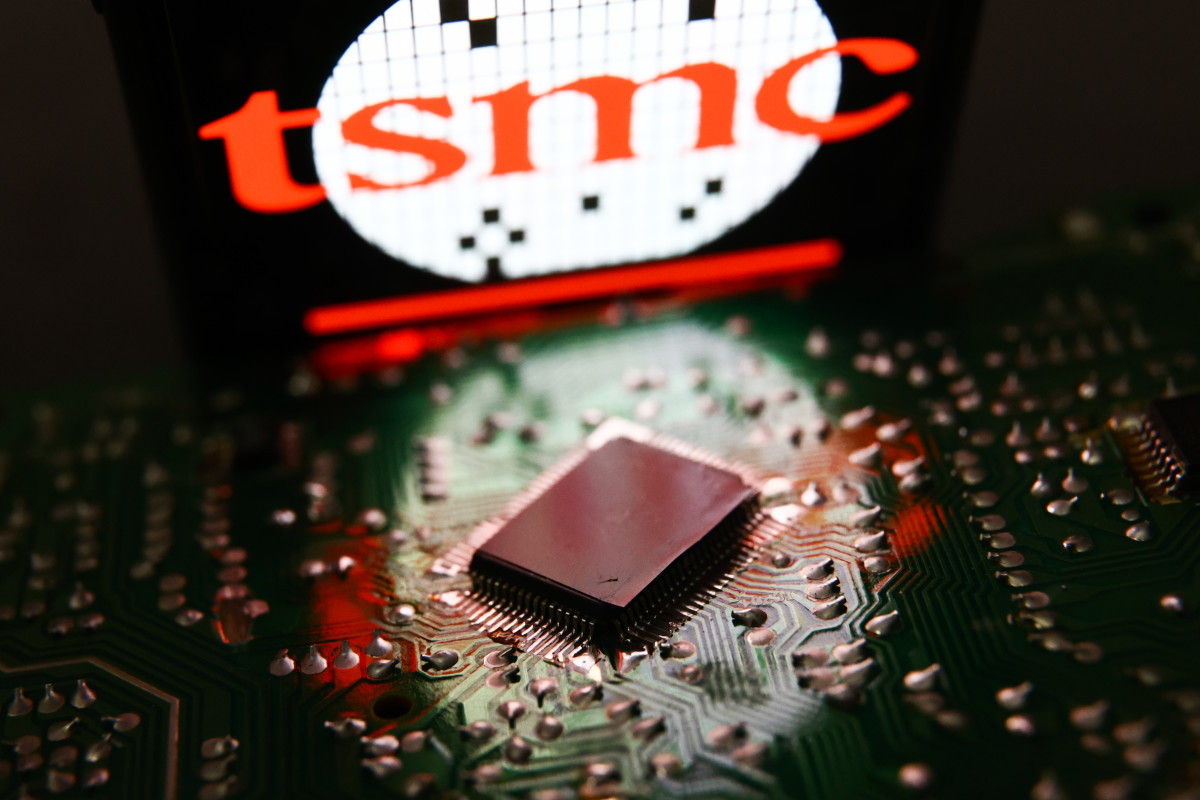 Goldman’s bold call underscores how critical chipmakers are to the AI supply chain.
Photo by NurPhoto on Getty Images
Goldman Sachs thinks TSMC’s AI run is just getting started
Goldman Sachs’ aggressive take rests on the premise that AI is a multi-year growth engine for Taiwan Semiconductor Manufacturing, effectively reshaping demand, pricing, and margins.
Analyst Bruce Lu argues that demand for AI “tokens” is growing at an exponential pace, keeping advanced-chip demand ahead of supply. That imbalance gives TSMC significant leverage, even as it spends heavily to expand its capacity.
Lu feels that 2026 is a year set to be “all about AI.”
More Tech Stocks:
- Morgan Stanley sets jaw-dropping Micron price target after event
- Nvidia’s China chip problem isn’t what most investors think
- Quantum Computing makes $110 million move nobody saw coming
- Morgan Stanley drops eye-popping Broadcom price target
- Apple analyst sets bold stock target for 2026
Despite three consecutive years of eye-popping investment, he sees margins rising as new fabs come online and boost productivity.
In particular, the tight capacity at TSMC’s most advanced 3nm and 5nm nodes will persist through 2027.
The TSMC numbers are tough to ignore:
- Earnings outlook: Lu has bumped his 2026 and 2027 EPS estimates by 9% to 15%, with earnings per share expected to reach NT$100 ($3.20) by 2027.
- Growth expectations: Sales are projected to increase by 30% in 2026 and 28% in 2027, representing a substantial rise from prior forecasts of 22% in both years.
- Investment and margins: TSMC is expected to spend more than $150 billion in capex from 2026-2028, including $54 billion in 2027 (gross margins above 60%).
Inside the AI bottleneck that’s working in TSMC’s favor
TSMC has effectively become the toll booth of the AI supply chain, performing remarkably better than the broader tech space.
The receipts back that up.
For perspective, in Q3 2025, TSMC reported $33.1 billion in sales for its high-performance computing platform, accounting for 57% of sales, compared to 30% from smartphones.
Related: Veteran analyst delivers blunt 3-word take on Tesla after report
Perhaps an even more telling statistic is that 74% of wafer sales came from 7nm-and-below, along with 23% from 3nm (the go-to for AI chips).
Moreover, demand remains as robust as ever.
The company said it continues to see healthy demand for AI-related products, while updating its full-year sales forecast to close near the mid-30% range.
The AI giant is also maintaining a capital expenditure (capex) level of $40 to $42 billion.
Importantly, 10% to 20% of that spending is earmarked for advanced packaging, testing, and masks, the unglamorous plumbing that is mission-critical for GPUs to ship on time.
That plumbing is imperative because advanced packaging, particularly TSMC’s method CoWoS, remains the key choke point for the industry.
As we look ahead, CoWoS capacity is expected to continue growing, with Bernstein estimating that TSMC’s capacity will increase to 125,000 wafers per month by the end of 2026, Investing.com reports.
Despite the impressive ramp-up, giants like Nvidia are blunt in saying that packaging constraints are likely to persist.
A technical signal that traders rarely ignore is flashing on TSM stock
Another pertinent bullish take comes from TheStreet Pro’s veteran analyst and trader Stephen Guilfoyle, nicknamed “The Sarge.”
Put simply, Guilfoyle lays out the case that TSM stock has moved from a consolidation period into a renewed uptrend.
His core argument centers on the formation of a bullish “inverted head-and-shoulders” pattern, indicating that the stock spent months building a foundation, pushing back above key levels that traders are closely monitoring.
TSM has reclaimed both the short-term and medium-term moving averages, indicating that buyers are in control and momentum is building without triggering “overbought” warnings.
This sets the stage for more upside, as Guilfoyle explains.
Based on that technical backdrop, he assigns an even higher price target of$377 on TSM stock, arguing its current strength reflects improving fundamentals.