
The U.S. auto industry has been transformed over the past five decades.
Once the envy of the automotive world due to its sheer volume, the U.S. auto industry is still extremely valuable as the second-largest market behind China. Still, the market has shifted in recent years.
U.S. 2025 new-vehicle sales forecast
- GM: 2.83 million vehicles (+5.1% year over year); 17.3% market share
- Toyota: 2.52 million vehicles (+8.4% YoY); 15.5% market share
- Ford: 2.18 million vehicles (+5.6% YoY); 13.4% market share
- Hyundai: 1.84 million vehicles (+7.9% YoY); 11.3% market share
- Honda: 1.42 million vehicles (+0.6% YoY); 8.8% market share Source: Cox Automotive
While U.S. hallmark General Motors still closed 2024 with the highest U.S. market share at 17% and Ford ranks third with a 13% market share, foreign models from Asia round out the top five, according to Cox Automotive data.
Toyota ranks second with 15% U.S. market share, while Korean brand Hyundai ranks fourth with 11%. Toyota’s fellow Japanese brand, Honda, is fifth in the market, with 9%.
Hyundai is especially impressive, since the Korean automaker had an inauspicious start in the U.S.
Early last summer, Hyundai Motor North America CEO Randy Parker said, “We just wrapped up the strongest first half in Hyundai’s history, driven by sales growth across our lineup,” after the company sold 439,280 vehicles worldwide in the first half of 2025, a 10% year-over-year increase that was capped by a 10% second-quarter increase to 235,726 units.
June sales increased 3% year-over-year to 69,702 units in North America. The company carried that momentum into the second half of the year, leading to another U.S. sales record for the company.
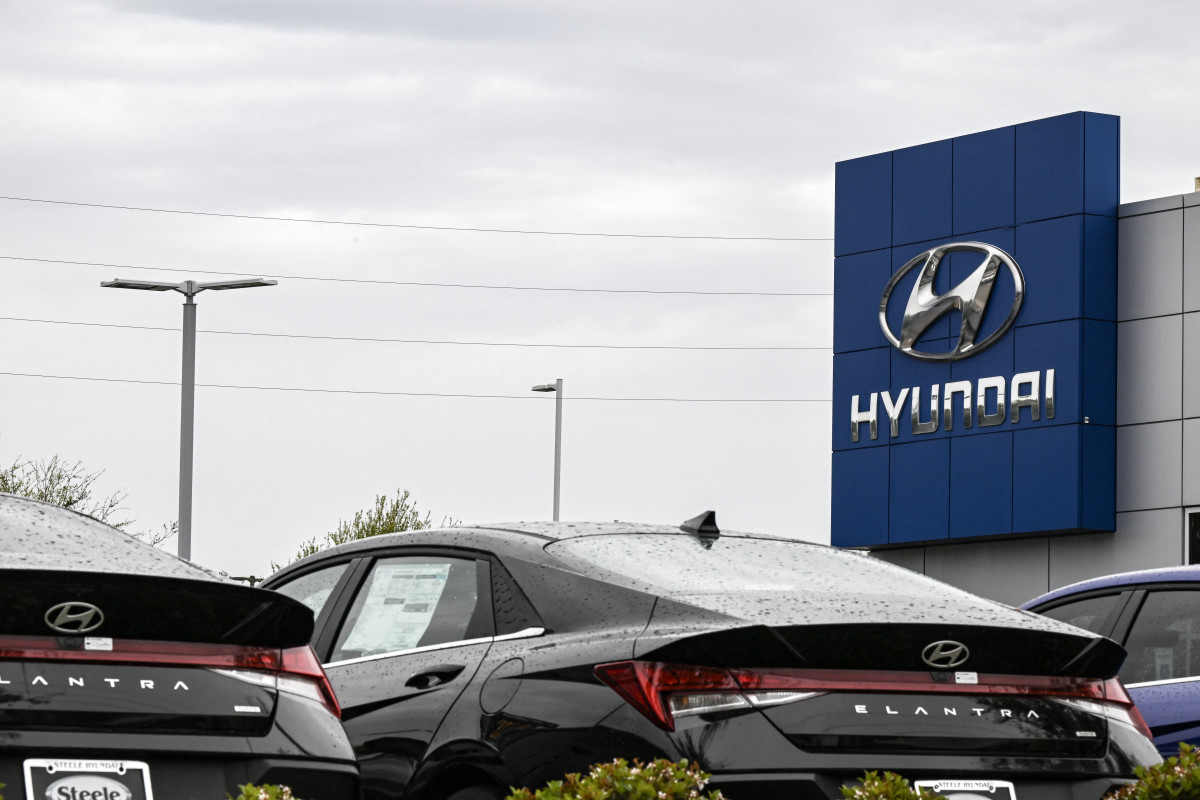 Hyundai saw strong sales this past year.
Photo by RONALDO SCHEMIDT on Getty Images
Hyundai sets new U.S. sales record for fifth consecutive year
Hyundai followed up a strong 2024 with an even stronger 2025 as the Korean carmaker announced its fifth consecutive year of record annual retail sales.
Hyundai sold 772,712 vehicles in the States last year on the way to selling more than 900,000 cars globally.
Related: Ford, GM take issue with Elon Musk’s special treatment
Hyundai reports that electric vehicles accounted for 30% of its total sales, including its best-selling EV, the IONIQ 5, which was purchased by more than 47,000 Americans last year.
While Hyundai is a foreign company, it has a large manufacturing footprint in the U.S.
Hyundai’s Alabama plant, the company’s first U.S. facility, was built in 2005 and employs approximately 4,200 people. The plant has assembled more than 6.2 million vehicles since its inauguration and produced nearly 360,000 last year.
Kia, Hyundai’s sister company, also reported record U.S. sales for the third consecutive year.
Kia sells more than 850,000 vehicles in the U.S. after shifting its tariff strategy
Kia sold 852,155 vehicles in 2025, marking the third consecutive year the Korean carmaker has reported record U.S. sales and the first time it has topped 800,000 vehicles sold.
The strong sales record was possible due to record-setting years from four of its most popular models: the Carnival, Sportage, Telluride, and K4.
Related: New car buyers are resorting to a risky trend
Kia’s top-selling vehicles 2025 (through October)
- Sportage: 150,159 year over year +13%
- K4/Forte: 117,598 YoY +1%
- Telluride: 101,069 YoY +11%
- Sorento: 80,710 YoY +5%
- K5: 60,212 YoY +76% Source: Kia
Meanwhile, the Kia Sportage SUV was the company’s best-seller, moving nearly 183,000 vehicles, a 13% increase from 2024.
The record year didn’t come without bumps in the road, as the company was forced to shift its strategy this summer amid a fluid tariff environment.
On July 25, Kia announced that it would adjust its U.S. business operations, cutting the incentives that automakers have been using to entice tariff-weary shoppers.
Kia vehicles manufactured at its Georgia facility would be prioritized for the U.S., while supplies shift away from Mexico and the Middle East. Meanwhile, cars made in Korea will be redirected to Canada to avoid U.S. tariffs.
At the time the changes were announced, Kia’s quarterly operating profit of 2.8 trillion won ($2 billion) was down 24% year over year, despite sales climbing 6% during the period.
Tariffs alone cost the company $569 million in the quarter.
Related: ‘AI slop’ is taking over the most popular social media platform