
Shares of General Motors were falling 1% at last check Monday afternoon, Jan. 12, but the stock clawed back from steeper declines soon after the opening bell.
The automotive company was still reeling from its latest 8-K filing, in which the company detailed the $6 billion charge it incurred in the fourth quarter due to struggles in its electric vehicle division.
General Motors Q3 facts at a glance:
- U.S. market share: 17%
- Electric vehicles sold: 67,000
- EV market share: 16.5%
- Dealer inventory: Down 16% year over year
- EV inventory: Down 30% since June Source: General Motors
Approximately $1.8 billion of that amount is comprised of non-cash charges for supplier commercial settlements and contract cancellation fees.
The rest is comprised of cash charges of $4.2 billion, as it looks to wind down production in response to waning U.S. demand for electric vehicles.
However, analysts at Citigroup see an opportunity for the company to recalibrate and come out the other end of its EV restructuring stronger than it was before.
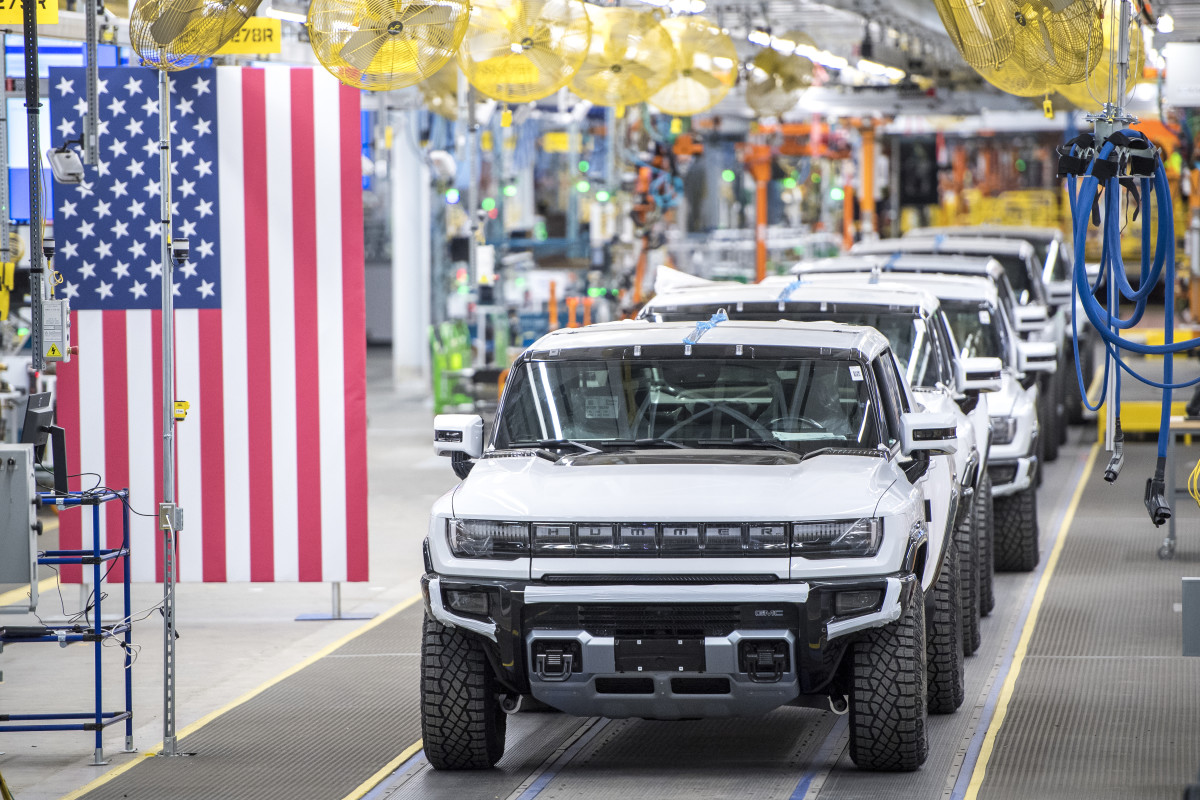 GM North America plans a strategic realignment of its EV capacity and manufacturing footprint.
Photo by Nic Antaya on Getty Images
Citigroup upgrades General Motors following $6 billion charge
Analysts at Citi are bullish on General Motors following the company’s announcement of a $6 billion price tag for its EV restructuring plans.
The firm raised its price target on General Motors to $98 from $86, while maintaining a buy rating on the company’s shares. According to Citi, the $6 billion charge and restructuring will bring lower operating expenses and reduced supplier reimbursements.
Related: GM puts $6 billion price tag on latest mistake
Those savings will help GM North America get its margins back in the 8% to 10% targeted range, according to Citi.
GM shares were down 0.75% to $82.24 at last check on Jan. 12.
In October, the country’s largest automaker by volume said its board of directors approved third-quarter charges of $1.6 billion in GM North America for a “planned strategic realignment of [its] EV capacity and manufacturing footprint” to match consumer demand.
That included a non-cash impairment charge of $1.2 billion in the quarter, as the company is in the process of converting EV manufacturing platforms for other purposes, and another $400 million in contract cancellations and commercial settlement fees.
However, the company warned in an 8-K filing at the time that the $1.6 billion figure could grow substantially as it conducted a reassessment of its EV capacity, manufacturing footprint, and battery component manufacturing.
Turns out the final number was four times larger.
General Motors to lay off over 1,100 workers at Factory Zero
General Motors Factory Zero plant is an all-EV assembly plant located in the Detroit-Hamtramck, Michigan area.
The plant was originally built in 1985, but it was retrofitted to produce electric vehicles (EVs). Currently, it manufactures the GMC Hummer EV pickup and SUV, the Chevy Silverado EV, the Cadillac Escalade IQ, and the GMC Sierra EV.
Related: Ford, General Motors get disturbing news on car sales
Largest Regional BEV sales 2024:
- China: 6.4 million
- Europe: 2.2 million
- U.S.: 1.2 million
- Rest of the world: 1 million Source: International Energy Agency
In October, GM announced that it would reduce production at the factory to one shift and lay off more than 1,000 workers.
According to a Worker Adjustment and Retraining Notification Act notice GM filed with the Michigan Department of Labour and Economic Opportunity, GM is scheduled to lay off 1,140 hourly employees from Factory Zero effective January 5, 2026.
Factory Zero currently employs about 4,000 workers, but there were also a series of layoffs at the plant earlier this year.
U.S. EV sales falter after $7,500 tax credit expires
U.S. EV sales dropped sharply in October, the first month without the $7,500 government tax incentive.
Dealers sold 74,835 electric vehicles in the U.S. in October, according to Cox Automotive data, representing a 48.9% year-over-year decrease.
“Buyers rushed to secure incentives before the deadline, but once it passed, momentum slowed. Inventories climbed quickly, and pricing shifted upward for both new and used EVs, reflecting a market in transition.”
U.S. car buyers purchased 90 different EV models in the third quarter, but only nine sold more than 10,000 units.
Tesla Model Y and Model 3 were top sellers, moving more than 114,000 and 53,000 vehicles, respectively. GM’s own Chevy Equinox sold just under 25,000.
However, those three models were outliers.
“The vast majority of EVs sell at a rate of far less than 2,000 units a month, or 6,000 units a quarter. In the volume-driven business of automotive manufacturing, low volume is the enemy; EV profitability remains a distant dream for nearly every automaker,” according to Cox Automotive.
Related: General Motors makes a harsh decision as EVs falter