
If people don’t go to the office, then all of the infrastructure built to support workers stops being viable.
Remote and hybrid work are reshaping downtown economies, and restaurants are among the businesses feeling the impact most acutely.
“As remote or hybrid work continues to be popular, office attendance has fallen. Less in-person work may increase office vacancy rates and reduce foot traffic to other businesses located in office-dense areas,” according to data from the Federal Reserve.
That shift played out firsthand near my former office, where a Starbucks in the attached hotel closed after the pandemic.
For businesses, it’s death by a thousand paper cuts. It’s not the loss of any one customer, but thousands of them visiting less often.
Restaurants, coffee shops, and bars have felt the pinch from hybrid work situations.
“Even though you may be busy on Wednesday and Thursday, your Mondays and Fridays may be very slow,” Andrew Rigie, executive director of the New York City Hospitality Alliance told CNBC. “If someone was to walk by a restaurant around lunch or dinner time on a Thursday, they may say, ‘Wow, that restaurant’s packed, they’re so busy,’ but it’s not like that every single day.”
That’s not unique to New York.
“In cities such as New York, Los Angeles, and Atlanta, the three-day in-person work week has posed challenges for hospitality businesses. With fewer workers in offices on Mondays and Fridays — which for some businesses were their strongest sales days — many businesses have been forced to shift work schedules or launch initiatives to pull in customers at the start and end of the week,” CNBC reported.
This change in consumer behavior has forced an iconic Boston marketplace to close its doors forever.
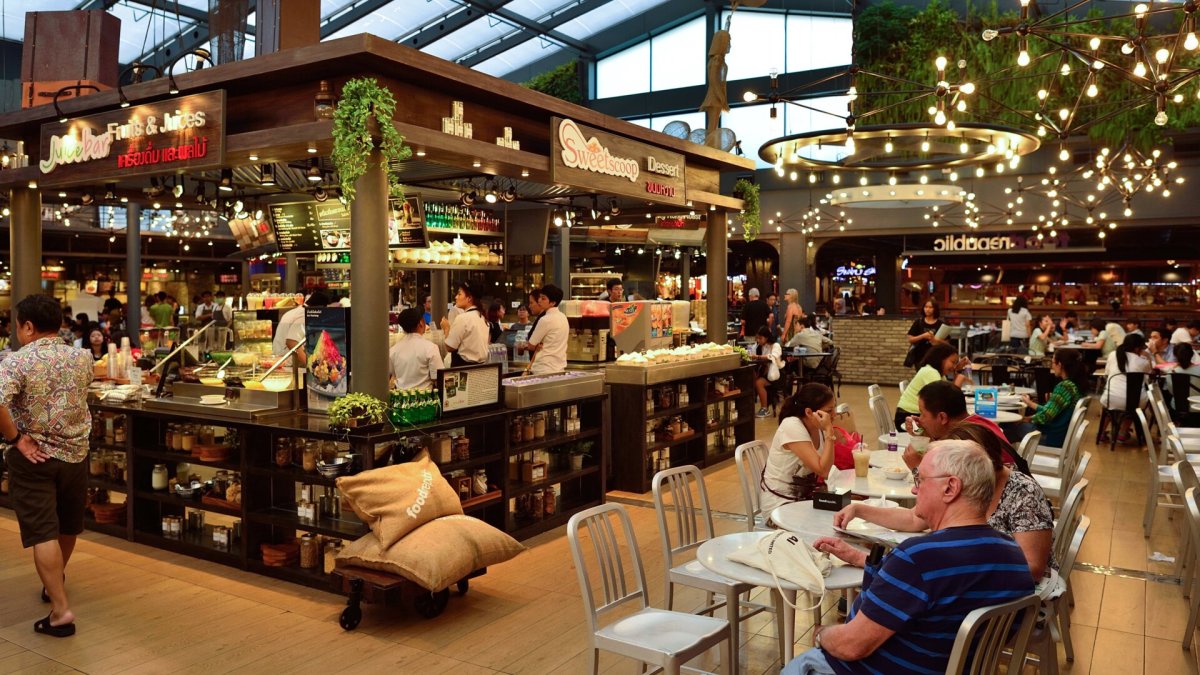 Food halls have been growing in many tourist areas.
Shutterstock
Boston’s Time Out Market closing
Food halls have been a growing trend in tourist areas, driven by the Covid shutdown of buffets. In Las Vegas, where there used to be buffets in nearly every hotel on the Strip, only a handful remain, and more food halls have opened.
A modern take on the mall food court, food halls offer multiple restaurants under the same roof. Some even offer ordering via QR code, making it easy to have a meal where dishes come from multiple restaurants.
This concept has also been adopted in cities as a way to serve workers, and one of the best-known food halls, Time Out Market, located near Fenway Park, has decided to close its doors.
“Following the pandemic, we have seen the Boston Market recover and grow, and we have focused on initiatives driving further growth; however, footfall until today remains inconsistent in the area due to ongoing hybrid working and in addition, operating costs have increased — all of which prevents consistent profitability,” Time Out Market CEO Michael Marlay said in a statement.
Time Out Market Boston will close forever on Jan. 23.
The food hall was meant to showcase the best of the city.
“Time Out Market Boston opened in the heart of the buzzing Fenway neighborhood in 2019. Spread across 27,000 square feet, the curated dining destination delivers 15 eateries, two bars, a huge patio and a video-installation wall into one space that encompasses the best food, drinks and culture that Boston has to offer,” it shared on its website.
More Restaurants
- Taco Bell and KFC work on simplifying their restaurants
- Chick-fil-A making major change to 425 restaurants nationwide
- Bankrupt beer and pizza restaurant chain closes locations
- Restaurant chain famed for rude waiters closes multiple locations
Workers at Time Out Market were surprised by the sudden closure.
“I thought it was a joke,” an employee at Cusser’s who did not want to be identified told CBS News. “We found out just like two days ago, and these past two nights, I haven’t even slept yet.”
Time Out Market operates in multiple cities around the world. The Miami location closed in 2023.
Work-from-home hits restaurants hard
WFH Research, which conducts surveys and research projects on working arrangements and attitudes, released sobering findings last week.
“Remote work is costing cities billions a year,” according to data from WFH Research.
The per-person reduction in spending in New York City was $4,661, followed by $4,200 in Los Angeles and $4,051 in Washington, D.C. The study outlined a dozen cities with a reduction in yearly spending of over $2,000 per person, the research found.
Some of that spending has simply disappeared as work-from-home employees make their own coffee, breakfast, and lunch, while some dollars have shifted to residential areas.
Remote work negatively impacts foot traffic for urban centers. A 10% decline in foot traffic in a census tract prompted a 2.8% drop in employment for accommodation and food services and a 2% reduction in retail trade employment, according to a Bureau of Labor Statistics study.
Related: 25-year-old BBQ chain closes 39 restaurants as bankruptcy looms