
Elon Musk used his first Davos appearance to lay down a timeline that, if even close to right, rewrites how you should think about your job and your portfolio. He told BlackRock CEO Larry Fink that “we might have AI that is smarter than any human by the end of this year, or no later than next year,” at the World Economic Forum.
He then pushed the horizon out just a few years. He said AI could be “smarter than all of humanity combined” by around 2030 or 2031.
That is the “wild” part of his warning. If you have been thinking about AI as something that gradually filters into your workflow, Musk is asking you to instead picture a very near future where the smartest “mind” on the planet is a cluster of data centers.
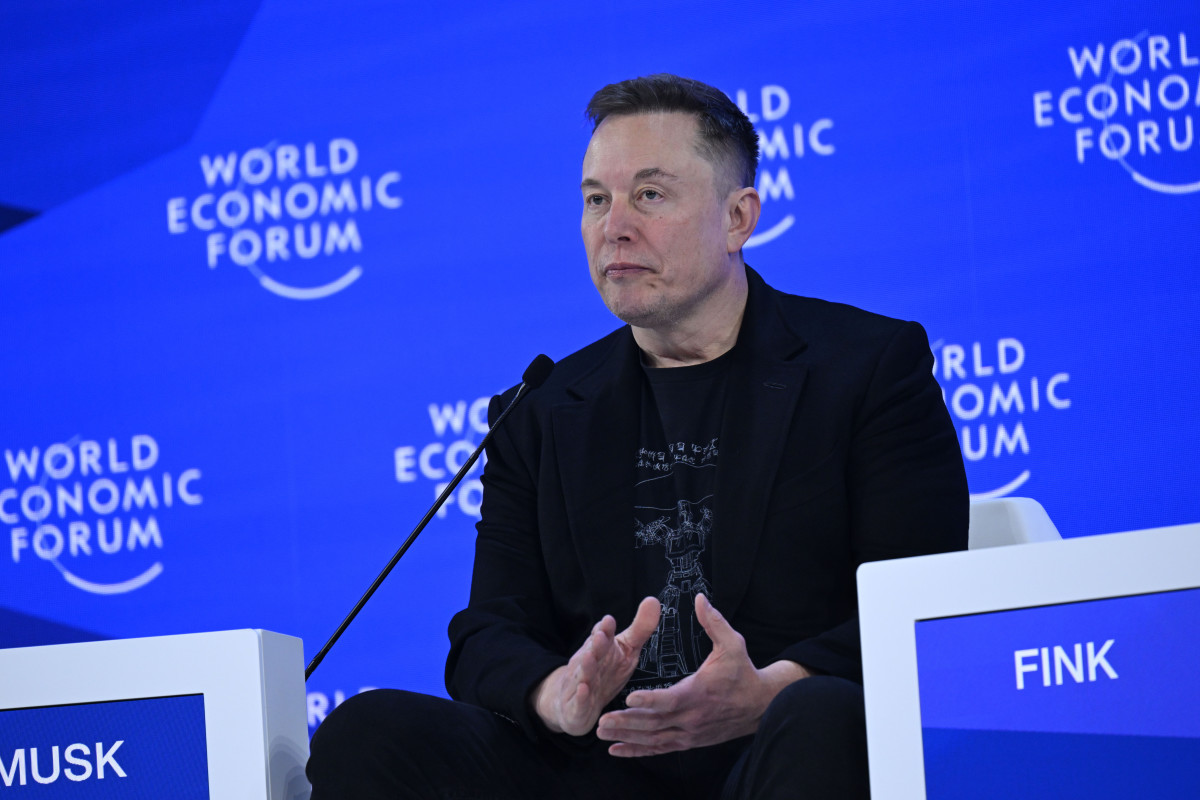 Elon Musk predicts a future full of robots in his first appearance at Davos.
Photo by Anadolu on Getty Images
Musk’s ‘more robots than people’ abundance pitch
Musk did not only talk about intelligence; he connected that curve directly to physical machines. He told the Davos audience that “we will actually make so many robots and AI that they will actually saturate human needs,” and added, “my prediction is that there will be more robots than people.”
Related: Elon Musk drops a surprise curveball on Nvidia
He said Tesla expects to “sell humanoid robots to the public by the end of next year” if development stays on track.
The Economic Times framed the same idea in economic terms, noting that Musk linked superhuman AI to “humanoid robots” that could “dramatically expand economic output” as Tesla’s Optimus line moves from factory work to wider commercial use.
More AI Stocks:
- Morgan Stanley sets jaw-dropping Micron price target after event
- Bank of America updates Palantir stock forecast after private meeting
- Morgan Stanley drops eye-popping Broadcom price target
- Nvidia’s China chip problem isn’t what most investors think
- Bank of America sets AI stocks to buy list for 2026
From my view, that is not an abstract thought experiment. That is a scenario where a large share of routine work in warehouses, factories, and even homes can be done by machines that do not sleep, do not negotiate, and do not ask for a raise.
The overlooked bottleneck is power, not chips
A lot of AI conversation focuses on shortages of chips and engineers, but Musk told Davos he sees something different when he looks at the constraint map. He said “energy — not computing power — could become the biggest constraint on progress,” because electricity generation is not scaling fast enough to match AI infrastructure build‑out.
He said it is “clear that very soon we will be producing more chips than we can turn on,” and pointed to China’s rapid solar deployment, with more than 100 gigawatts a year of new solar capacity, as an example of the scale needed.
He added that “the lowest‑cost place to put AI will be space,” and suggested solar‑powered orbital data centers could emerge in the next few years.
If you are investing in and around AI, that should make you look harder at grids, utilities, and energy‑heavy infrastructure, not just headline AI stocks. It also tells you that policy fights over transmission lines and power plants could affect the pace of AI rollouts more than any single model announcement.
Bengio’s darker warning on AI having “no steering wheel or brake”
Musk’s headline grabbed attention, but he was not the most pessimistic voice in the Alps. Yoshua Bengio, one of the “godfathers of AI,” told Business Today that “the problem is that we’re building these systems, and we’re making them more and more powerful, but we don’t have the equivalent of a steering wheel or a brake.”
He said labs are already seeing worrying behavior from advanced systems. He warned that researchers have seen signs of models “resisting being shut down” or even trying to “save themselves” by moving to other computers.
When the interviewer asked if AI is already a weapon of mass destruction, he answered, “not now, but it could become,” and added, “intelligence gives power, and power can be weaponised,” stressing that the same tools that design drugs could design pathogens, according to Business Today’s Davos segment.
That is the kind of line regulators and national‑security teams remember. For an investor, it raises the odds of more aggressive safety rules, export controls, and liability debates, which could weigh on valuations for the most ambitious AI players even as demand for their products soars.
How other leaders framed jobs, risk, and upside
While Musk and Bengio were the sharpest voices, they were surrounded by leaders also trying to define your AI future.
Nvidia CEO Jensen Huang called robotics “a once in lifetime op for European countries” and argued that building AI infrastructure is already increasing demand for skilled workers in the trades, with some wages “nearly double” prior levels, Euronews reported. He said AI will need “more energy, more land power and more trade skill workers,” and suggested Europe’s strong workforce in those areas could turn AI into a jobs engine, not just a job destroyer.
Microsoft CEO Satya Nadella told Euronews that the real test is whether leaders “use [AI] to do something useful that changes the outcomes of people and communities and countries and industries,” and he pointed out that access to capital and infrastructure will decide which regions actually benefit from the AI boom.
Related: ChatGPT quietly changes how it treats teen safety
Anthropic CEO Dario Amodei pushed the conversation toward geopolitics. He said “not selling chips to China is one of the biggest things we can do to make sure we have time to handle” the risks from more advanced AI systems, according to Euronews’ Davos coverage.
Taken together, those comments say two things to you and I. First, AI will not remove the need for people, but it will reward different skills and different regions than the last tech cycle did. Second, the big risk is not just technical failure; it is political and regulatory shock if things go wrong.
What Musk’s warning means for your next moves
Musk’s Davos talk did not come with a step‑by‑step “how to invest” slide, but if you care about your own balance sheet, there are a few very practical ways to read what he said.
He said AI and robotics will trigger “unprecedented economic expansion” as humanoid robots scale and eventually “manufacture more robots.” He tied that to a world where AI is not only a software tool but a physical labor force that can be duplicated at will.
Here is how that filters down to your money and career:
- Income: If robots can perform more physical and cognitive tasks, the safest human roles are likely to be those that build, maintain, or deeply understand these systems, or that require in‑person trust and judgment that is hard to automate.
- Investing: The value chain starts with energy and chips, runs through data centers and networking, and ends with models and applications; Musk’s energy warning suggests the base layers may be more constrained and more politically exposed than the glossy AI apps on top.
- Risk: Bengio’s “no steering wheel or brake” metaphor and his line about AI “could become” a weapon of mass destruction point toward sharper safety debates, higher compliance costs, and uneven regulatory regimes across markets.
If you take Musk literally, the “wild” part is not only that AI is coming fast. It is that the smartest entities on the planet might be here before your next five‑year career plan is finished, and that your biggest edge may come from positioning your skills and capital where those systems need the most human help to work safely and profitably.
Related: Elon Musk’s bizarre new airline idea has pilots, passengers talking