
Alex Karp is no stranger to transforming the markets. Now he’s entering the culture-war debate and changing it to a capital-markets moment.
The Palantir (PLTR) CEO believes the issue of large-scale immigration will become irrelevant moving forward, Fortune reported.
Karp believes a need for future large-scale immigration is “hard to imagine,” except for people with very specialized skills essential to a company such as Palantir. His comment clearly blasts a hole in the culture-war issue.
Now, it isn’t my first rodeo covering Palantir, and I see things purely from a financial perspective. High-end, white-collar employees are responsible for a large chunk of expenses for every major large-cap company.
The bottom line is that Palantir isn’t a think tank; it’s a stock. The market is pricing it like a megacap inevitability.
Palantir shares are up more than 130% over the prior 12 months, pushing its value to about $400 billion.
Are you starting to see what this can mean? Pain on Main Street, power on Wall Street.
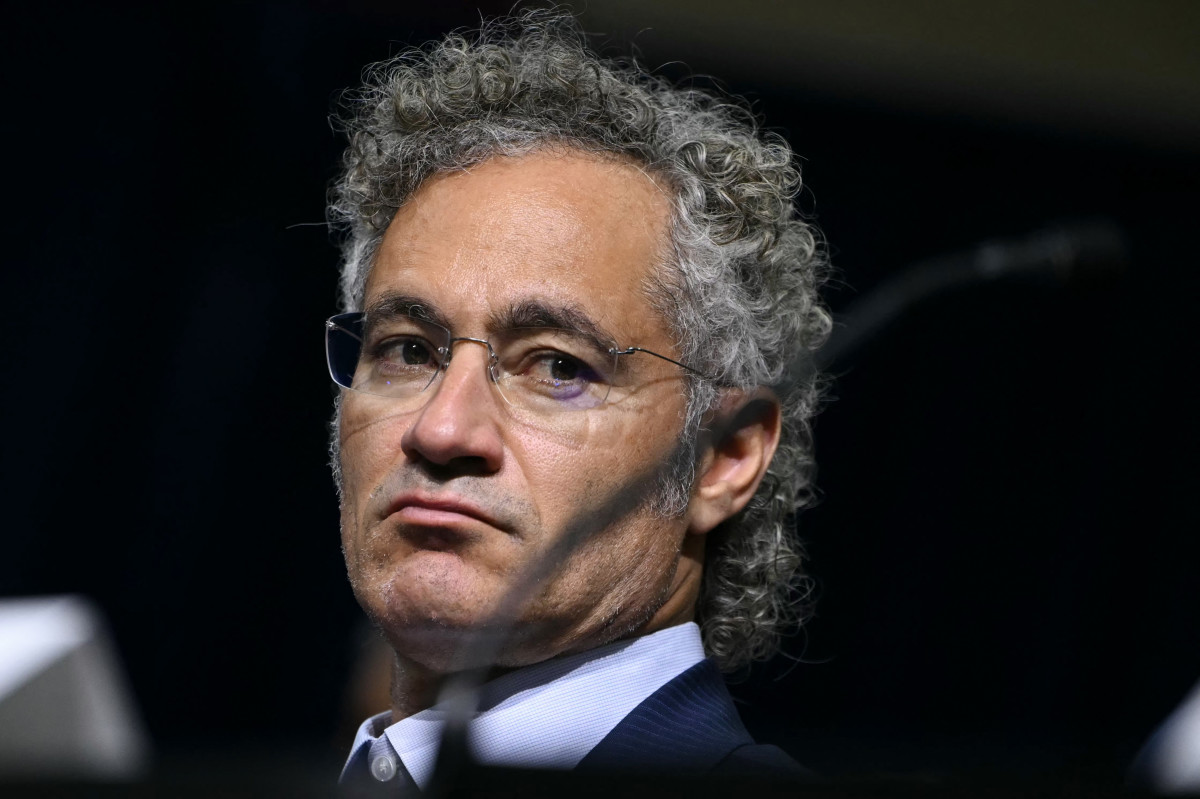 Alex Karp just lit a match under the immigration debate.
Photo by ANDREW CABALLERO-REYNOLDS on Getty Images
Palantir quick facts at a glance
- Last stock price: about $169.60
- 12-month run:+130%
- Market value: about $400B
- Next earnings date:Feb. 2, 2026
Why Karp’s take on immigration matters to investors
Karp’s comment isn’t just about politics; it’s also a matter of branding.
Karp’s argument regarding the job market is that Palantir’s software is at the core of a future in which businesses and governments need to accomplish more with fewer people.
That story may help a company keep its premium, but it may also increase headline risk. This is particularly true for Palantir, which has worked with U.S. immigration officials in the past and is often in the news for political reasons.
When a corporation already has a “priced for perfection” aura, political instability doesn’t have to be “material” to be important. It just has to be loud.
The H-1B cost math: what corporate America actually pays
If Alex Karp says AI makes large-scale immigration “hard to imagine,” it’s important to remember that corporate America usually talks about the spreadsheet first, not ideology.
For a typical large employer filing a new cap-subject H-1B, employer spending is best thought of in two buckets: (1) government fees and (2) legal/compliance costs, which bleeds into the debate Karp is discussing.
Related: Samsung drops Galaxy S26 Ultra bombshell
Common government fees for hiring non U.S.-citizen employees (typical large employer):
- $215registration fee
- $780 Form I-129 H-1B filing fee (for many employers)
- $600 Asylum Program Fee (for many employers)
- $750 or $1,500ACWIA training fee (depends on employer size; not owed for certain same-employer extensions)
- $500 fraud fee in specified filing situations
- $4,000 Public Law 114-113 fee for a subset of employers
Option to expedite the hiring process:
- Premium processing is set to rise to $2,965 effective March 1, 2026 (up from $2,805).
Legal/compliance is the multiplier. Lawyers often charge a few thousand dollars for each case, and the time spent by internal HR and compliance staff adds a lot to the cost.
So why not eliminate it altogether? That is what Palantir’s CEO is talking about.
Scale marker (this is why it adds up quickly):
- USCIS approved about 399,395 H-1B petitions in FY2024.
141,205 initial
258,190 ongoing
When you add up all the government fines and “low-thousands” legal fees, the total cost to businesses across the economy is usually in the low single-digit billions of dollars each year.
The numbers that make Palantir’s bull case seem real
To support Palantir’s value, it’s important to remember what the company has done and is still doing.
This has nothing to do with the immigration debate.
In its earnings report for the third quarter of 2025, which it sent to the SEC, Palantir reported the following.
- Revenue: $1.181 billion (up 63% from last year)
- GAAP net income: $476 million (40% margin)
- GAAP operating income: $393 million, which is a 33% profit margin
- Adjusted income from operations:$601M, or 51% of sales
- Adjusted free cash flow: $540 million (46% margin)
- $6.4B in cash, equivalents, and short-term Treasuries
- GAAP EPS of $0.18, and adjusted EPS of $0.21
These aren’t “small-cap software” margins; they’re the kind of margins that help investors understand a price that makes traditional “cheap/expensive” arguments seem pointless.
Until the first mistake.
This is where I propose a different point of view. Palantir’s comments will definitely have a major impact on the future of both immigration and business.
More Palantir
- Bank of America updates Palantir stock forecast after private meeting
- US Navy bets $448M on Palantir AI to speed shipbuilding
- Palantir secures quiet contract win with big implications
- Michael Burry shares bold predictions for OpenAI, Palantir
But right now, PLTR stockholders want the AI company to explain why its stock is so high, to keep growing, and to stay out of political arguments that are hard to resolve.
On the other hand, commercial revenue is rising, which means Palantir will seem less like a corporate face of the immigration debate and more like a real AI analytics company that wants to change how corporate America does business.
U.S. commercial deal momentum is what Wall Street keeps talking about
Palantir’s Q3 statement shows that the company is still going strong with its transaction data.
- The total value of closed contracts was $2.76 billion, which is 151% more than last year.
- The U.S. commercial TCV closed at $1.31 billion, a 342% increase from the previous year.
- The remaining deal value for U.S. businesses is $3.63 billion, which is up 199% from last year and 30% from last quarter.
- Customer count is up 45% from last year (and up 7% from last quarter).
The bulls call that RDV number “future revenue already under the hood.”
Skeptics also see this as a warning that the market expects today’s pipeline to become tomorrow’s acceleration, not tomorrow’s digestion.
HD Hyundai and “30% faster” shipbuilding
Palantir didn’t just talk at Davos this week.
Palantir and HD Hyundai’s expanded deal is worth hundreds of millions of dollars over a number of years and covers the whole company.
Hyundai says that using Palantir software to speed up work has helped it build ships about 30% faster.
This is why Karp keeps pushing “vocational workers” and “real industry” rather than simple office-work automation, integrating Palantir to hard productivity outcomes, not just dashboards.
What to watch before Palantir’s next earnings report
Here’s a quick list to check off before February 2.
- Guidance: Does Palantir win again, or does it “meet” and move on?
- U.S. commercial RDV: Does $3.63B keep climbing at rates of three digits?
- Cash flow: Is it possible for Palantir to continue making $540 million in adjusted FCF-type numbers every quarter while it grows?
- Karp is choosing to get into big public fights, which is a headline risk for investors.
In the end, despite cultural conversation surrounding Karp’s immigration line in Davos, math will decide Palantir’s stock.
But remember: Sometimes the line between these can blur.
Related: Bank of America drops bold call on Roblox, sees massive upside