
Gold just had the kind of day that tests everyone’s convictions, mine included.
Futures briefly dropped more than 11% on Friday, Jan. 30, and spot prices fell close to 10%, the steepest one-day fall since the early 1980s. Yet Deutsche Bank is not backing off its headline call that gold can reach $6,000 per ounce in 2026.
In a fresh round of commentary and a CNBC interview, the bank’s metals team is treating the rout as a cleanup move in a crowded trade, not the end of the bull run.
As someone who has watched plenty of commodity cycles turn on a dime, I read that as a strong signal that, at least for now, one of Wall Street’s most aggressive bulls still thinks the bigger forces driving gold higher are intact.
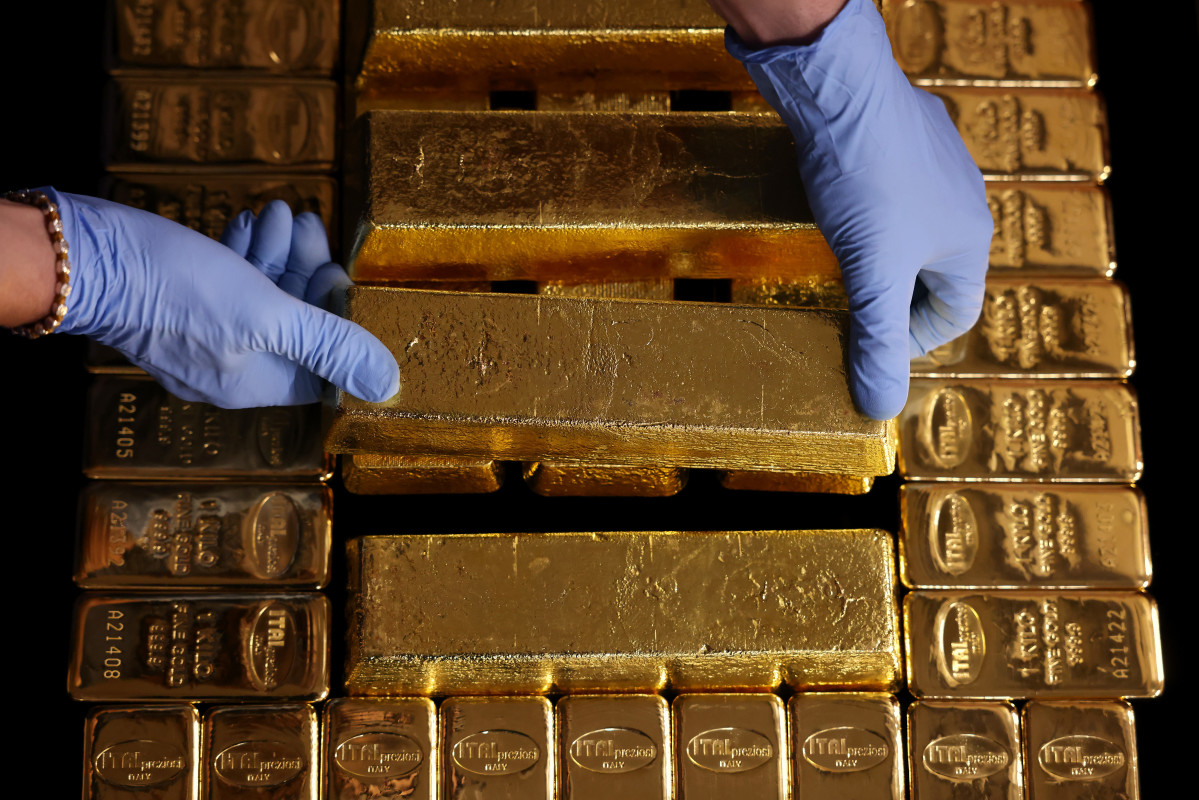 Deutsche Bank sets a $6,000 gold target price.
Photo by Bloomberg on Getty Images
Why Deutsche Bank still likes $6,000 gold
Deutsche Bank is telling clients that gold “could climb to $6,000 per ounce in 2026” as central banks and private investors add to non‑dollar and real assets, as seen on Investing.com.
The bank added that in some of its alternative paths “a $6,900 per ounce price would in fact be more in line with the past two years’ outperformance.”
Related: J.P. Morgan revamps gold price target for 2026
In its latest written commentary, Deutsche Bank said the recent selloff “overshot the significance of its ostensible catalysts” and that official, institutional, and individual buyers “have not likely changed for the worse as of yet,” according to a note cited by Mitrade and FXStreet.
The bank added that gold’s “thematic drivers remain positive” and that conditions “do not appear primed for a sustained reversal in gold prices,” contrasting today’s backdrop with major breakdowns in the 1980s and 2013.
On air, Head of Metals Research Michael Hsueh laid out the same view in plain language, that the bank is reiterating its $6,000 forecast despite “heavy selling” in precious metals, according to a CNBC interview. Hsueh described the drop as a tactical washout in a very extended market and said the target “doesn’t seem extraordinary, or even unachievable, given the scale of the move we’ve already seen.”
When I put that alongside the published scenarios, what jumps out to me is that, in their framework, last week’s pain was more about positioning than about the core thesis.
Inside the historic selloff everyone’s talking about
The Jan. 30 futures move was not your garden‑variety pullback.
- Spot gold fell about 9.5% to roughly $4,883 an ounce after setting a record above $5,590 the prior day, while February futures settled down 11.4% at about $4,745.
- The drop marked gold’s largest one‑day percentage decline since 1983 and its biggest one‑day dollar loss on record, according to Qatar News Agency.
- Gold was “down over 12% at its peak and falling below $4,900,” according to a TradingKey note.
Several reports linked the timing of the crash to President Donald Trump’s preference for a more hawkishFederal Reserve chair, a shift that boosted the dollar and forced traders to rethink how quickly policy might ease.
Fed expectations, higher margin requirements, and the mechanics of leveraged futures positioning were the key drivers of the plunge, according to an analysis from Alex Lexington.
From where I sit, that combination of stretched positioning and a sudden macro surprise looks exactly like the kind of setup that produces an “air pocket,” not necessarily a long‑term top.
How other big banks frame 2026 gold
Deutsche Bank may have the loudest number on the Street, but it is not alone in seeing serious upside. Here is how I would frame the cluster of big numbers that now surround Deutsche Bank’s call.
- Deutsche Bank: $6,000 base case for 2026, upside scenario near $6,900
- Societe Generale: $6,000, with a note that the figure may prove conservative
- Goldman Sachs: $5,400 by December 2026, with “meaningful upside risk”
- Morgan Stanley: Bull case around $5,700 in the second half of 2026
What would actually support $6,000 gold
If I strip away the rhetoric and focus on the mechanics, Deutsche Bank’s target rests on three pillars: weak real rates, a softer dollar, and persistent buying from central banks and long‑term investors.
In its 2026 scenarios, the bank believes that “persistent investment demand as central banks and investors increase allocations to non‑dollar and real assets” is the core driver of its $6,000 forecast, as seen in Investing.com’s coverage.
The bank has also stressed that flows from China matter. In a recent note, Deutsche Bank analyst Michael Hsueh said his team “highlights ongoing positive thematic drivers for gold and notes significant investment flows from China as a key factor supporting this outlook,” FXStreet highlights.
In the same commentary, Deutsche Bank wrote that investors’ “rationale for gold (and precious) allocations will not have changed” and that “the conditions do not appear primed for a sustained reversal in gold prices.”
More Gold:
- Every major analyst’s gold price forecast for 2026
- Market uncertainty resets silver, gold bets
- Billionaire Dalio sends 2-word warning on markets
A separate MarketWatch‑linked summary of the research, cited by InvestingLive, said Deutsche Bank’s scenario work shows gold higher six and 12 months after big rallies in roughly two‑thirds of historical cases.
I’ve spent enough time looking at past gold cycles to know that history never repeats perfectly, but that kind of hit rate does at least give you a framework for treating this crash as one of the uglier drawdowns inside a still‑live bull market, rather than proof that the thesis has failed.
How I’m thinking about the risk‑reward after the gold crash
After a day like Jan. 30, the easy reaction is to swear off gold entirely. I’ve felt that impulse myself in other cycles, especially when margin calls and forced selling push prices well past anything the fundamentals justify.
This time, the speed of the move and the leverage in the trade look familiar, but the macro story around deficits, de‑dollarization, and central‑bank buying feels different than the early‑2010s unwind.
For me, the most useful way to read Deutsche Bank’s decision to stand by $6,000 is not as a guarantee, but as a probability bet from a team that has put real work into the numbers.
When an institution with that kind of reach keeps its target intact after the worst one‑day plunge in four decades, it tells me that, in their view, the structural case is still stronger than the latest headline shock.
If I were managing risk around this move rather than just analyzing it, I would be watching three things most closely from here.
- How real yields behave as the Fed path evolves
- How the dollar trades against a basket of emerging‑market currencies
- Whether official sector gold purchases slow or accelerate after this drawdown
The price action can swing around those forces for days or weeks at a time, but the $6,000 story lives or dies on those deeper currents, not on one violent Friday.
Related: What a Warsh Fed means for your gold and silver portfolio