
If you have been watching gold this year, you know it has not traded like a sleepy inflation hedge. It has traded more like a meme stock with a 5,000‑year backstory.
That is why J.P. Morgan’s latest move on its gold forecast caught my attention.
The bank now expects gold to reach $6,300 per ounce by the end of 2026, saying that “demand from central banks and investors” should keep pushing prices higher, according to Reuters.
My recent TheStreet coverage about J.P. Morgan’s prior framework noted that gold is “pushing toward $5,000/oz. by Q4 2026” with an upside path to $8,000-$8,500 if households bumped up their allocations.
Seeing that base case shift so quickly tells me something important changed inside the house models, even if the public explanation sounds calm and clinical.
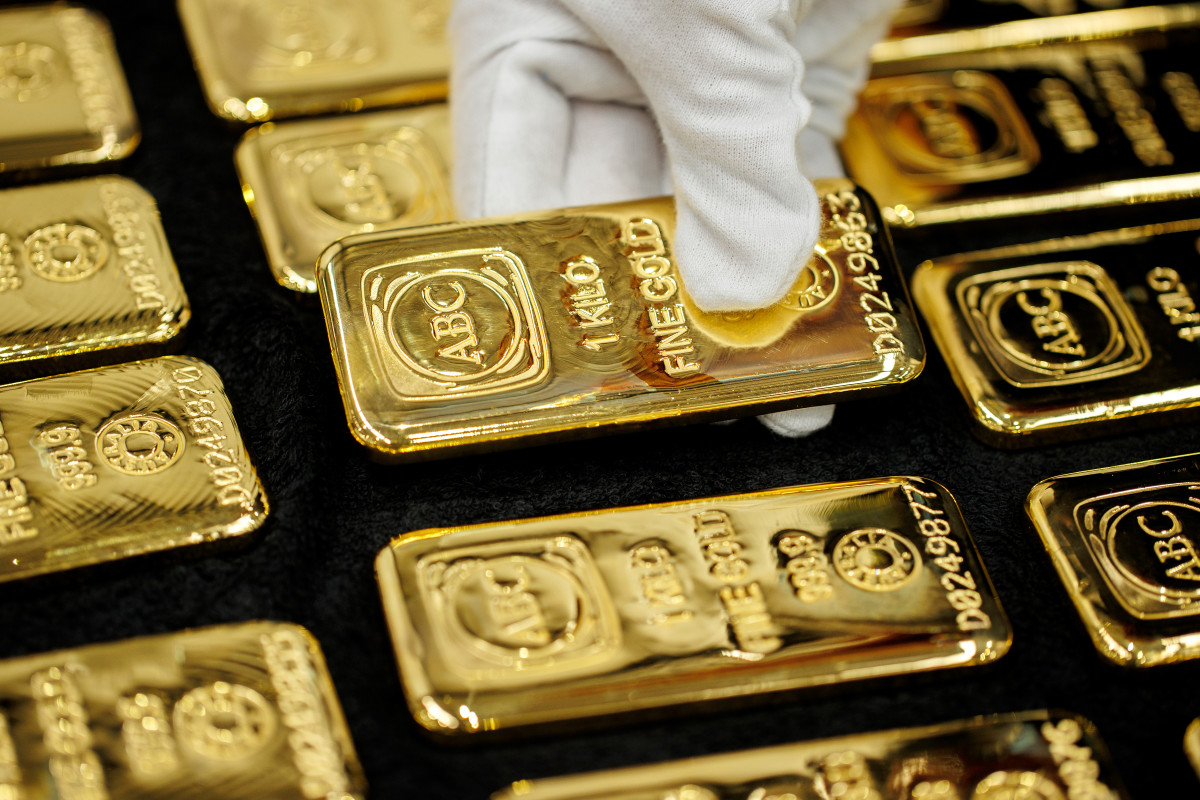 J.P. Morgan says it now expects gold to reach $6,300 by the end of 2026.
Photo by Bloomberg on Getty Images
What J.P. Morgan is really saying with $6,300 gold price target
On Feb. 2, J.P. Morgan told clients it now expects gold to reach $6,300 by the fourth quarter of 2026, citing an “ongoing, unexhausted trend of reserve diversification” and saying it remains “firmly bullishly convicted in gold over the medium term,” according to Reuters.
The bank lifted its projection for central‑bank gold buying to about 800 tons in 2026 and tied that to what it called a “clean, structural, continued diversification trend” in favor of real assets over paper assets, Reuters said.
Related: J.P. Morgan revamps gold price target for 2026
That language tells you this is not just about short‑term headlines.
In my earlier story, I highlighted how J.P. Morgan had already moved from treating gold as a niche hedge to calling it a “core holding” being “rebased higher” in portfolios.
Now, instead of talking about $5,000 as the key number with $8,000 to $8,500 as a what‑if, the bank is planting a new flag at $6,300 and framing it as the logical outcome of central banks and investors doing more of what they have already been doing.
If you own gold, that is the story you are being sold: the idea that structural demand, not just panic, can reset the price range.
How this differs from the gold story earlier this year
When I first dug into J.P. Morgan’s gold work this year, the story was more restrained.
The note I covered in late January laid out a base case of gold moving toward $5,000 by late 2026, with a more aggressive path to $8,000 to $8,500 if private investors raised their allocation from roughly 3% to about 4.6% and central‑bank buying stayed strong.
I wrote then that the important shift was not just the upside number, but the way the bank talked about behavior. It described households swapping “duration risk” in long bonds for more gold, and it talked about investors willing to give up some income “to own something that is nobody’s liability,” as CNBC summarized strategist Nikolaos Panigirtzoglou’s argument.
More Gold:
- Market uncertainty resets silver, gold bets
- Billionaire Dalio sends 2-word warning on markets
- Every major analyst’s gold price forecast for 2026
Now the numbers have moved again. J.P. Morgan sees gold at $6,300 per ounce by the end of 2026, putting it at the upper end of the current Wall Street range, Reuters reported.
In the space of a few days, the bank has shifted from “pushing toward $5,000” as a base case to treating $6,300 as the outcome you should plan around, with the same macro story and the same behavior shifts doing even more work.
As a reporter, that is the kind of fast revision that makes me want to reread the fine print.
The backlash I have seen around the original gold price targets
When my prior coverage was pushed on social media, the response looked very familiar: Hardcore gold bulls loved the $8,000 line, and skeptics rolled their eyes.
The broader backlash has focused on three things I also worry about.
- First, the speed of the move. In that earlier piece, I walked readers through how gold had gained roughly 27% year to date through Jan. 29, moving from about $4,332 to $5,500, and roughly 185% over three years.
- Second, the reliance on a big change in ordinary investor behavior. J.P. Morgan’s upside path assumed households would lift their allocation from 3% to 4.6%, a huge swing for everyday savers who still mostly think in terms of stocks, bonds, and maybe some crypto on the side.
- Third, the risk that policy or market plumbing pulls the rug out from under the trade.
We just saw a version of that. Gold suffered a one‑day drop of more than 9.8% on Jan. 30, its worst daily fall since 1983, as the CME raised margin requirements and forced leveraged traders to cut exposure, as seen in Reuters coverage.
Come Feb. 2, there is a further decline. Gold and silver together “shed nearly $1 trillion in combined market cap over the past 24 hours, with gold down 2.6% and silver falling 3.8%,” Cointelegraph posted on X (formerly Twitter).
When I see a forecast that pushes higher right after that kind of flush, I read it two ways: as a statement of conviction and as a reminder that the ride will not be gentle.
Other gold price targets I am tracking
- J.P. Morgan: $6,300 per ounce by late 2026; earlier upside band $8,000 to $8,500 if allocations rise
- Goldman Sachs: $5,400 by end‑2026
- Morgan Stanley: Bull case near $5,700 in H2 2026
- UBS: $6,200 by end‑2026; upside case $7,200, downside $4,600
- Citi: About $5,000 in its 2026 framework, seeing support from lingering macro risks
- Deutsche Bank: Around $6,000 in 2026, keeping a positive stance after the latest pullback
Gold price returns in USD, last 12 months
- 1 week: +$139.00 (+3.0%)
- 1 month: +$309.00 (+6.9%)
- 3 months: +$854.00 (+22.0%)
- 6 months: +$1,454.00 (+44.0%)
- 9 months: +$1,854.00 (+64.0%)
- 12 months: +$1,940.00 (+69.0%)
Where Kevin Warsh’s warnings fit into this moment
You also have to place J.P. Morgan’s call in the context of the broader macro debate, and that is where Kevin Warsh keeps showing up in my notes.
Warsh, the former Federal Reserve governor, has been one of the voices warning that inflation, fiscal deficits, and geopolitical shocks can change how investors think about safe assets.
In past commentary, Warsh has argued that central banks risk falling behind persistent price pressures and that investors will eventually demand compensation for the risk that policy stays easier for longer than the models assume.
That line of thinking rhymes with J.P. Morgan’s description of a “regime of real asset outperformance vs paper assets” that supports its gold call, as Reuters quoted from the latest note.
If you believe that the regime is real and durable, you understand why a bank would push its gold target higher even after a nasty correction.
If you think the Fed and other central banks will eventually reassert control and restore a more “normal” environment, you are more likely to see $6,300 as a stretch built on fear rather than fundamentals.
I do not think you have to pick a side today, but you should know which story your own portfolio is quietly telling.
What I think this means if you hold or are considering gold
When I strip away the big numbers, here is how I look at it as someone who writes for individual investors.
J.P. Morgan’s $6,300 call tells you that serious people with big research budgets think gold still has room to run over the next couple of years, even after an explosive rally. The note was framed as a reaffirmation of “strong optimism about gold in the medium term” despite recent volatility, Investing.com said.
At the same time, the same coverage reminds you that this market can erase decades of “sleepy hedge” stereotypes in a single session, as it did with that near 10% drop on Jan. 30.
So if you are underweight gold or have zero exposure, you need to decide whether you are comfortable continuing to sit out a move that major banks now see topping $6,000.
For most long‑term savers, my own bias is toward moderation and clarity.
I would rather see you treat gold as one piece of a diversified portfolio, sized in a way that lets you sleep at night, than chase someone else’s price target or blow off the entire asset class out of habit.
Related: JP Morgan CEO issues stark warning on U.S. national debt