
Advanced Micro Devices (AMD) Q4 earnings on February 3 caused shares to plunge, resetting Wall Street analysts’ outlook, and leading Bank of America to update its take on what could happen to shares next.
While CEO Lisa Su‘s company beat consensus estimates, her guidance disappointed investors, sending shares down 16% at the time of writing, Wednesday morning, Feb. 4.
Still, Su struck a positive tone on the earnings call about future demand for AI chips, aiming to steal market share from AI-chip kingpin Nvidia.
“Our AI business is accelerating, with the launch of MI400 series and Helios representing a major inflection point for the business as we deliver leadership performance and [total cost of ownership] at the chip, compute tray, and rack level,” said AMD CEO Lisa Su during the earnings call.
“Based on the strength of our EPYC and Instinct roadmaps, we are well-positioned to grow data center segment revenue by more than 60% annually over the next three to five years and scale our AI business to tens of billions in annual revenue in 2027.”
Bank of America’s Vivek Arya, who has been covering technology stocks since the 1990s, seems equally optimistic, lifting his price target based on the results.
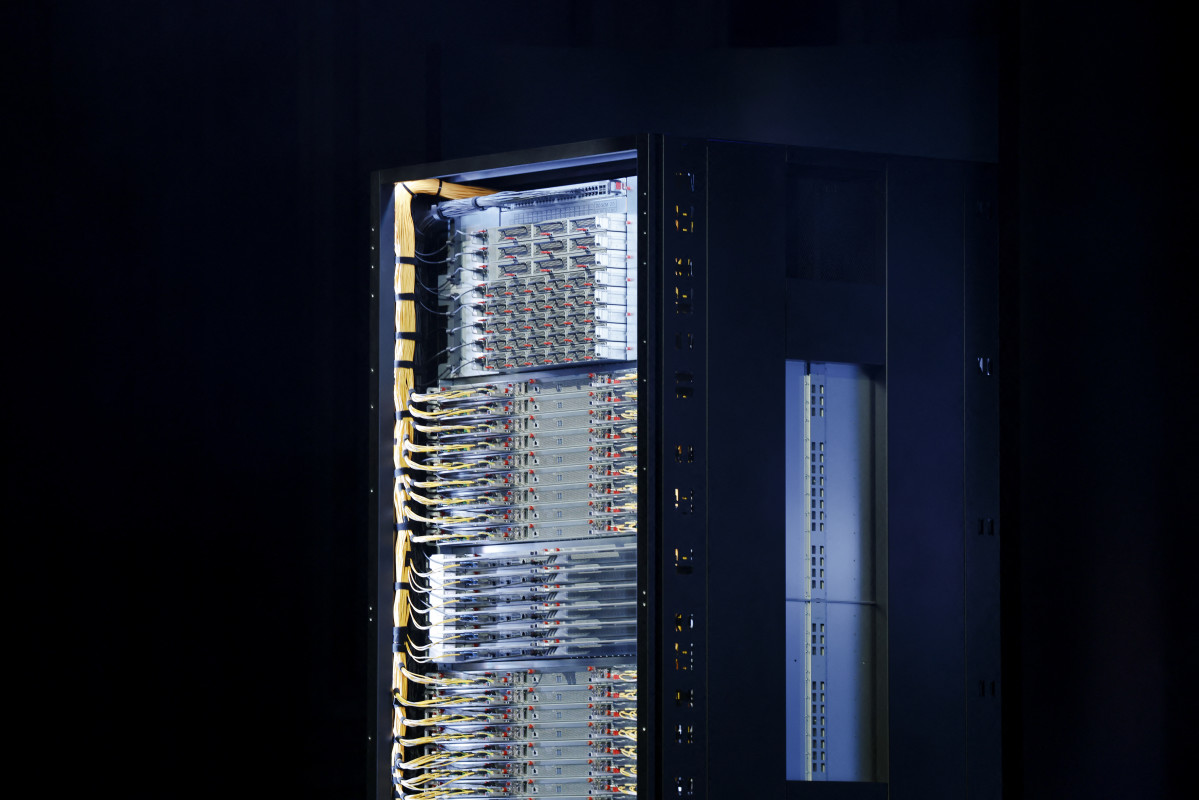 AMD’s Helios rack will launch this year.
Photo by CAROLINE BREHMAN on Getty Images
Here are the AMD Q4 earnings highlights:
- Revenue of $10.3 billion, up 34% year over year, and up 11% sequentially.
- Gross margin of 54%, up 3 percentage points YoY, and up 2 percentage points sequentially.
- Net income of $1.5 billion, up 213% YoY, and up 22% sequentially.
- Diluted earnings per share (EPS) of $0.92, up 217% YoY, and up 23% sequentially.
AMD provided an outlook for Q1 2026
- Revenue of approximately $9.8 billion, plus or minus $300 million, including approximately $100 million of AMD Instinct MI308 sales to China. The midpoint of the revenue range represents year-over-year growth of approximately 32% and a sequential decline of approximately 5%.
- Non-GAAP gross margin is expected to be approximately 55%.
Bank of America raises AMD stock price target
Bank of America analyst Vivek Arya and his team updated their opinions on AMD stock after earnings.
Analysts said that according to data from the Bank of America Strategy team, AMD stock remains relatively under-owned (just two of 10 investors) and underweighted (0.16x relative weightage to SPX) in U.S. large-cap portfolios.
After the Q4 earnings call, analysts raised their pro forma EPS estimates for calendar years 2026 and 2027 by 3% and 9%, to $6.49 and $10.30, respectively.
The team believes that AMD’s server CPU business will continue to grow at a strong double-digit rate (35% YoY) in calendar year 2026 and follow the same growth patterns it saw in 2024 and 2025.
Related: Palantir CEO delivers curt 8-word message to investors
They noted that one of the two key risks for the company is that while OpenAI’s first 1 GW of the total 6 GW partnership is contractual and ramps throughout the second half of 2026 and 2027, it represents about $15 billion to $20 billion, or approximately 50% of AI sales from a single customer within that time period.
The other key risk is AMD’s execution of its first rack-scale system, Helios. They said it remains a potential risk, given that AMD’s competitor Nvidia had a history of technical hiccups and modest delays during its first rack-scale “GB200 NVL72” launch/ramp.
To understand how important the Helios rack launch is, and how analysts reacted when AMD unveiled it, read my article “Analysts revamp AMD stock price after key conference.”
In a research note shared with me, Arya reiterated a buy rating for AMD stock and raised the target price to $280 from $260, based on 27 multiple his estimate for non-GAAP EPS for 2027, which is toward the middle of AMD’s historical range of 13 to 58.
Analysts noted downside risks for AMD:
- Execution on first rack-scale product (MI400 Series)
- Timing/magnitude of Middle East AI projects
- Lumpy nature of consumer and enterprise spending that could create delays inacceptance and success of new products
- High reliance on one outsourced manufacturing partner
- Maturity of current game console cycle
Upside risk:
- Greater share gain potential in the PC and server processor market againstcompetitors
UBS and Mizuho lower AMD stock price targets
UBS reiterated a buy rating for AMD stock and lowered the price target to $310 from $330. The firm said that AMD has outperformed peers such as Nvidia (NVDA) and Broadcom (AVGO) this year, supported by expectations of strong server demand. UBS analyst noted that near-term EPS upside is limited due to a $1 billion gaming business cut, according to TheFly.
UBS believes that AMD’s CPU and GPU fundamentals remain positive, with a clear path to more than $11 EPS in 2027 and more than $15 in 2028.
Mizuho reiterated its outperform rating for AMD stock and lowered the price target to $275 from $285. The firm reduced the price target following the earnings report due to the higher spending.
More AI Stocks:
- Morgan Stanley sets jaw-dropping Micron price target after event
- Bank of America updates Palantir stock forecast after private meeting
- Morgan Stanley drops eye-popping Broadcom price target
- Nvidia’s China chip problem isn’t what most investors think
- Bank of America sets AI stocks to buy list for 2026
Sequentially lower AMD revenue guidance, combined with uncertainty about future sales in China, is probably the biggest reason the stock is tumbling. AMD’s Form 10-K states: “Sales of our MI308 products into China depend on customer demand, China’s import control rules, and our ability to obtain licenses. As such, our revenues and results of operation could be negatively affected.”
However, once Helios launches, and if it does so without problems, it is poised to create a big shift for AMD and how well the company can actually compete with Nvidia.
The Helios rack combines 72 GPUs, and AMD says it can deliver up to 1.4 exaFLOPS of FP8 and 2.9 exaFLOPS of FP4 performance, with 31 TB of total HBM4 memory and 1.4 PB/s of aggregate bandwidth. These numbers put it in the same ballpark as, and in some cases faster than, Nvidia’s Vera Rubin NVL72 rack systems, according to The Register.
Related: Analysts reset Amazon stock price target before earnings